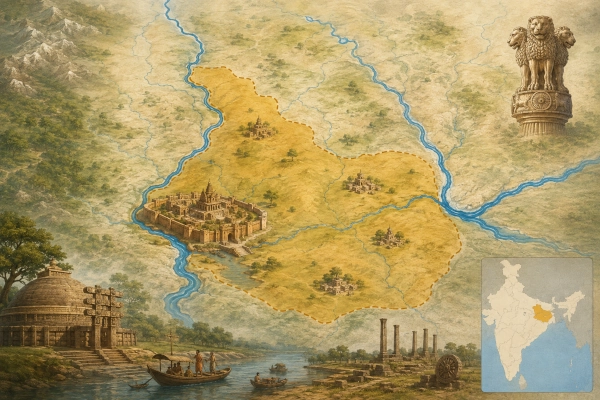
Vatsa was one of the important kingdoms of the central Gangetic world. Its political heart lay at Kaushambi, the ancient fortified city on the Yamuna, while its wider geographical setting extended toward Prayaga, the great confluence of the Ganga and Yamuna in present-day Prayagraj.
The Mahabharata remembers Vatsabhumi as an identifiable country conquered by Bhima during Yudhishthira’s Rajasuya campaign. It also preserves traditions connecting Kaushambi with the Chedi king Uparichara Vasu, records Karna’s conquest of the Vatsas, and places Vatsa warriors among the forces fighting for the Pandavas at Kurukshetra.
The region later emerged clearly in historical sources as the Vatsa Mahajanapada, with Kaushambi as its capital. By the sixth century BCE, the city had become one of northern India’s major political, commercial and religious centres. The official history of Kaushambi district describes the ancient city as the capital of the Chedi-Vatsa janapada and places its ruins about 51 kilometres southwest of Prayagraj on the Yamuna.
Vatsa at a Glance
| Feature | Description |
|---|---|
| Ancient Kingdom | Vatsa / Vatsabhumi |
| Principal Capital | Kaushambi |
| Modern Core | Kaushambi district and adjoining Prayagraj region of Uttar Pradesh |
| Principal River | Yamuna |
| Eastern Geographical Anchor | Prayaga, modern Prayagraj |
| Mahabharata Association | Conquered by Bhima during the Rajasuya Digvijaya |
| Karna Association | Vatsas listed among peoples subdued by Karna |
| Kurukshetra Alignment | Vatsa warriors fought on the Pandava side |
| Epic Foundation Tradition | Kaushambi associated with Kushamba, son of Chedi king Uparichara Vasu |
| Later Historical Identity | One of the sixteen Mahajanapadas |
| Famous Later Ruler | Udayana |
| Archaeological Centre | Ancient Kaushambi ruins near Kosam |
| Modern State | Uttar Pradesh |
| Country Today | India |
The Land of Vatsa
The most secure geographical centre of ancient Vatsa was Kaushambi. The ruins of the ancient city lie near modern Kosam on the left bank of the Yamuna, southwest of Prayagraj. The official Kaushambi district history gives the site coordinates as approximately 25°20′30″ N and 81°23′12″ E and places it 51.2 kilometres southwest of Prayagraj.
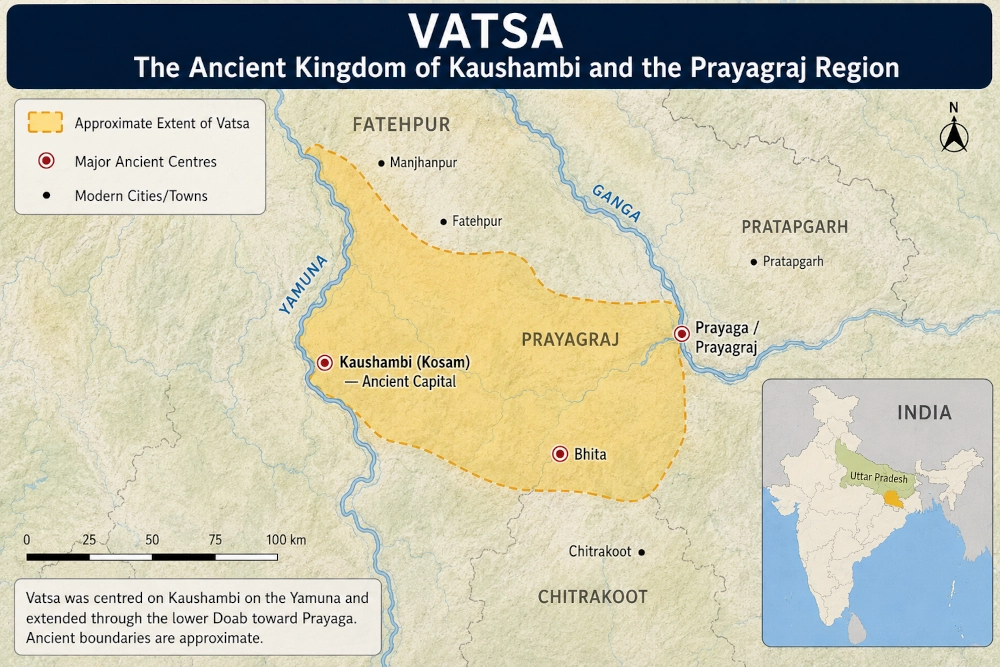
Ancient Vatsa should therefore be understood as a kingdom of the lower Yamuna and lower Ganga-Yamuna Doab. Kaushambi controlled a strategic stretch of the Yamuna before the river reached its confluence with the Ganga at Prayaga. Later historical traditions consequently associate the Vatsa country closely with the wider Prayagraj region.
For a modern geographical reconstruction, its core can be represented approximately as:
Ancient Kaushambi – lower Yamuna corridor – Prayaga/Prayagraj – adjoining lower Doab
Ancient kingdoms did not possess surveyed borders comparable to modern districts. Any mapped frontier for Vatsa must therefore remain approximate. The strongest evidence concerns its capital, its river setting and its relationship with the lower Doab rather than a precise political boundary.
Kaushambi: The Capital on the Yamuna
Kaushambi was one of the great cities of early northern India. Its position on the Yamuna placed it on major routes linking the Gangetic plain with western India, central India and the Deccan. The Kaushambi district administration describes it as a major communications centre where important north-south and east-west routes met. It also functioned as a terminus for river traffic and as an important emporium of Madhyadesha.
Modern archaeological research reinforces this picture. A 2025 study in Ancient Asia describes Kaushambi as the capital of the Vatsa Janapada and highlights its position on routes connecting the Yamuna-Ganga system with Sarnath, Mathura, Bhita, Taxila and Ujjain. The same study identifies the city as an important economic, artistic and Buddhist centre.
Kaushambi was therefore not merely a royal residence. Its location made it a gateway between regions.
To the east lay Prayaga and the middle Gangetic world. To the west ran the Yamuna corridor toward the upper Doab and Mathura. Routes southward connected the city with the Vindhyan zone and central India.
That geographical position helps explain why Vatsa remained politically important long after the epic traditions associated with it.
The Mahabharata Tradition of Kaushambi’s Foundation
The antiquity of Kaushambi is preserved in several traditions.
According to the Mahabharata tradition cited by the official Kaushambi district history, the city was founded by Kushamba, the third son of the Chedi king Uparichara Vasu. The Ramayana preserves a related but different genealogy, presenting Kushamba as a son of King Kusha.
The difference is significant because it shows that Kaushambi already occupied an ancient place in India’s geographical memory. Multiple traditions attempted to explain the city’s origin and name.
The Mahabharata connection with Uparichara Vasu is especially interesting. Uparichara Vasu is one of the important royal ancestors in the epic’s dynastic traditions and is strongly associated with Chedi. Kaushambi’s legendary foundation therefore links Vatsa with the wider political world of central and northern Bharat.
Vatsabhumi in Bhima’s Eastern Campaign
Vatsa enters the Mahabharata’s political geography directly during the preparations for Yudhishthira’s Rajasuya Yajna.
The Pandava brothers marched in different directions to obtain the submission of neighbouring rulers. Bhima led the eastern campaign.
The Sabha Parva records that after subduing several regions, Bhima conquered Vatsabhumi by force. The passage then places his campaign among the Bhargas, Nishadas, southern Mallas and other peoples before he continued farther east.
This brief reference is one of the most important epic passages concerning Vatsa.
It establishes Vatsabhumi as a recognised territorial kingdom.
It also places the region on Bhima’s eastern military route from the central Gangetic world toward the kingdoms farther east.
The location fits the geography well. A force moving from the Kuru-Panchala sphere toward eastern Bharat could naturally encounter the lower Yamuna country around Kaushambi before advancing toward the middle and lower Ganga.
Vatsa and Yudhishthira’s Rajasuya Sphere
Bhima’s conquest of Vatsabhumi should not necessarily be understood as permanent annexation.
The Rajasuya Digvijaya was primarily concerned with establishing Yudhishthira’s imperial authority and obtaining tribute or political submission from other rulers.
Vatsa consequently entered the wider political sphere recognised by Yudhishthira before the Rajasuya.
This pattern is repeated across the Mahabharata. Kingdoms defeated during the Digvijaya often retained their rulers and political identity. Their later loyalties during the Kurukshetra conflict could change according to alliances, dynastic ties and political circumstances.
Vatsa provides an especially useful example because the kingdom later appears among the forces supporting the Pandavas.
Karna Also Subdued the Vatsas
Vatsa was not connected only with the Pandava sphere.
The Mahabharata also remembers the Vatsas among the peoples conquered by Karna during his campaigns. A traditional index of Mahabharata references lists Vatsa among the countries brought under Karna’s control.
Another epic passage listing Karna’s victories names the Vatsas together with the Gandharas, Matsyas, Panchalas, Videhas, Kasi-Kosalas, Angas, Pundras, Kalingas and several other peoples.
The political implication is important.
Vatsa lay within a zone contested by the great powers surrounding the Kuru dynasty. Both the Pandava and Kaurava political networks sought influence over it.
Bhima’s conquest associated Vatsa with Yudhishthira’s Rajasuya order. Karna’s campaign shows that Duryodhana’s side also projected power into the same region.
Vatsa Fights for the Pandavas at Kurukshetra
When the Kurukshetra War finally began, Vatsa warriors appear on the Pandava side.
The Mahabharata’s description of the Pandava battle formation on the second day places the Vatsas among the contingents forming part of the great Krauñcha array. Nakula and Sahadeva occupied the left wing of this formation, with the Vatsas included among the peoples deployed in that sector.
This gives Vatsa a direct military role in the war.
The kingdom was not merely a distant name in a geographical catalogue. Warriors from Vatsa were present within the Pandava army and took their assigned position in the battlefield formation.
A separate traditional Mahabharata index also records that the people of Vatsa fought on the Pandava side.
The sequence therefore becomes clear:
Bhima subdues Vatsabhumi → Karna later projects Kaurava power into Vatsa → Vatsa warriors ultimately fight with the Pandavas at Kurukshetra
This is precisely the kind of shifting political geography that the Mahabharata repeatedly preserves.
Prayaga and the Eastern Edge of the Vatsa World
Kaushambi and Prayaga should not be treated as identical cities.
Kaushambi stood upstream on the Yamuna, while Prayaga lay at the confluence of the Yamuna and Ganga. Yet the two were geographically close and formed part of the same lower Doab landscape.
The ancient Kaushambi ruins are roughly fifty kilometres southwest of Prayagraj. This placed the Vatsa capital within easy reach of the great river junction.
The Mahabharata separately recognises the people of Prayaga. In the description of the Pandava Krauñcha formation, the ruler of the Dasharnas and the Prayagas appear among the contingents positioned in the neck of the formation, while the Vatsas occupy another sector.
This distinction is valuable.
It suggests that Vatsa and Prayaga could possess separate political or regional identities even though they belonged to the same broader geographical zone.
For modern mapping, Vatsa may therefore be centred on Kaushambi and extended toward the Prayagraj region without assuming that every reference to ancient Prayaga automatically means Vatsa.
The Vatsa Country and the Story of Amba
The Mahabharata associates Vatsabhumi with another major narrative: the story of Amba.
After the events involving Bhishma and the king of Salva, Amba undertook severe austerities in her determination to obtain revenge against Bhishma.
Traditional Mahabharata references place one of the hermitages associated with Amba in the Vatsa country. The same tradition states that part of Amba became a river flowing through Vatsabhumi.
Whether this represents historical geography or sacred landscape tradition, it adds another dimension to Vatsa’s place in the epic.
The country was remembered not only through kings and military campaigns, but also through forests, hermitages, rivers and ascetic traditions.
Vatsa and the Kuru-Bharata Connection
One of the most fascinating later traditions connects Kaushambi directly with the descendants of the Pandavas.
The Puranas state that after Hastinapura suffered destructive flooding, the Kuru ruler Nicakshu, a descendant of Parikshit, transferred his capital to Kaushambi. The official Kaushambi district history preserves this tradition and notes that the migration confirmed the importance already attached to Kaushambi.
This tradition creates a remarkable dynastic bridge.
The Mahabharata describes Vatsabhumi as a kingdom encountered by Bhima.
Later Puranic genealogy associates Kaushambi with the descendants of the very Kuru-Pandava line that emerged from the Mahabharata war.
Over time, therefore, Kaushambi became connected with the Bharata dynasty itself.
This helps explain why later Vatsa rulers could be represented as members of a Bharata or Kuru-derived royal tradition.
From Epic Vatsabhumi to the Vatsa Mahajanapada
The Mahabharata’s Vatsabhumi and the historically documented Vatsa Mahajanapada should be related carefully.
The epic preserves a political and geographical memory of a country called Vatsa. Later Buddhist and historical sources present Vatsa as one of the sixteen major states of northern India.
These layers do not necessarily belong to the same chronological moment.
By the sixth century BCE, however, Kaushambi was firmly established as the capital of Vatsa. Historical studies describe the city as one of the major centres of political, economic and religious life in northern India.
This distinction is important for responsible historical writing.
The Mahabharata gives us the epic geography of Vatsabhumi.
The Mahajanapada period gives us a more historically visible political state centred on Kaushambi.
The continuity of the name and geographical centre is nevertheless striking.
Udayana: The Famous King of Vatsa
The most celebrated later ruler of Vatsa was King Udayana.
Udayana became one of the great royal figures of classical Indian literary tradition. Stories surrounding his reign, his capture by Pradyota of Avanti and his romance with Vasavadatta inspired several Sanskrit works.
Historical traditions place Udayana in the sixth century BCE and identify him as ruler of Vatsa from Kaushambi.
His reign also belongs to the period associated with Gautama Buddha.
Buddhist tradition remembers the Buddha visiting Kaushambi, and the city later developed major monasteries and religious institutions.
Vatsa therefore acquired a second great historical life.
The Mahabharata remembered it as a kingdom of warriors.
The Buddhist age remembered Kaushambi as a royal capital, commercial centre and religious city.
Kaushambi as a Great Commercial Crossroads
Kaushambi’s importance cannot be understood without the Yamuna.
The river connected the city with northern and western India. The nearby confluence at Prayaga opened access to the Ganga system and the eastern Gangetic plain.
The official district history describes Kaushambi as a communications hub where major land routes met and as a terminus of river traffic.
Recent scholarship similarly emphasises the city’s links with Mathura, Ujjain, Bhita, Sarnath and other centres. Trade helped support not only political power, but also religious institutions and artistic production.
Its geography made Kaushambi one of the natural urban centres of northern India.
A kingdom controlling Kaushambi could influence movement along the lower Yamuna while remaining connected with the Ganga through Prayaga.
This was the geographical foundation of Vatsa’s importance.
Archaeology Confirms the Scale of Ancient Kaushambi
Ancient Kaushambi survives today as one of the major archaeological landscapes of Uttar Pradesh.
The Archaeological Survey of India includes an official Excavation Report of Kausambi among its published excavation reports.
The protected remains include ancient fortifications and extensive archaeological mounds. The official district history describes the ruins as a chain of large elevated mounds beside the Yamuna, with the Vindhyan landscape visible beyond the river.
Archaeology has revealed a long sequence of urban occupation, religious establishments, sculptures, terracottas and architectural remains. Modern research also identifies Kaushambi as a significant centre for early Buddhist art and monastic culture.
The physical remains therefore give unusual substance to the literary geography.
Vatsa is not merely a kingdom reconstructed from names in ancient texts.
Its capital still survives on the ground.
Kaushambi, Bhita and the Wider Prayagraj Landscape
The wider Prayagraj region contained several important ancient settlements.
Bhita, south of Prayagraj, later developed as a mercantile township connected with the wider trade network of Kaushambi. Modern research treats Kaushambi and Bhita as complementary commercial and cultural centres within the regional economy.
Prayaga itself occupied the extraordinary strategic and sacred position where the Yamuna entered the Ganga.
Together, these centres formed a landscape shaped by rivers, pilgrimage routes, trade corridors and political movement.
For a modern reconstruction of Vatsa, Kaushambi must remain the central political point. Prayaga should appear as the major eastern geographical landmark, while places such as Bhita may be shown as significant ancient centres within the surrounding cultural and trade zone.
Vatsa on the Modern Map
For the purpose of our ancient kingdoms series, Vatsa can be represented approximately as:
Vatsa / Vatsabhumi → Kaushambi + lower Yamuna corridor + adjoining Prayagraj region → Uttar Pradesh, India
The principal historical core lies around:
Ancient Kaushambi/Kosam – Manjhanpur region – lower Yamuna – Prayaga/Prayagraj
The wider zone may be shown extending into parts of the present lower Doab around western Prayagraj and eastern Kaushambi district.
Modern Identification
| Ancient Geography | Modern Geography |
|---|---|
| Vatsabhumi | Lower Yamuna and lower Ganga-Yamuna Doab |
| Capital Kaushambi | Ancient ruins near Kosam, Kaushambi district |
| Prayaga | Prayagraj |
| Main River | Yamuna |
| Wider Sacred-River Zone | Ganga-Yamuna confluence |
| Modern Administrative Region | Kaushambi and Prayagraj districts |
| State | Uttar Pradesh |
| Country | India |
The approximate ancient frontier should not be drawn as if it were a modern administrative border.
A responsible map should instead show a shaded core Vatsa zone centred on Kaushambi and extending eastward toward Prayaga, while clearly marking the Yamuna, Ganga and surrounding modern districts.
From the Mahabharata to Historical India
Vatsa possesses an unusual continuity.
In the Mahabharata, it is Vatsabhumi, a recognised kingdom conquered by Bhima and later represented in the Pandava army.
In dynastic tradition, Kaushambi becomes connected with the descendants of the Kuru-Pandava line.
In the age of the Mahajanapadas, Vatsa emerges as one of the great states of northern India.
Under Udayana, Kaushambi becomes one of the most celebrated capitals of early Indian political and literary history.
Under Buddhist influence, it becomes an important religious and monastic centre.
Archaeology then preserves the physical remains of that long urban civilisation.
Few ancient kingdoms allow literary tradition, historical geography and archaeology to meet so clearly in one location.
Vatsa’s Place in the Mahabharata
Vatsa is not among the Mahabharata’s most frequently discussed kingdoms, yet its references are remarkably consistent.
The epic knows a country called Vatsabhumi.
Bhima conquers it during the Rajasuya campaign.
Karna is remembered as having subdued the Vatsas.
Vatsa warriors later stand with the Pandavas at Kurukshetra.
The country also enters the sacred geography of Amba’s story.
Kaushambi itself is connected through epic tradition with Kushamba and Uparichara Vasu.
When this literary evidence is placed beside the later historical rise of the Vatsa Mahajanapada, the significance of the region becomes much clearer.
Ancient Vatsa occupied one of the most strategic river landscapes of northern Bharat.
Its capital watched over the Yamuna.
Its eastern horizon opened toward Prayaga and the Ganga.
Its roads linked the Gangetic plain with western and central India.
And its warriors eventually entered the great battlefield of Kurukshetra on the side of the Pandavas.
Today, the ruins of Kaushambi still stand beside the Yamuna in Uttar Pradesh, preserving the physical memory of a kingdom whose name reaches back into the Mahabharata.
References
Mahabharata — Sabha Parva, Section XXIX
Bhima subdues Vatsabhumi during his eastern Digvijaya before Yudhishthira’s Rajasuya.
Mahabharata — Bhishma Parva, Section L
Vatsa warriors appear in the Pandava Krauñcha battle formation, associated with the left wing commanded by Nakula and Sahadeva.
Mahabharata traditions concerning Karna and Vatsa
Vatsas are listed among peoples subdued during Karna’s campaigns.
Mahabharata tradition concerning Kaushambi
Kaushambi’s foundation is attributed to Kushamba, son of the Chedi king Uparichara Vasu.
Kaushambi District Administration, Government of Uttar Pradesh
Official history identifies ancient Kaushambi with the capital of the Chedi-Vatsa janapada and locates the ruins southwest of Prayagraj on the Yamuna.
Archaeological Survey of India
Official excavation publications include the Excavation Report of Kausambi.
Ancient Asia, 2025 — “Situating Kaushambi”
Academic study of Kaushambi’s trade networks, archaeology, Buddhist institutions and artistic development.
You may also like
-
Yavana in the Mahabharata: Greek Connections, Pandava Campaigns and the Warriors of Kurukshetra
-
India and Sri Lanka Launch SAMHiTA Manuscript Digitisation Project to Preserve Ancient Buddhist Heritage
-
ASI Uses Ground-Penetrating Radar to Investigate Ancient Buddhist Stupa at Ujjain After Nearly 90 Years
-
Pahlava: The Parthian World Beyond India’s Northwestern Frontiers in the Mahabharata
-
Namami Gange in 2026: 368 Projects Completed, 4,339 MLD Sewage Treatment Capacity Created as Ganga Rejuvenation Advances
