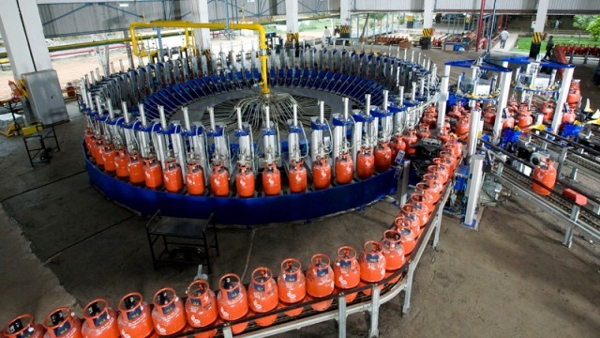
India has increased refinery production of Liquefied Petroleum Gas to around 50,000 tonnes per day, marking a significant operational response by the Petroleum Ministry at a time when global energy flows remain under pressure from developments in West Asia. The update was given by Sujata Sharma, Joint Secretary, Ministry of Petroleum and Natural Gas, during an official briefing, with PIB and DD India carrying the statement that refinery LPG output is now reaching this level.
The increase is important because LPG is one of India’s most sensitive household fuels. It powers millions of kitchens across urban, semi-urban and rural India, and its uninterrupted availability is directly linked to household welfare, women’s health, food security and daily convenience. A rise in domestic refinery output gives the country a stronger cushion when international cargo movement, pricing or supply reliability comes under stress.
The latest figure also shows a clear improvement from the position reported in April, when India’s daily LPG requirement was estimated at around 80,000 tonnes and domestic output had been raised to about 46,000 tonnes. At that stage, officials had also said that India had diversified LPG import sources from 10 countries to 15, including additional purchases from the United States, Norway, Canada, Algeria and Russia, alongside traditional Gulf suppliers.
This makes the current 50,000-tonne-per-day production level more than a refinery statistic. It reflects a wider energy-security strategy: maximise domestic output, diversify import sources, maintain household supply priority, expand alternatives such as piped natural gas, and discourage panic buying. The Ministry’s message has been clear that citizens should purchase fuel as per requirement while the supply chain remains actively managed.
India’s LPG system has become far larger over the past decade. As of 1 March 2025, the country had 32.94 crore active domestic LPG consumers, including 10.33 crore beneficiaries under the Pradhan Mantri Ujjwala Yojana. This scale explains why even a small disruption in LPG availability can create large public anxiety, and why refinery production, import planning and last-mile distribution must move in tight coordination.
The government has also been pushing piped natural gas as a parallel solution to reduce pressure on domestic LPG demand in areas where city gas infrastructure is available. According to the latest official briefing, around 7.99 lakh PNG connections have been gasified, 2.87 lakh connections are ready for gas supply after infrastructure creation, and more than 8.27 lakh customers have registered for PNG connections.
This shift matters because India’s clean-cooking transition cannot depend on one fuel channel alone. LPG remains the dominant clean cooking fuel for millions of households, especially in areas where piped gas infrastructure has yet to reach. PNG can absorb part of the urban demand load, while induction cooking and electric cooktops can provide additional flexibility for households with reliable power access.
The Petroleum Ministry’s refinery push also shows how India’s refining system can be used as a strategic buffer. Refinery LPG is produced during crude processing and can be redirected to strengthen domestic availability when import flows become uncertain. By raising refinery output, India reduces immediate pressure on import logistics and gives oil marketing companies more room to manage bottling plants, distributors, transport fleets and consumer deliveries.
The real challenge lies in balancing three demands at once: household supply, commercial consumption and industrial use. Domestic LPG cylinders carry the highest social priority because they serve everyday cooking needs. Commercial and industrial users also require energy continuity, but during tight supply conditions, household fuel availability becomes the first line of public policy.
The production increase therefore sends a reassuring signal. India is using refinery capacity, diversified sourcing and alternative fuel expansion to protect consumers from global energy turbulence. The move also highlights the importance of long-term planning: more domestic refining flexibility, stronger LPG storage, wider PNG coverage, diversified import contracts and better demand management during crisis periods.
At 50,000 tonnes per day, refinery LPG production now covers a major share of India’s daily requirement. The remaining demand will still require careful import management, but the domestic production increase gives the country a stronger safety margin. In energy policy, that margin matters. It is the difference between reacting to disruption and managing it with preparedness.
India’s latest LPG production update is therefore not just an oil-and-gas headline. It is a household security story, a clean-cooking story and an energy resilience story. As global supply chains face uncertainty, the ability to keep kitchens running smoothly becomes one of the most practical measures of national preparedness.
You may also like
-
India Advances Trade Diplomacy at G20 Ministerial in Milwaukee
-
Kokasa Launches to Build Indigenous Mission-Critical Systems for Su-30MKI, MiG-29 and T-72
-
Tata Projects and MDS Aero Partner to Build Advanced Aero-Engine Test Infrastructure in India
-
Flying Wedge Defence Partners With Portugal’s Keydef to Manufacture Kaal Bhairava and YAMA Drones in Europe
-
Armenia Conducts Live-Fire Exercise With Indo-French TRAJAN 155 mm Howitzers Manufactured in India
