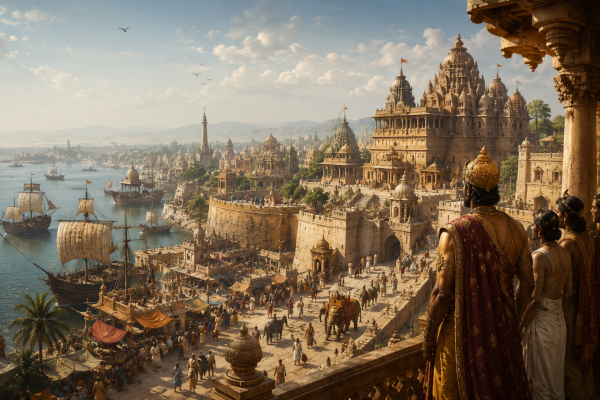
Known in ancient records as Valabhi or Vallabhi, the settlement in present-day Gujarat became one of the most important political and intellectual centres of early medieval western India. It served as the capital of the Maitraka dynasty, a ruling house that rose after the weakening of Gupta authority and governed large parts of Saurashtra and Gujarat between the 5th and 8th centuries CE. At its height, Valabhi was more than a royal capital. It was a centre of administration, maritime commerce, temple building, Buddhist scholarship, Jain learning and Sanskritic culture.
The Maitrakas emerged during a major transition in Indian history. The Gupta Empire, which had shaped northern India’s political and cultural life, began to fragment under pressure from internal decline and external invasions. In the western provinces, especially Saurashtra and Gujarat, local military commanders and regional elites began to assert greater autonomy. Out of this political atmosphere came Bhatarka, a Gupta general or military governor in Saurashtra, who established himself at Valabhi around the late 5th century CE. His title, Senapati, meaning commander, reflected his military background and also his careful early positioning. He did not immediately present himself as an imperial monarch, but he laid the foundation for a powerful regional kingdom.
Valabhi’s location gave the Maitrakas a natural advantage. Situated in the Saurashtra region, close to the Gulf of Khambhat and connected to the commercial landscape of western India, the capital stood near routes that linked inland Gujarat with ports on the Arabian Sea. This helped the kingdom grow through agriculture, coastal exchange, craft production and long-distance trade. The Maitraka state developed in a region already shaped by earlier powers such as the Western Kshatrapas and the Guptas. The dynasty inherited that political and commercial legacy, then turned it into a distinct regional order.
Bhatarka’s successors gradually transformed the family from a military house into a full monarchy. The early rulers continued to use titles that suggested caution, but by the time of later kings such as Dronasimha, the Maitrakas began to adopt higher royal titles. The rise in titles mirrored the rise in power. Valabhi moved from being a provincial centre to the seat of an independent kingdom. The dynasty’s authority expanded over Saurashtra and parts of Gujarat, with influence that at times reached into neighbouring regions such as Malwa and Rajasthan.
One of the strongest features of Maitraka rule was administrative continuity. The dynasty issued large numbers of copper-plate grants, many of them written in Sanskrit. These grants recorded donations of land, villages or revenues to Brahmins, temples and Buddhist monasteries. They were legal documents, but they were also political statements. Through them, the king announced his authority, rewarded religious and scholarly institutions, confirmed rights over land and linked the throne with dharma. The inscriptions help historians reconstruct the dynasty’s genealogy, administrative structure, religious policy and regional geography.
The Maitraka administration appears to have worked through territorial divisions such as vishaya and grama, with officials managing local units and revenue arrangements. The village remained the basic unit of agrarian life, while larger districts connected the countryside to the capital. The copper plates reveal a system in which royal authority, land revenue, religious patronage and local administration were closely connected. The king ruled through grants, officials, alliances and ritual legitimacy, creating a durable state structure that lasted for nearly three centuries.
The religious world of Valabhi was especially remarkable. The Maitraka kings are generally associated with Shaivism, and many adopted titles that reflected devotion to Shiva. Their coins and symbols often carried Shaiva imagery such as the trident. Yet their rule was marked by broad patronage. Buddhist monasteries received grants. Brahmanical institutions flourished. Jain scholarship found a major home in Valabhi. This was one of the finest examples of religious coexistence in early medieval India, where a Shaiva royal house could support Buddhist viharas, Brahmanical learning and Jain textual traditions.
Valabhi became famous as one of ancient India’s great centres of learning. In the intellectual map of early medieval India, it stood beside Nalanda as a respected university city. Chinese pilgrims such as Xuanzang and Yijing described western India’s Buddhist institutions and helped preserve the memory of Valabhi’s scholastic importance. The city was associated with Buddhist teachers such as Gunamati and Sthiramati, who were linked with major philosophical traditions. While Valabhi was known particularly for Buddhist learning, its curriculum was not limited to religion. It was also associated with studies in political science, administration, law, economics, accountancy, agriculture, business and philosophy.
This practical curriculum made Valabhi distinctive. It was not only a monastery-centred learning space; it also produced students who could serve in courts and administrations. In this sense, Valabhi functioned as an intellectual training ground for the political economy of the age. Students came for religious study, but also for governance, law and statecraft. The presence of scholars, monks, teachers, scribes and administrators made the city a living knowledge economy.
The city also played a major role in Jain history. Valabhi is traditionally associated with the codification and preservation of the Shvetambara Jain canon. Jain councils held at Valabhi helped shape the textual tradition of western Indian Jainism. This gave the city a sacred intellectual status among Jain communities. The Maitraka period therefore became a bridge between royal patronage, monastic scholarship and the preservation of religious literature.
Economically, the Maitraka kingdom benefited from Saurashtra’s coastal orientation. Ports such as Ghogha, Somnath, Dwarka and Porbandar were connected with wider maritime circuits. Western India had links with the Persian Gulf, the Red Sea, the Arab world and other regions of the Indian Ocean. The Maitrakas inherited a commercial culture shaped by earlier trade networks and carried it forward during a period of active exchange. Valabhi’s prosperity rested on this combination of inland revenue and maritime connectivity.
Coinage also reflects the dynasty’s economic confidence. Maitraka coins often followed the style of earlier Western Kshatrapa issues, especially in silver. Their coinage carried symbols such as the trident and helped maintain commercial circulation in Gujarat and Saurashtra. Coins, seals and copper plates together show a kingdom that understood the importance of monetary exchange, legal documentation and royal symbolism.
The Maitrakas were also patrons of architecture and art. Many temples from the broader Maitraka period are associated with the western coast of Saurashtra and nearby regions. These structures belong to an important phase in the evolution of early temple architecture in Gujarat. The period saw the growth of stone temples, shrines and sacred complexes that combined local styles with wider Indian architectural trends. Though many monuments are ruined today, they point to a vibrant artistic environment under Maitraka patronage.
Politically, the Maitrakas had to operate among powerful neighbours. Their kingdom existed in a competitive world shaped by the Maukharis, the Chalukyas, the Pushyabhutis of Kannauj under Harsha and later Arab forces from Sindh. At times, the Maitrakas came under pressure from stronger northern or southern powers. During the age of Harsha, Valabhi appears to have accepted some form of subordinate relationship while retaining local autonomy. After Harsha’s death, the Maitrakas regained space and continued as an important western Indian power.
One of the dynasty’s most prominent rulers was Shiladitya I, often remembered as a strong and influential monarch. Under rulers of this line, Maitraka power reached a high point. The kingdom had enough strength to command respect across western India, support large institutions and sustain Valabhi’s role as a major capital. The use of titles, grants and alliances shows a dynasty that understood both military power and cultural legitimacy.
The later phase of Maitraka history was shaped by new geopolitical pressures. After the Arab conquest of Sindh in the early 8th century, western India faced fresh military challenges. Arab expeditions moved toward Gujarat and Saurashtra, placing pressure on regional kingdoms. The Maitrakas, already weakened by conflicts and shifting alliances, faced repeated disturbances. Tradition remembers Valabhi’s fall as a major destruction, often linked with Arab attacks, though the precise historical process remains debated. By the late 8th century CE, the Maitraka line had disappeared from power.
The fall of Valabhi marked the end of one of western India’s most important early medieval kingdoms. Yet the legacy of the Maitrakas survived in several ways. Their copper plates preserved a record of political authority and landholding. Their religious patronage shaped Buddhist, Jain and Brahmanical institutions. Their university gave western India a place in the intellectual geography of ancient India. Their maritime economy connected Saurashtra with wider Indian Ocean networks. Their temples contributed to the development of Gujarat’s sacred architecture.
Valabhi deserves far greater attention in Indian historical memory. Nalanda is widely remembered as a great centre of learning, while Valabhi often remains in the shadows. Yet in its own time, Valabhi was a powerful capital, a trading city, a scholastic centre and a religious meeting ground. It represented the strength of regional India after the Guptas, showing how new kingdoms could preserve learning, support institutions and create durable political cultures.
The Maitraka kingdom was not merely a successor state after Gupta decline. It was a creative power in its own right. It turned Saurashtra into a centre of administration, learning and ocean-linked prosperity. It supported monks, scholars, Brahmins, Jain teachers, merchants and officials. It balanced royal Shaivism with generous religious patronage. It connected land grants with governance, ports with prosperity and scholarship with statecraft.
In the story of ancient and early medieval India, Valabhi stands as the great capital of western knowledge. The Maitrakas built a kingdom that combined sword, scripture, commerce and culture. Their capital may survive today only through ruins, inscriptions, coins and memory, but its historical importance remains immense. Valabhi was the city where western India spoke in the language of power, learning and faith.
You may also like
-
GeM’s AABHAR Collection Showcases 294 Indigenous Products, Strengthens Market Access for Indian Artisans
-
Tushara in the Mahabharata: The Lands Beyond the Hindu Kush and the Horsemen Who Faced Arjuna
-
Shaka in the Mahabharata: Central Asia’s Steppe Peoples, Nakula’s Campaign and the Alliance with Duryodhana
-
Yavana in the Mahabharata: Greek Connections, Pandava Campaigns and the Warriors of Kurukshetra
-
India and Sri Lanka Launch SAMHiTA Manuscript Digitisation Project to Preserve Ancient Buddhist Heritage
