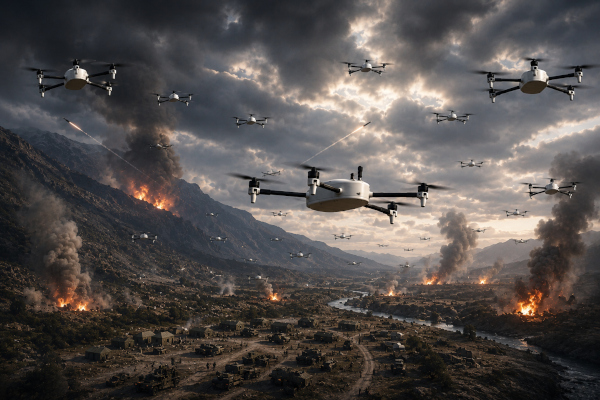
India’s defence technology ecosystem has taken an important step forward with Tashi Network and DroneVerse conducting a live drone swarm field trial in the Delhi region. The exercise demonstrated how multiple unmanned aerial systems can operate as a coordinated team, share mission data, adapt to changing conditions and continue assigned tasks even when communication links are disrupted or individual drones leave the mission.
The trial is significant because modern warfare is moving rapidly from single-drone operations to networked uncrewed systems. Future battlefields will require drones that can search, track, coordinate, support troops, relay information and reassign tasks with speed. The Tashi Network–DroneVerse demonstration points to this next stage of autonomous operations, where drones function as a connected tactical unit rather than isolated flying platforms.
The field evaluation reportedly ran across a 72-hour operational window and involved multi-aircraft autonomous tactical cells operating over a simulated contested perimeter of around 20,000 square metres. The drones were tested through rapid tasking cycles and mission scenarios designed to examine coordination, resilience and autonomous decision support.
A major highlight of the trial was the use of a decentralised mesh architecture. In traditional drone operations, aircraft often depend heavily on a central controller or command link. In a contested environment, electronic warfare, jamming, link failure or terrain interference can weaken such control structures. The system demonstrated by Tashi Network focused on shared coordination at the edge, allowing drones to communicate with one another and preserve mission coherence even when individual units face connectivity loss, low battery or operational withdrawal.
This is where the idea of a “thinking swarm” becomes important. The drones are designed to maintain a shared mission picture, distribute tasks among themselves and adapt when the situation changes. Human operators remain responsible for intent, authorisation and oversight, while the drone network handles fast, machine-speed coordination inside the mission area. This kind of human-in-the-loop autonomy is especially relevant for defence and internal security operations where speed and control must work together.
In one scenario, multirole tactical drones reportedly performed a coordinated find-fix-finish mission over a predefined perimeter. Surveillance drones searched the area, reconnaissance units helped identify and relay information, and the system coordinated follow-on action after human approval. Such a model can support border surveillance, counter-infiltration, perimeter security, high-risk reconnaissance and tactical support missions.
Another scenario involved a search-and-rescue model, where the swarm divided the search area among itself. When one drone returned due to low battery, the remaining drones redistributed the workload and continued the mission. This capability has major relevance beyond combat. It can support disaster response, flood rescue, forest search operations, industrial emergencies, coastal monitoring and large-area public safety missions.
DroneVerse’s role in the trial is equally important because India’s drone industry is increasingly moving into defence-grade platforms, counter-UAS systems, training, manufacturing and tactical deployment models. The company positions itself in low-altitude defence, drone training, UAV systems and counter-drone technologies. Its collaboration with Tashi Network shows how Indian companies can combine hardware platforms with advanced autonomous coordination software to create mission-ready drone ecosystems.
For India’s armed forces and security agencies, swarm technology can become a powerful force multiplier. A swarm can cover larger areas, reduce risk to soldiers, improve target detection, maintain persistent surveillance and respond more flexibly than single-drone missions. It can also help in operations where communication links are contested and real-time adaptability becomes essential.
The trial also fits into India’s larger Atmanirbhar Bharat defence vision. Indigenous drone swarms can reduce dependence on foreign systems, create domestic intellectual property, build local manufacturing depth and support Indian start-ups working in artificial intelligence, robotics, sensors, secure communications and electronic warfare resilience. As drones become central to modern conflict, technological sovereignty in autonomous systems will become a strategic requirement.
The demonstration also reflects lessons from recent global conflicts, where drones have transformed surveillance, targeting, artillery correction, battlefield awareness and tactical strikes. The next phase of this transformation will be defined by coordination. A single drone gives visibility. A swarm gives persistence, coverage, redundancy and distributed intelligence.
At the same time, field demonstrations are only one stage in the journey towards operational deployment. For defence use, such systems must pass demanding evaluations related to reliability, secure communications, cyber protection, electronic warfare resistance, payload integration, endurance, airspace safety and rules of engagement. The Tashi Network–DroneVerse trial should therefore be seen as a promising technology milestone that can support future testing, refinement and potential adoption.
The successful Delhi-region field trial shows that Indian private-sector defence innovators are moving into advanced areas of autonomous warfare. By combining indigenous drone platforms with decentralised coordination systems, India is building the foundations of a future-ready uncrewed combat and security ecosystem.
If scaled through further trials, larger formations, mixed payloads and service-level evaluations, such drone swarms can strengthen India’s surveillance, tactical response, border protection and internal security capabilities. The Tashi Network–DroneVerse demonstration marks an encouraging step towards resilient, intelligent and self-organising drone operations built in India for the security challenges of the future.
You may also like
-
Rajnath Singh to Lead Indian Delegation at ASEAN Defence Summit in Philippines, Strengthening Indo-Pacific Security Cooperation
-
Bengaluru Startup Paar Autonomy Develops AI-Powered Drone Systems for GPS-Denied Environments
-
Sigma Advanced Systems Secures Fresh ₹973 Crore NATO Artillery Ammunition Order
-
India Advances Indigenous Defence and Space Technologies Through Naval Innovation, Drones and Advanced Electronics
-
Thales Seeks Indian Partnerships for Next-Generation Missiles, Radars and Electronic Warfare Systems
