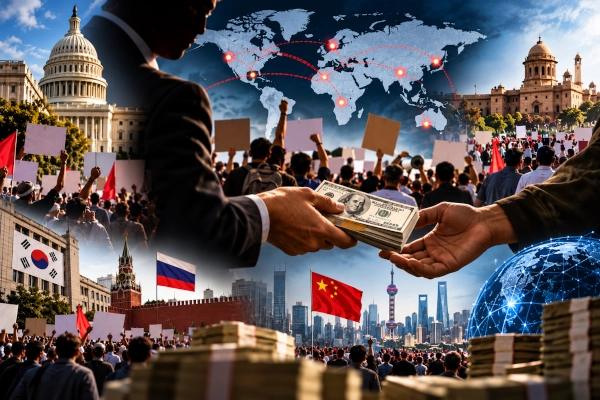
Public demonstrations have historically played an important role in shaping political decisions, influencing public policy and bringing social grievances to the attention of governments. From movements demanding democratic reforms to protests concerning labour rights, environmental protection and economic policies, peaceful public assembly remains an essential part of democratic participation. However, investigations across several countries have exposed another dimension of political mobilisation: the deliberate use of financial resources to organise demonstrations, finance advocacy groups and manufacture the appearance of widespread public support.
The business of paid protests extends beyond individuals receiving money to attend demonstrations. It can involve recruitment agents, event organisers, transportation providers, political consultants, publicity agencies and digital media operators. These intermediaries may receive substantial payments for arranging participation, organising political events and amplifying their visibility through conventional and social media. When the financial relationships behind such campaigns are deliberately concealed, the public may mistake professionally organised political activities for spontaneous expressions of popular sentiment.
Government investigations in the United States and South Korea have documented substantial financial arrangements involving political organisations, foreign-linked operatives and advocacy campaigns. American federal prosecutors identified a Russian political influence operation with a monthly budget exceeding $1.25 million in September 2016. South Korean investigators examined the distribution of billions of won to politically aligned civic organisations, including groups involved in public demonstrations. More recently, American authorities uncovered foreign-linked political operations involving payments for travel, proposed protest financing and nearly $10 million in concealed funding for political media production.
These investigations reveal how political influence can become an organised financial activity involving multiple layers of sponsorship and expenditure. In certain cases, the objective was to promote a government’s political interests, while other operations sought to influence domestic political debates or intensify existing disagreements. The financial beneficiaries included advocacy organisations, intermediaries and communications businesses whose commercial interests could remain separate from the ultimate political objectives of the campaign.
However, the distinction between direct protest financing and wider political influence expenditure is essential. A million-dollar propaganda budget cannot automatically be described as money paid to street demonstrators. Similarly, financial assistance provided to a genuine advocacy organisation does not establish that its members were hired to express views they did not hold. The seriousness of concealed political financing lies in the deliberate misrepresentation of sponsorship, the possible violation of national laws and the attempt to influence public opinion without revealing the interests directing the activity.
The following examination brings together 11 documented investigations and related cases, retaining the financial figures, countries, activities and evidentiary distinctions necessary to understand the international business of political mobilisation.
What Constitutes a Paid Protest or Manufactured Political Campaign?
A paid protest generally refers to a demonstration in which individuals receive money or material benefits to participate in an event, particularly when those payments are intended to create an exaggerated or misleading impression of public support. The arrangement becomes especially concerning when participants are presented as independent supporters while organisers conceal the financial incentives responsible for their attendance. Such activity differs from legitimate organisations providing transportation, meals or accommodation to members who genuinely support a cause.
Manufactured political mobilisation is closely associated with astroturfing, a practice in which professionally coordinated campaigns imitate spontaneous grassroots movements. An organisation may finance demonstrations, commission publicity, sponsor seemingly independent advocacy groups or employ coordinated online accounts to promote a political narrative. The central objective is to make an organised and financially supported activity appear to represent independent public sentiment.
The financial structure may involve several levels of intermediaries. An interested sponsor might provide resources to an organisation, which then engages coordinators to arrange public gatherings, transportation and communications. Publicity firms may prepare campaign material, while digital operators distribute photographs, videos and political messages to increase the visibility of the event. The economic beneficiaries can therefore include a wider commercial network rather than merely the people appearing in the demonstration.
Not every organised or financed demonstration involves wrongdoing. Genuine civic movements also require logistical support, fundraising and professional communication. The determining issues are whether financial relationships have been concealed, whether participation has been deliberately misrepresented and whether the funds were obtained or used in violation of applicable laws. These distinctions are especially important when evaluating allegations concerning foreign governments, intelligence-linked organisations or corporate sponsors.
Government-Documented Political Mobilisation and Influence Funding Across the World
Government investigations have identified several forms of financially supported political mobilisation. Some cases involve direct assistance for demonstrations, while others concern institutional funding for advocacy organisations or extensive expenditure on media campaigns designed to influence public opinion. The following consolidated list preserves these distinctions rather than presenting all identified expenditures as payments to individual protesters.
| No. | Country | Investigation or operation | Period | Amount identified | Nature of financing | Evidence status |
|---|---|---|---|---|---|---|
| 1 | United States | Russian Internet Research Agency — Project Lakhta | 2014–2018 | More than $1.25 million per month by September 2016 | Covert influence campaign involving online activity and organised rallies | Federal indictment |
| 2 | United States | Russian-linked political activities and four-city advocacy tour | 2015–2016 | $12,000 guarantee letter | Financial guarantee for a political advocacy tour | Evidence presented in federal jury trial |
| 3 | United States | Russian-directed California demonstrations | 2022 | Travel paid for four participants | Flights for individuals attending a demonstration | Evidence presented in federal jury trial |
| 4 | United States | Russian-directed demonstrations in Georgia | 2022 | Amount not specified | Foreign direction of public demonstrations | Evidence presented in federal jury trial |
| 5 | South Korea | Presidential administration-linked conservative civic organisation funding | 2014–2016 | Approximately ₩6.8 billion | Corporate contributions to politically aligned organisations involved in rallies and media campaigns | Special prosecution investigation |
| 6 | South Korea | National Intelligence Service-linked advocacy funding | 2010–2012 | Approximately ₩11.8 billion | Funding to conservative groups involved in pro-government rallies and campaigns | Intelligence task-force findings reported by prosecutors |
| 7 | South Korea | Samsung and SK payments to conservative organisations | Investigated in 2017 | Approximately ₩2 billion | Corporate funding allegedly arranged through intelligence-linked channels | Prosecutorial investigation; may overlap with Case 6 |
| 8 | United States | Chinese-linked political influence proposal | 2023 | $80,000 requested | Proposed financing for pro-China public political activity | Official complaint; subsequent conviction and sentencing for foreign-agent conduct |
| 9 | United States | Russian RT-linked domestic media financing operation | 2023–2024 | Approximately $9.7 million transferred | Covert financing of political content production and distribution | Federal indictment; not direct protest financing |
| 10 | United States and Europe | Russian Operation Doppelganger | 2022–2024 | No comprehensive expenditure figure established | Paid advertising, influencers and deceptive media sites | FBI affidavit and enforcement action |
| 11 | Philippines | Investigation into possible foreign financing of anti-government rallies | 2025 | No amount established | Suspected foreign contributions to demonstrations | Official investigation announced; allegation not established |
The available figures demonstrate substantial expenditure on selected political influence activities, but they do not establish a reliable global total for paid demonstrations. In particular, the South Korean financial figures may overlap because separate investigations examined related organisational relationships and corporate contributions. The American cases also distinguish the overall budgets of influence operations from money spent on specific rallies.
The documented findings provide evidence of financial support for political mobilisation and covert influence, but the amounts should be interpreted according to the precise activities described in each investigation.
1. United States: Russian Internet Research Agency Operated with a Budget Exceeding $1.25 Million Monthly
The Russian Internet Research Agency investigation provides one of the most detailed official accounts of a foreign-linked political influence operation combining organisational expenditure, online propaganda and attempts to organise public demonstrations. On February 16, 2018, the United States Department of Justice announced an indictment against 13 Russian individuals and three companies accused of participating in a coordinated effort to interfere with American political processes. The activities were associated with Project Lakhta, an influence operation connected to organisations linked to Russian businessman Yevgeniy Prigozhin.
According to the federal indictment, individuals involved in the operation created fictitious American identities and used them to establish social media accounts, interact with domestic audiences and organise political activities. The operation sought to make its messaging appear to originate from ordinary American citizens rather than from a foreign organisation. Its activities included purchasing online advertisements, cultivating social media communities and contacting individuals in the United States to assist with events and demonstrations.
The financial structure was particularly significant. Federal prosecutors stated that Project Lakhta’s monthly budget exceeded 73 million Russian roubles, equivalent to more than $1.25 million, by September 2016. The indictment also described approximately one million roubles in bonus payments. Investigators alleged that financial arrangements were concealed through affiliated companies, bank accounts and descriptions intended to disguise the actual purpose of certain expenditures.
The operation reportedly supported political activities associated with competing positions, including demonstrations supporting and opposing Donald Trump. This aspect of the investigation demonstrated that a covert influence campaign might attempt to intensify political divisions rather than consistently promote one political organisation. By creating apparently independent online communities and organising visible political events, the operation sought to influence public discussion through both digital and physical channels.
The financial evidence demonstrates the scale of resources that may support sustained political influence. However, the $1.25 million monthly figure represented the operation’s broader budget, covering multiple activities rather than a specific amount paid to demonstrators. The indictment established formal allegations by American prosecutors and should not be interpreted as a conviction of every person named in the case.
2. United States: Russian-Linked Organiser Provided a $12,000 Guarantee for Political Advocacy
A separate American investigation identified a more specific financial arrangement involving an advocacy campaign supported by an individual associated with Russian political interests. The case concerned Aleksandr Ionov, a Russian national linked to the Anti-Globalization Movement of Russia, and his relationships with organisations conducting political activities in the United States. These relationships formed part of a federal investigation into alleged foreign direction of domestic political organisations.
According to evidence described by the Justice Department following a federal jury trial, Ionov provided a $12,000 guarantee letter in January 2016 to support a four-city political advocacy tour. The proposed tour concerned a petition to the United Nations associated with the African People’s Socialist Party and allegations against the United States. The financial commitment was intended to support organised political outreach and public activities connected with the petition.
The guarantee illustrates how foreign-linked individuals can provide financial backing to domestic advocacy initiatives without necessarily appearing as their public organisers. Local organisations may possess established community relationships, political identities and organisational networks that make them effective vehicles for public mobilisation. Financial support can help extend such activity across multiple cities and create opportunities for media coverage.
However, a guarantee letter is different from a completed financial transfer. The existence of the $12,000 commitment does not independently establish that the entire amount was disbursed or spent. The documented arrangement demonstrates proposed financial backing for political advocacy, not a verified payroll for individual demonstrators.
The broader federal proceedings resulted in convictions for conspiracy to act as agents of a foreign government. The case is relevant because it connects foreign-linked financial assistance to organised political activity while also illustrating why the precise nature of each financial transaction matters.
3. United States: Russian-Directed California Demonstrations Involved Paid Travel for Four Participants
The federal prosecution involving Ionov also uncovered a direct connection between foreign-linked financing and the participation of individuals in an American political demonstration. Following Russia’s invasion of Ukraine in February 2022, investigators examined communications concerning public activities intended to advance political positions favourable to Russia.
According to the Justice Department, Ionov directed domestic political organisations to conduct demonstrations outside the headquarters of a social media company in California. The events concerned allegations that the company had suppressed pro-Russian viewpoints. The demonstrations provided opportunities to generate publicity and communicate political messages through visible public activity.
Federal prosecutors reported that Ionov paid for Augustus Romain and three other members of the Black Hammer organisation to fly to California to participate in one of the demonstrations. The financial support covered the travel of identified participants, establishing a direct relationship between a foreign-linked organiser and the logistical arrangements for a domestic public event. Members of another organisation were also directed to conduct related activities.
The investigation additionally examined communications concerning the possibility of assembling larger crowds for subsequent events. These discussions revealed an interest in expanding the public visibility of demonstrations through coordinated mobilisation. The available findings did not, however, establish that every participant was paid a wage or that the political views expressed during the event were necessarily insincere.
The Justice Department’s announcement did not identify the total cost of the flights. Nevertheless, the case provides a documented example of financial support for individuals travelling to participate in a politically directed demonstration. The broader federal prosecution resulted in four American citizens being convicted of conspiracy to act as agents of a foreign government, with the convictions announced on September 12, 2024.
4. United States: Russian-Directed Demonstrations Extended to Georgia
The same federal proceedings examined additional demonstrations organised in Georgia during 2022. According to the Justice Department, Ionov directed activities involving the Black Hammer organisation after Russia’s invasion of Ukraine, including events intended to promote positions favourable to the Russian government. These activities formed part of the broader relationships between foreign-linked individuals and domestic political organisations investigated by American authorities.
In May 2022, a demonstration was organised outside a media company in Atlanta to commemorate Russia’s Victory Day. A further event took place at the Georgia State Capitol in June 2022 in support of Russia. The locations provided opportunities for public visibility, political messaging and the creation of photographs or video footage suitable for subsequent distribution.
These events demonstrate how a foreign-directed campaign can operate through domestic groups at multiple locations. Local organisations may provide participants and organisational facilities, while the external sponsor supplies political direction or other forms of assistance. The resulting demonstration can appear to be an independent expression of domestic political sentiment even when communications reveal outside involvement.
The American prosecution established relevant foreign direction as part of the evidence examined during the trial. However, the Justice Department’s publicly cited account did not identify a separate financial budget for the Georgia demonstrations. It would therefore be misleading to assign the California travel expenditure to these events or estimate an amount without supporting records.
The Georgia demonstrations are important because they show that organised political influence need not depend upon a single large event. Multiple public gatherings, each generating its own publicity, can contribute to a wider influence campaign. The financial amount for these specific demonstrations remains undisclosed in the cited official material.
5. South Korea: ₩6.8 Billion Channelled to Conservative Civic Organisations
South Korea provides an important example of politically aligned advocacy financing involving domestic government and corporate relationships. In 2017, special prosecutors investigated allegations that officials associated with former President Park Geun-hye’s administration had encouraged major corporations to provide financial support to conservative civic organisations. The investigation examined arrangements involving the Federation of Korean Industries, a prominent business association representing major South Korean companies.
According to findings reported from the special prosecution, approximately 6.8 billion South Korean won was directed towards conservative organisations between 2014 and late 2016. The funds were associated with politically aligned activities, including public rallies and media campaigns. Prosecutors investigated whether government officials had influenced the allocation of financial assistance to organisations whose activities supported the administration or challenged its political opponents.
The funding mechanism attracted particular attention because the public-facing activities were conducted by civic organisations, while investigators examined the possible involvement of government officials and corporate contributors behind the financing. Such arrangements raise questions about whether an organisation’s public advocacy reflects independent mobilisation or financial relationships that have not been adequately disclosed.
The case also demonstrates that organised political influence is not confined to opposition movements seeking to challenge governments. Financially supported advocacy can promote incumbent administrations, defend existing policies or criticise political opponents. In each situation, the relevant transparency concern is whether the public understands the organisational and financial interests behind the campaign.
The identified ₩6.8 billion represented financial support to politically aligned organisations, not a verified sum paid directly to individual demonstrators. The distinction matters because recipient organisations may have used their resources for several activities, including administration, publicity and public events. The special prosecution findings provide an important example of institutional political financing, although the available reporting does not establish a final criminal conviction covering every contribution or recipient.
6. South Korea: Intelligence Investigation Identifies ₩11.8 Billion in Political Group Funding
A separate South Korean investigation examined the use of financial resources to support politically aligned organisations during the administration of former President Lee Myung-bak. In October 2017, prosecutors and an internal task force of the National Intelligence Service examined allegations concerning the intelligence agency’s involvement in domestic political activities, including support for groups conducting pro-government advocacy.
According to the findings reported at the time, approximately 11.8 billion South Korean won had been provided to conservative organisations between 2010 and 2012. The funding was associated with organisations involved in pro-government rallies, campaigns against political opponents and other public advocacy activities. Investigators examined whether intelligence-linked officials had influenced the distribution of resources through relationships with corporate contributors and intermediary organisations.
The findings attracted attention because an intelligence organisation’s involvement in domestic political activity raises questions extending beyond ordinary campaign finance. Intelligence institutions possess access to information, organisational capabilities and government relationships that are not available to independent civic groups. Allegations that such resources were used to support politically aligned organisations therefore raised concerns about institutional neutrality and the independence of public advocacy.
The financial arrangements also illustrated how funding could move through institutional relationships before reaching organisations conducting public campaigns. Where several entities participate in the funding process, the public may find it difficult to identify the original source of support or determine whether the recipient group is acting independently.
The ₩11.8 billion figure covered funding to political organisations and related activities, rather than a separate calculation of payments to protest participants. The investigation demonstrates the scale of resources potentially involved in politically aligned mobilisation, but it does not establish that everyone attending rallies associated with the recipient organisations was financially compensated.
7. South Korea: Samsung and SK Linked to Approximately ₩2 Billion in Political Advocacy Funding
Investigations into South Korea’s political advocacy financing also examined the role of major industrial enterprises in providing resources to conservative organisations. In October 2017, prosecutors reportedly identified approximately 2 billion won in contributions associated with Samsung and SK, two of the country’s leading corporate groups. The payments were examined in connection with requests allegedly associated with the National Intelligence Service.
Investigators assessed whether corporate contributions had been arranged through intelligence-linked channels to support organisations conducting politically aligned activities. The inquiry raised concerns about how financial resources provided by large businesses could reach advocacy groups whose activities supported particular political interests.
Such arrangements are relevant to understanding the business of political mobilisation because they involve relationships among corporate contributors, institutional intermediaries and public-facing organisations. An advocacy group conducting a demonstration may receive support through a funding chain that is not immediately visible to participants, journalists or the wider public.
The legal and ethical significance depends upon the circumstances surrounding the contributions. Corporate donations to organisations can be lawful, but the alleged involvement of intelligence officials in directing financial support towards politically aligned groups raised additional questions about institutional authority and accountability.
The approximately ₩2 billion identified in this investigation should not be added to the ₩11.8 billion examined in the broader intelligence investigation without establishing that the amounts are entirely separate. The available reporting indicates potentially overlapping financial arrangements. This is an important consideration when analysing large political funding cases, where multiple investigations may examine different aspects of the same network.
8. United States: Chinese-Linked Political Operative Requested $80,000 for Public Political Activities
An American investigation involving alleged Chinese political influence provides a specific example of proposed financial support for public political activity. On December 19, 2024, the United States Department of Justice announced the arrest of Yaoning Sun, also known as Mike Sun, who was accused of acting as an illegal agent of the People’s Republic of China. Federal investigators examined his relationship with Chen Jun and communications concerning political activities involving Chinese government interests.
According to the criminal complaint, Sun helped prepare a proposal in February 2023 requesting $80,000 from Chinese authorities to support political activities in the United States. The proposed activities included a pro-China demonstration associated with an Independence Day parade in Washington, DC. Investigators alleged that the broader effort was intended to promote positions favourable to the Chinese government and counter groups considered hostile to its interests.
The financial proposal is significant because it identified a specific amount linked to planned public political activity. Unlike cases involving broad organisational budgets, the request provides an indication of the resources sought for a defined set of activities that included a proposed demonstration.
However, the amount was a funding request rather than verified expenditure. The cited complaint did not establish that Chinese authorities transferred the entire $80,000 or that the requested sum was subsequently used to pay individuals attending a demonstration. Treating the proposed budget as confirmed spending would therefore overstate the financial evidence.
A subsequent Justice Department announcement stated that Sun had been sentenced to 48 months in federal prison for acting as a covert agent of the Chinese government. The sentencing established the outcome of his foreign-agent case, but it did not convert every proposed financial arrangement described in the investigation into a verified payment.
The case illustrates how foreign-linked political activities can involve explicit funding proposals while also demonstrating the importance of distinguishing requested money from funds actually received or spent.
9. United States: Russian Media Operation Allegedly Financed Political Content with $9.7 Million
The financing of political influence is not limited to street demonstrations. Digital media companies, online personalities and professional content producers can also become important channels for distributing political narratives, particularly when financial sponsorship is concealed from audiences.
On September 4, 2024, the United States Department of Justice announced an indictment against two employees of RT, the Russian state-controlled international media organisation. Prosecutors alleged that the individuals participated in an operation to covertly finance an American online content company that produced and distributed political videos.
According to the indictment, approximately $9.7 million was transferred to the company between October 2023 and August 2024, representing nearly 90% of its bank deposits during the relevant period. Investigators alleged that the transfers passed through companies associated with Turkey, the United Arab Emirates and Mauritius, with descriptions that disguised the payments as transactions involving electronic equipment.
The recipient company’s political content addressed American domestic issues, international relations and Russia’s invasion of Ukraine. Prosecutors alleged that the financing arrangements were intended to conceal Russian involvement while enabling the material to reach American audiences through apparently independent media channels.
This case demonstrates how the commercial structure of political influence can extend into content production, distribution and audience development. Rather than financing people standing in a street, sponsors may direct substantial resources towards media operations designed to shape the information available to the public.
The $9.7 million figure concerned alleged financing of political media content, not direct protest expenditure. It remains relevant to the wider investigation of manufactured political narratives because media amplification can significantly influence how demonstrations and political controversies are perceived. Nevertheless, the indictment contained criminal allegations, and its contents must be distinguished from final judicial findings against the charged individuals.
10. United States and Europe: Operation Doppelganger Used Paid Advertising and Deceptive Media Networks
Operation Doppelganger represents another example of political influence activity conducted primarily through digital infrastructure rather than physical demonstrations. On September 4, 2024, the United States Department of Justice announced enforcement action concerning 32 internet domains allegedly associated with a Russian government-directed influence operation targeting audiences in the United States and other countries.
According to an FBI affidavit, the operation used websites that imitated established news organisations, social media accounts that appeared to represent ordinary users and promotional methods designed to circulate selected political narratives. Investigators also described the use of paid advertisements and influencers to increase the visibility of the material.
The strategy relied upon creating apparently independent sources of political information. By imitating established media outlets and using ordinary-looking online identities, the campaign allegedly sought to obscure its connection to Russian government interests. The resulting material could circulate through social media platforms and reach audiences who were unaware of the sponsorship behind it.
The operation is relevant to the business of manufactured political influence because the same methods can be used to amplify demonstrations, political controversies and public campaigns. A physical event may generate initial photographs or video footage, while coordinated digital distribution can extend its apparent significance to much larger audiences.
Unlike the Internet Research Agency case, the cited Justice Department announcement did not provide a comprehensive verified expenditure figure for Operation Doppelganger. Investigators identified paid promotional methods and deceptive infrastructure, but the public record did not establish an overall campaign budget or a specific amount paid to street demonstrators.
The financial scale therefore remains unspecified in the cited official findings. The case nevertheless illustrates how professional media and digital communication services can contribute to covert political influence without requiring the organisation of large physical crowds.
11. Philippines: Military Investigates Possible Foreign Financing of Anti-Government Rallies
The Philippines provides an example of an official investigation into suspected foreign protest financing where the publicly available findings did not establish that the alleged financing occurred. On November 18, 2025, the Armed Forces of the Philippines announced that it was examining possible foreign financial support connected with anti-government demonstrations.
The inquiry concerned political rallies organised by groups opposing the administration of President Ferdinand Marcos Jr., including activities associated with the United People’s Initiative. Military officials stated that authorities were assessing potential funding sources and examining whether domestic or overseas organisations had contributed to the mobilisation.
The investigation reflected concerns that foreign entities might attempt to influence domestic political developments through financial support for public campaigns. Such concerns are especially significant when demonstrations involve demands for changes in national political leadership, because allegations of overseas sponsorship can affect public perceptions of a movement’s independence.
However, the announcement of an investigation is not equivalent to an official finding that foreign financing took place. The cited public record did not identify a confirmed overseas sponsor, establish that participants received payments or disclose evidence of financial transfers for the demonstrations.
No verified expenditure amount was provided. The case therefore belongs in a comprehensive examination of government scrutiny of protest financing, but it should not be presented as a proven example of foreign-funded demonstrations.
Its inclusion illustrates the importance of maintaining a clear distinction between allegations under examination and conduct established through documentary evidence or judicial proceedings. The investigation was confirmed, but foreign financing and paid participation were not established in the cited announcement.
What the Financial Figures Reveal About the Business of Political Mobilisation
The 11 investigations reveal different financial arrangements through which political activity can receive organised support. Some involved foreign-linked individuals financing specific events, while others concerned substantial contributions to politically aligned organisations or digital media operations. Together, they demonstrate that the financing of political influence can involve far more than payments to people attending demonstrations.
The Russian Internet Research Agency case identified a broad operation with a monthly budget exceeding $1.25 million, while the Russian-linked advocacy case involved a specific $12,000 financial guarantee. The California demonstrations provide an example of travel expenses paid for identified participants. These findings illustrate how expenditure can range from the support of individual public events to the maintenance of extensive political influence infrastructure.
South Korea’s investigations revealed another model involving financial relationships among government-linked individuals, corporate contributors and civic organisations. The identified sums of ₩6.8 billion and ₩11.8 billion demonstrate the scale of funding examined in connection with politically aligned advocacy. However, they do not establish that the entire amounts financed demonstrations or that individual participants were paid.
The RT investigation revealed a different commercial structure, involving approximately $9.7 million allegedly transferred to a political content business. Operation Doppelganger further illustrated the use of paid advertising, influencers and deceptive media websites. Such operations demonstrate how professional communication services can become important components of politically directed information campaigns.
These cases also reveal why there is no reliable global figure for spending on paid protests. Financial investigations cover different periods, activities and jurisdictions, while several identified budgets combine demonstrations with other forms of advocacy and communication. Any attempt to add the figures together would produce a misleading total.
How Professional Intermediaries Benefit from Organised Political Campaigns
The financial arrangements identified in these investigations demonstrate how political mobilisation can involve multiple organisations rather than a direct relationship between a sponsor and individual demonstrators. A financing entity may support an advocacy organisation, which then arranges public events, commissions communications services or coordinates participants through established networks.
Professional service providers can receive payment for work associated with these activities. Transportation companies may arrange travel, event managers may coordinate gatherings, and communications agencies may prepare campaign materials or distribute publicity. Digital media operators can expand the audience for a campaign through content production and online promotion.
These services are not inherently deceptive. Legitimate political parties, trade unions and civil society organisations routinely employ professionals and purchase services to conduct public activities. The concern arises when financial relationships are deliberately concealed to misrepresent the origins or independence of a political campaign.
The American foreign-influence cases illustrate how domestic intermediaries may become involved in activities directed by overseas sponsors. South Korea’s investigations demonstrate how institutional and corporate funding relationships can support advocacy organisations operating within a domestic political environment.
An important economic feature of these arrangements is that intermediaries may receive compensation regardless of the final political outcome. A transport provider can be paid for its services, while an event organiser can complete a contracted demonstration without establishing whether the publicity changed public attitudes.
Consequently, the financial success of organising a campaign does not necessarily demonstrate that the campaign achieved its political objectives.
Media Amplification Can Increase the Political Visibility of Financed Demonstrations
Public demonstrations have considerable communication value because they generate visible images of collective participation. A gathering outside a government institution, political office or prominent commercial establishment can attract journalists and produce photographs or video footage suitable for repeated distribution.
For genuine civic movements, such coverage provides an opportunity to communicate public concerns. However, organisations involved in deceptive political mobilisation may attempt to exploit the same mechanism by presenting financially coordinated participation as spontaneous public sentiment.
The international investigations demonstrate how physical demonstrations and digital communications can reinforce each other. The Internet Research Agency allegedly used fictitious online identities to support political activities and reach domestic audiences. The foreign-directed demonstrations examined in the Ionov prosecution provided public events that could generate additional attention.
The RT and Doppelganger investigations illustrate the wider significance of media distribution. Political narratives can reach large audiences through professional video production, online advertising, deceptive websites and coordinated social media activity without the need to organise major street demonstrations.
These methods can amplify the visibility of an event, but the resulting publicity does not establish that the underlying political message enjoys widespread support. Crowd photographs, online engagement and repeated media coverage provide information about an event’s visibility, not a representative measurement of public opinion.
Responsible reporting therefore requires examining the organisers, financial relationships and circumstances of demonstrations rather than relying exclusively upon the size or apparent enthusiasm of a crowd.
Foreign Sponsorship, Domestic Funding and Political Influence Require Separate Examination
The documented investigations demonstrate that political influence financing can originate from both foreign and domestic sources. The Russian and Chinese cases involved alleged or established relationships with foreign political interests, while the South Korean investigations examined funding associated with domestic government and corporate institutions.
These distinctions have important legal consequences. Foreign-directed political activity may involve undeclared agency relationships, prohibited financial transfers or violations of national regulations governing foreign influence. Domestic political financing may instead raise questions concerning institutional authority, corporate contributions, financial disclosure or the improper use of government resources.
India regulates specified foreign financial contributions through the Foreign Contribution (Regulation) Act, 2010. The legislation restricts certain categories of recipients, including political parties, from accepting foreign contributions and establishes regulatory requirements for organisations permitted to receive such funds.
However, the existence of a foreign financial relationship does not automatically establish covert political interference. Lawful international cooperation, research grants and other permitted activities must be distinguished from financing intended to conceal foreign direction of domestic political activity.
Similarly, a demonstration that receives funding or logistical support cannot automatically be classified as manufactured. Establishing concealed sponsorship requires evidence connecting particular financial arrangements to the relevant activities and demonstrating how those arrangements affected the public representation of the campaign.
The international cases provide useful examples of investigative methods and financial structures, but they do not establish wrongdoing by unrelated organisations or protest movements in India.
Paid Demonstrations Cannot Guarantee Electoral Support
One of the fundamental limitations of financially organised political mobilisation is that money spent attracting participants or generating publicity cannot guarantee genuine public support.
Individuals may attend demonstrations because they agree with the cause, because their organisations have encouraged participation or because they receive financial assistance. These motivations can overlap, making it difficult to infer political commitment from attendance alone.
Even when organisers successfully attract large crowds, the event does not establish that participants will support a particular political party during an election. Voting decisions are influenced by numerous considerations, including economic conditions, leadership, local issues and personal political preferences.
The documented American investigations established financial arrangements and foreign-directed activities, but they did not provide a reliable measurement of how many voters changed their preferences because of the operations.
This creates a distinction between the commercial and political outcomes of organised mobilisation. Event organisers, publicity agencies and other service providers may receive payment for delivering contracted activities, while the sponsor may fail to generate meaningful political support.
Large expenditure can produce media visibility, but publicity does not automatically create public confidence. Money may finance demonstrations and political messaging, but it cannot guarantee votes, lasting loyalty or electoral success.
Why Governments Must Follow the Money Behind Political Mobilisation
The investigations examined in this article demonstrate the importance of financial records, communications and organisational relationships when authorities assess suspected covert political influence.
The American federal cases involved documentary evidence concerning financial arrangements, foreign direction, travel support and political communications. South Korea’s investigations examined relationships among government-linked individuals, corporate contributors and advocacy organisations.
These approaches are more reliable than attempting to determine the legitimacy of a demonstration through photographs, crowd estimates or the political positions expressed by participants.
Investigators examining suspected unlawful financing must establish who provided the money, who received it, how it was used and whether the relevant conduct violated applicable laws. Identifying the ultimate sponsor may require examining intermediaries and the relationships between organisations involved in transferring or spending funds.
Careful attention must also be given to the difference between a proposed budget, a financial guarantee, a completed transfer and an actual expenditure. The $80,000 proposal identified in the Chinese-linked influence case, for example, cannot be treated as equivalent to the $9.7 million in transfers alleged in the RT case.
The same standards should apply when governments examine domestic demonstrations. Allegations of foreign sponsorship require verifiable evidence, and the announcement of an investigation should not be presented as a finding that wrongdoing occurred.
Effective scrutiny protects public institutions from concealed interference while safeguarding the legitimacy of genuine civic participation.
The Business of Paid Protests and the Importance of Financial Accountability
Government investigations across the United States and South Korea have revealed how substantial financial resources can support politically directed demonstrations, advocacy organisations and wider influence campaigns. Some cases involved foreign-linked actors financing participation in public events, while others exposed institutional contributions and multimillion-dollar media operations designed to influence political discussion.
The documented amounts demonstrate that political influence can involve professional organisation, financial intermediaries and communication networks operating across national boundaries. They also show that the beneficiaries of political expenditure may include advocacy organisations, event organisers and media businesses rather than only individuals attending public demonstrations.
At the same time, the available evidence does not support the claim that all organised protests are paid or that every demonstration attracting foreign attention is externally financed. Legitimate civic movements also require resources, and participants may sincerely support a cause while receiving lawful logistical assistance.
India’s Foreign Contribution (Regulation) Act (FCRA), 2010, provides an important legal framework for preventing foreign financial contributions from improperly influencing domestic political activities. Administered by the Ministry of Home Affairs, the legislation restricts political parties, candidates for election and certain other categories of recipients from accepting foreign contributions. It also regulates organisations designated as being of a political nature and requires eligible recipients to comply with registration, reporting and financial accountability requirements. These provisions are particularly relevant when allegations arise concerning foreign-sponsored demonstrations, covert political mobilisation or the diversion of overseas funding towards activities prohibited by law. The FCRA enables authorities to scrutinise relevant foreign financial transactions and examine whether funds have been received or utilised in violation of statutory restrictions. However, receiving lawful foreign contributions does not itself establish political interference. Effective FCRA enforcement can strengthen financial transparency, protect India’s democratic institutions from unlawful foreign influence and ensure that genuine civic participation remains distinct from covertly financed political operations.
The distinction between authentic participation and manufactured political influence depends upon transparency, documentary evidence and the independence of the organisations involved.
For India, these international findings reinforce the importance of applying existing financial regulations, maintaining credible investigative standards and ensuring that public debate is not distorted by undisclosed sponsorship.
The economic and political consequences of deceptive mobilisation deserve scrutiny, particularly when hidden financial interests seek to influence public policy or misrepresent popular support. However, such scrutiny must remain consistent with the constitutional protection of peaceful assembly and the need for evidence-based conclusions.
The global business of paid political influence demonstrates that money can purchase organisation, publicity and access to audiences, but it cannot guarantee genuine political conviction or electoral support.
Greater transparency in political financing can protect authentic public movements, strengthen confidence in democratic institutions and reduce opportunities for concealed sponsors to manipulate the appearance of public opinion.
References
United States Government Investigations
1. United States Department of Justice — February 16, 2018
Grand Jury Indicts Thirteen Russian Individuals and Three Russian Companies for Scheme to Interfere in the United States Political System
Official indictment announcement concerning the Internet Research Agency, covert political activities, organised rallies and foreign influence.
https://www.justice.gov/archives/opa/pr/grand-jury-indicts-thirteen-russian-individuals-and-three-russian-companies-scheme-interfere
2. United States Department of Justice — February 16, 2018
United States v. Internet Research Agency LLC, et al. — Federal Indictment
Primary court filing describing Project Lakhta’s monthly budget, alleged corporate financing arrangements and coordinated political activities.
https://www.justice.gov/d9/fieldable-panel-panes/basic-panes/attachments/2018/02/16/internet_research_agency_indictment.pdf
3. United States Department of Justice — September 12, 2024
U.S. Citizens Convicted of Conspiring to Act as Illegal Agents of the Russian Government
Official account describing the $12,000 financial guarantee, California demonstration travel payments, activities in Georgia and federal jury convictions.
https://www.justice.gov/usao-mdfl/pr/us-citizens-convicted-conspiring-act-illegal-agents-russian-government
4. United States Department of Justice — December 19, 2024
California Political Operative Arrested on Complaint Alleging He Acted as Illegal Agent of People’s Republic of China
Official investigation concerning Yaoning Sun and proposed financing for pro-China political activities.
https://www.justice.gov/archives/opa/pr/california-political-operative-arrested-complaint-alleging-he-acted-illegal-agent-peoples
5. United States Department of Justice — 2026
Political Operative Sentenced to 48 Months in Federal Prison for Acting as Covert Agent of People’s Republic of China
Official sentencing announcement concerning the foreign-agent case and the previously reported $80,000 proposal.
https://www.justice.gov/opa/pr/political-operative-sentenced-48-months-federal-prison-acting-covert-agent-peoples-republic
6. United States Department of Justice — September 4, 2024
Two RT Employees Indicted for Covertly Funding and Directing U.S. Company That Published Thousands of Videos in Furtherance of Russian Interests
Official indictment announcement concerning approximately $9.7 million in alleged transfers to a domestic political content company.
https://www.justice.gov/usao-sdny/pr/two-rt-employees-indicted-covertly-funding-and-directing-us-company-published
7. United States Department of Justice — September 4, 2024
Justice Department Disrupts Covert Russian Government-Sponsored Foreign Malign Influence Operation Targeting Audiences in the United States and Elsewhere
Official announcement concerning Operation Doppelganger, deceptive websites, digital advertising and coordinated political messaging.
https://www.justice.gov/usao-edpa/pr/justice-department-disrupts-covert-russian-government-sponsored-foreign-malign
South Korean Investigations
8. Yonhap News Agency — September 26, 2017
Prosecutors Raid Conservative Civic Groups Allegedly Sponsored by Park Government
Reporting based on prosecutorial investigations concerning approximately 6.8 billion won in funding to politically aligned civic organisations.
https://en.yna.co.kr/view/AEN20170926006600315
9. Yonhap News Agency — October 24, 2017
Samsung, SK Funded Conservative Activist Groups at Spy Agency’s Request: Prosecution
Reporting on investigations identifying approximately 11.8 billion won in organisational funding and approximately 2 billion won in corporate contributions.
https://en.yna.co.kr/view/AEN20171024009500315
Philippines Investigation
10. Philippine News Agency — November 18, 2025
AFP Probes Possible Foreign Funding Behind Anti-Government Rallies
Reporting on the official military inquiry into possible foreign financing of demonstrations. The announcement did not establish that such financing occurred.
https://www.pna.gov.ph/articles/1263499
Indian Legal Framework
11. Ministry of Home Affairs, Government of India
Foreign Contribution (Regulation) Act, 2010
Official legislation governing foreign contributions, specified restrictions and regulatory compliance.
https://www.indiacode.nic.in
12. Ministry of Home Affairs — FCRA Online Services
Official government portal containing information about foreign contribution registration, reporting and compliance.
https://fcraonline.nic.in
You may also like
-
The Business of Political Opposition: Protest Funding, Manufactured Narratives and the Economics of Political Influence
-
BHAVYA: India’s push to build 100 plug-and-play industrial parks
-
India Launches National Strategic Trade Command Centre to Strengthen Export Intelligence
-
The Business of Paid Protests: Manufactured Crowds, Media Manipulation and the Economics of Political Influence
-
Maharashtra’s Inter-Caste Marriage Incentive Scheme Helps Young Couple Build a Future Based on Equality
