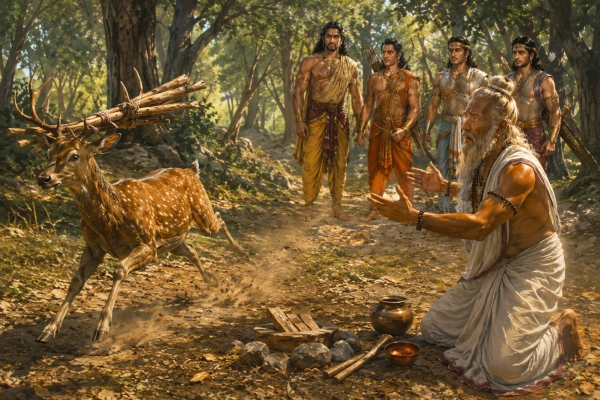
Near the end of their long forest exile, the Pandavas were approached by a distressed Brahmin whose sacred fire-making sticks had been carried away by a deer. What appeared to be a simple request soon drew Yudhishthira, Bhima, Arjuna, Nakula and Sahadeva deep into the wilderness, where a mysterious lake and an unseen guardian waited to test them.
A Brahmin Comes Seeking Help
The twelve years of forest exile were nearing their conclusion when a Brahmin hurried towards the Pandavas with an unusual problem. He explained that the wooden implements used to kindle his sacred fire had been hanging near a tree when a deer came rubbing its antlers against the trunk.
The sticks became caught in the animal’s antlers, startling the deer and causing it to flee into the forest. Without those wooden fire-making implements, the Brahmin could not properly perform his daily sacred rites, and he therefore begged the Pandavas to recover them.
Yudhishthira immediately understood the importance of the request. Although the five brothers themselves were exiles without kingdom or palace, they had never abandoned their duty to protect those who came seeking their help.
The Pandavas gathered their bows and followed the animal’s trail. None of them imagined that the apparently ordinary deer was leading them towards one of the most profound tests of Dharma in the entire Mahabharata.
The Deer Leads Them Deeper Into the Forest
At first, the pursuit seemed simple. The Pandavas were experienced warriors and hunters, and surely five men of such extraordinary ability could overtake a single deer.
Yet whenever they seemed about to catch it, the animal bounded farther away. It slipped through trees, disappeared behind thick undergrowth and reappeared briefly in the distance before racing deeper into the wilderness.
Arjuna tried to bring the deer within range of his bow, while Bhima used his tremendous endurance to continue the pursuit. Nakula and Sahadeva followed the tracks carefully, but somehow the mysterious animal remained beyond their reach.
The farther they went, the stranger the chase became. The deer appeared almost to be deliberately drawing them away from familiar paths and into increasingly remote parts of the forest.
The Great Warriors Fail to Catch One Deer
Eventually, even the Pandavas began to feel the strain of the pursuit. The heat of the day grew stronger, their breathing became heavy, and thirst began to trouble them.
They had fought mighty warriors, Rakshasas and dangerous creatures, yet they had been unable to capture one deer. The absurdity of the situation did not escape them, and the brothers began wondering why fortune continued to test them in such unexpected ways.
At last, the deer disappeared completely among the trees. The Pandavas could no longer see its tracks clearly, and the sacred fire sticks remained lost somewhere in the wilderness.
Exhausted, the brothers stopped beneath the shade of a large tree. Their immediate concern was no longer the deer but the terrible thirst created by the long chase.
Yudhishthira Sends Nakula to Find Water
Yudhishthira asked Nakula to climb a tree and look across the surrounding countryside for signs of water. Nakula climbed high among the branches and noticed vegetation and birds that suggested a lake or pool might be nearby.
Yudhishthira therefore asked him to go in that direction and bring water for everyone. Nakula descended from the tree and quickly disappeared into the forest.
After some time, he reached a beautiful lake surrounded by trees and lush vegetation. The clear water glimmered invitingly before him, and his thirst became almost impossible to resist.
Just as Nakula approached the water, a mysterious voice warned him not to drink. The unseen speaker declared that the lake belonged to it and that Nakula must first answer its questions before touching the water.
Nakula was extremely thirsty and could see no visible creature capable of threatening him. Believing the warning could be ignored, he bent down and drank from the lake.
Within moments, Nakula collapsed beside the water and lay motionless.
Sahadeva Follows His Brother
Back beneath the tree, Yudhishthira became concerned when Nakula failed to return. He then asked Sahadeva to follow his brother and bring back both Nakula and the water they desperately needed.
Sahadeva soon reached the same beautiful lake. There he discovered Nakula lying motionless upon the ground, and the sight of his twin brother in such a condition filled him with shock.
Before Sahadeva could drink, the mysterious voice spoke again. It warned him that Nakula had ignored its command and that the same fate would befall him unless he first answered the questions of the lake’s guardian.
Sahadeva was tormented by thirst and perhaps believed that no invisible voice could truly threaten him. He ignored the warning, drank the water and immediately collapsed beside Nakula.
Arjuna Comes to the Lake
When neither Nakula nor Sahadeva returned, Yudhishthira realised that something serious had happened. He sent Arjuna, one of the greatest warriors of the age, to discover what had become of his younger brothers.
Arjuna followed their path until he reached the lake. There he saw Nakula and Sahadeva lying motionless, yet no enemy stood nearby and no signs of battle could explain what had happened.
The mysterious voice warned Arjuna that the lake was protected and that he must answer its questions before drinking. Arjuna, angered by the unseen challenge, demanded that the hidden being reveal itself.
He prepared himself to confront whatever power had struck down his brothers. Yet the voice remained unseen, and Arjuna’s growing thirst finally overcame his caution.
He drank from the water and fell beside Nakula and Sahadeva. The warrior who had mastered divine weapons now lay helpless before a power that could not be defeated by arrows.
Bhima Goes in Search of the Others
When Arjuna also failed to return, Yudhishthira sent Bhima to investigate. If strength could overcome whatever danger waited near the water, there was scarcely anyone in Bharata more suited to the task.
Bhima moved swiftly through the forest until he found the lake. There he saw Arjuna, Nakula and Sahadeva lying motionless together, and anger immediately rose within him.
No ordinary warrior could have defeated all three without leaving visible signs of battle. Bhima searched for an enemy, but the peaceful lake and surrounding forest revealed nothing.
Then the mysterious voice addressed him. It warned Bhima that his brothers had ignored its command and that he too would fall if he drank without first answering its questions.
Bhima was exhausted and intensely thirsty. Trusting in his immense strength, he disregarded the warning and drank.
He too collapsed beside the lake. Four sons of Pandu now lay motionless along the water’s edge.
Yudhishthira Finds His Brothers
Yudhishthira waited for Bhima, but he too did not return. The eldest Pandava now understood that something extraordinary had happened and decided to follow the path himself.
After travelling through the forest, he arrived at the lake. What he saw there filled him with profound grief.
Bhima, whose strength could shake warriors with fear, lay still. Arjuna, master of the Gandiva and celestial weapons, had fallen beside him, while Nakula and Sahadeva also appeared lifeless.
Yudhishthira examined the scene carefully. There were no obvious wounds, no signs of combat and no enemy standing nearby.
The calm waters of the lake appeared beautiful, but the still bodies of his brothers revealed that some terrible power guarded the place.
The Mysterious Voice Speaks
As Yudhishthira approached the water, the same mysterious voice warned him not to drink. It explained that his brothers had ignored its command and had therefore suffered the consequences.
The unseen being told Yudhishthira that he too must answer a series of questions before being allowed to drink. If he ignored the command, he would share the fate of his brothers.
Yudhishthira’s response was very different from theirs. Although grief overwhelmed him and thirst burned within him, he did not rush towards the water.
He stopped and listened.
Instead of challenging the mysterious presence with weapons, Yudhishthira asked who it was and what power it possessed. He understood that no ordinary creature could have brought down Bhima and Arjuna without a visible struggle.
The Crane at the Lake
The mysterious guardian appeared in the form of a crane associated with the lake. Yet Yudhishthira quickly realised that an ordinary bird could never have defeated four of the greatest warriors of the age.
The crane was only an outward form. Behind it stood a powerful Yaksha, a supernatural being who had deliberately brought the Pandavas to this place.
The Yaksha declared that the lake belonged to him and repeated that Yudhishthira could drink only after answering his questions. The eldest Pandava accepted the condition.
At that moment, the story ceased to be about a hunt or even about thirst. It became a test of wisdom, restraint and Dharma.
Strength and Weapons Had Failed
The four younger Pandavas had each relied, consciously or unconsciously, upon the qualities for which they were famous. Arjuna possessed extraordinary skill, Bhima possessed unmatched physical power, while Nakula and Sahadeva were intelligent and highly trained warriors.
Yet none of those qualities had saved them.
The lake could not be conquered with arrows. It could not be subdued by physical strength or forced into submission through royal authority.
Yudhishthira succeeded where his brothers had failed because he first accepted that the situation required understanding rather than force. His willingness to pause, listen and respect the unseen guardian became the first answer to a test that had not yet formally begun.
The Deer Was Never an Ordinary Animal
Only later would the truth about the mysterious deer become clear. After Yudhishthira successfully answered the Yaksha’s celebrated questions and demonstrated his understanding of Dharma, the Yaksha granted him boons.
Even after undergoing such an extraordinary ordeal, Yudhishthira remembered the Brahmin whose fire sticks had been lost. He asked that the sacred rites of the Brahmin should not be interrupted and that the missing fire-making implements should be recovered.
The Yaksha then revealed the secret behind everything that had happened. He himself had taken the form of the deer and deliberately carried away the Brahmin’s fire sticks.
The deer had never simply escaped the Pandavas. It had been leading them towards the lake from the very beginning.
The Hunt Was Actually a Test
Suddenly, the entire day’s events acquired a different meaning. The impossible pursuit, the exhaustion, the thirst and the strange lake had all formed parts of one carefully arranged trial.
The deer had drawn the Pandavas away from familiar surroundings. Their physical strength had been exhausted, and their thirst had placed their self-control under pressure.
One by one, Nakula, Sahadeva, Arjuna and Bhima had acted before understanding. Yudhishthira alone stopped long enough to recognise that something greater than ordinary danger stood before him.
The deer therefore served as the first movement in the celebrated Yaksha Prashna, one of the great philosophical episodes of the Mahabharata.
From Sacred Fire to Sacred Knowledge
The structure of the episode carries a beautiful symbolism. It begins with a Brahmin attempting to preserve his sacred fire and ends with Yudhishthira being questioned about the deepest truths of human existence.
The Pandavas first seek fire sticks, then desperately seek water, and finally encounter knowledge. What begins as an act of service becomes a spiritual examination.
Yudhishthira did not enter the forest seeking wisdom from a supernatural teacher. He was simply trying to fulfil a promise made to a Brahmin.
That is one of the Mahabharata’s recurring lessons. Dharma often appears not as a grand proclamation but as an ordinary duty faithfully undertaken.
The Failure of Impulse
The lake also reveals something important about human nature. Nakula, Sahadeva, Arjuna and Bhima were not foolish men, but unbearable thirst narrowed their attention until the water before them became more important than the warning they had heard.
Each brother acted first and considered the consequences too late. Their extraordinary abilities could not protect them from a moment of impatience.
Yudhishthira experienced the same thirst and an even greater emotional burden because he believed his brothers might be dead. Yet he still preserved enough control to stop himself from repeating their mistake.
His wisdom therefore began not with a clever answer but with restraint.
Why Yudhishthira Was Chosen
The coming questions would examine Yudhishthira’s understanding of truth, duty, mortality, happiness, knowledge and human conduct. Yet the Yaksha had already begun judging him before asking the first question.
Could a man remain thoughtful when exhausted?
Could a brother remain disciplined when confronted with terrible grief?
Could a king respect a command when there was no visible army to enforce it?
Yudhishthira answered all three questions through his behaviour. He listened when others had ignored.
That quality made him ready for the deeper examination that followed.
The Deer That Opened the Door to the Yaksha Prashna
The strange deer appears only briefly compared with the long conversation that follows, yet it is essential to the episode. Without the deer, there would have been no pursuit, no desperate thirst and no encounter at the lake.
What looked like an insignificant forest incident became the doorway to one of the Mahabharata’s most memorable teachings. A pair of wooden fire sticks carried on the antlers of a deer ultimately led Yudhishthira into a direct examination of Dharma.
The forest around him was quiet. His four brothers lay motionless near the water, and the mysterious crane waited beside the lake.
Yudhishthira stood alone before the Yaksha.
The hunt was over.
The questions were about to begin.
The Deeper Lesson
The story of the deer and the fire sticks reminds us that strength does not always provide the correct answer. Bhima’s power and Arjuna’s weapons were useless because the challenge before them required patience rather than force.
It also teaches that urgency can become dangerous when it destroys judgment. The younger brothers saw water and responded immediately, while Yudhishthira recognised that the warning itself had to be understood before action could be taken.
Most importantly, the episode shows how Dharma can hide behind ordinary circumstances. The Pandavas believed they were helping a Brahmin recover two pieces of sacred wood, but every step of that duty was leading Yudhishthira towards a far greater encounter.
The deer had carried away the fire sticks.
The Pandavas had followed.
And waiting beside a silent forest lake was Dharma itself, ready to ask its questions.
You may also like
-
Indian Physicist Ashoke Sen Becomes First Indian to Receive Prestigious Oskar Klein Medal
-
Indian Army’s Northern Command Opens 75-Day Defence Technology Internship Programme for Young Innovators
-
Ayush Patent Filings Rise Eightfold as India Records 4,077 Applications and 711 Grants in 12 Years
-
DRDO Announces Paid Research Internships at Gwalior for Science and Engineering Students
-
PM-SETU: Government Approves ₹1,194.92 Crore to Modernise 25 ITIs Across Maharashtra, Odisha and Jammu & Kashmir
