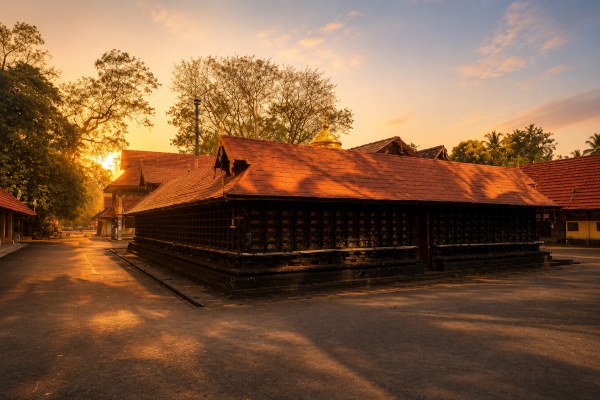
Thakazhi Sree Dharmasastha Temple, situated near Ambalappuzha in Kerala’s Alappuzha district, is one of those temples where the sacred geography of Kuttanad meets the old ritual world of Kerala. Dedicated to Lord Dharmasastha, widely worshipped in Kerala as Lord Ayyappa, the temple carries a quiet but powerful identity: it is not merely a local shrine, but a place connected with flood legend, Parasurama tradition, Kalamezhuthu ritual art, medicinal oil offering, and the old cultural landscape of the Chempakassery kingdom. Kerala Tourism describes it as a temple near Ambalappuzha dedicated to Lord Ayyappa, with an annual eight-day festival in the Malayalam month of Kumbham ending in the arattu procession.
The temple stands in Thakazhi, a name that immediately evokes two different worlds of Kerala memory. One is the sacred world of Sastha worship, temple lamps, oil offerings, festival drums and ritual floor drawings. The other is the literary world of Thakazhi Sivasankara Pillai, the great Malayalam novelist who gave Kuttanad’s farmers, labourers, fishermen and ordinary families a permanent place in modern Indian literature. The village itself belongs to the watery cultural zone of Alappuzha, where paddy fields, canals, temples, boat routes, agrarian memory and devotional practices exist side by side. This makes Thakazhi Sree Dharmasastha Temple more than a standalone shrine; it is part of a wider Kuttanad civilisation where faith grew close to water, soil and seasonal rhythm.
The presiding deity is Lord Dharmasastha, or Ayyappa, worshipped here in an east-facing sanctum. Several local and public temple accounts associate the shrine with the larger network of Sastha temples in Kerala, with one tradition placing it among the important Ayyappa shrines linked to the Parasurama consecration tradition. Temple tradition says that the idol was originally installed on Othara or Otharamala by Lord Parasurama, but during heavy floods, the idol became dislodged and drifted away, eventually reaching the region of Thakazhi. The story then brings in Vilwamangalam Swamiyar, one of Kerala’s most famous saintly figures in temple legends, who is said to have noticed a divine radiance and identified the sacred idol. A local Odiyan figure also appears in versions of the legend, helping in the recovery and ritual reinstallation of the murti. Later, the Chempakassery ruler is believed to have built the temple.
This flood legend is important because it fits the geography of Thakazhi perfectly. Kuttanad is a land shaped by water: floods, canals, paddy fields, bunds, boats and monsoon cycles are part of its cultural DNA. A deity arriving through floodwater is not merely a miraculous episode; it is a sacred explanation of how the divine entered a landscape where water has always been both danger and blessing. In many Kerala temple legends, the deity is discovered in forests, rivers, ponds, anthills or fields. At Thakazhi, the image of Sastha emerging from flood and clay gives the temple a deeply local identity.
Another beautiful tradition connects the very name “Thakazhi” with the act of touching or cleaning the recovered murti. One account says the idol was found in clay and purified by hand, linking the name with “thazhukal,” or the act of gently touching/cleaning. Whether taken as etymology or devotional folklore, the image is powerful.
The temple’s architecture follows the familiar grammar of Kerala temple design: sloping tiled roofs, a compact sacred core, dark wooden or laterite-toned surfaces, shaded courtyards and a devotional atmosphere shaped by lamps rather than excessive ornamentation. Unlike towering Dravidian gopurams of Tamil Nadu, many Kerala temples are inward-looking and climate-conscious, built to receive monsoon rain, hold ritual silence and preserve the sanctity of the sreekovil. The shrine does not try to overwhelm the devotee through scale; it draws the devotee inward through atmosphere.
One of the temple’s most distinctive ritual associations is Kalamezhuthu Pattu. Kerala Tourism notes that this ritual floor-art tradition is conducted here and is popular among devotees. In Kalamezhuthu, sacred figures are drawn on the floor using natural coloured powders, usually accompanied by devotional singing, percussion and ritual performance. It is a temporary sacred image created through colour, rhythm and mantra, and then ritually dissolved. This gives the temple a connection to Kerala’s older ritual-art world, where devotion is not limited to stone idols and lamps but expands into song, colour, gesture and community participation.
The temple is also famous for Valiyenna, literally “great oil,” a special offering associated with healing belief. Kerala Tourism mentions Valiyenna as a notable offering believed by devotees to possess curative power, while other temple accounts describe it as medicinal oil used by devotees especially for body pain and limb pain. This must be understood in its proper devotional context: Valiyenna is part of temple faith and traditional belief, not a substitute for medical treatment. Its importance lies in the way Kerala temples often became centres of ritual healing, where Ayurveda, folk medicine, prayer, vow and prasadam culture overlapped. In older Kerala society, temples were not only places of worship; they were also social institutions where people brought anxieties about illness, fertility, family welfare, fear, misfortune and recovery.
The main annual festival takes place in the Malayalam month of Kumbham, roughly between mid-February and mid-March. Kerala Tourism records that the eight-day festival begins on the Uthram star day and concludes with arattu, the ceremonial holy bath procession. The festival transforms the temple from a quiet village shrine into a centre of sound, movement and shared devotion. The rhythm of the festival is typically Kerala in spirit: kodiyettu, special poojas, lamps, processions, percussion, devotional gatherings, cultural programmes and the final arattu that symbolically renews the sacred energy of the deity and the community.
Pallivetta and arattu are especially meaningful in Sastha worship. Pallivetta, the symbolic royal hunt of the deity, represents the destruction of negative forces and the restoration of cosmic order. Arattu, the sacred bath, marks purification and completion. In Kerala’s temple festival culture, these are not isolated rituals; they dramatise the movement of the deity from sanctum to landscape. The god steps out, the village gathers, music fills the air, and sacred power is taken beyond the temple walls. This is why festivals in Kerala are also civic events. They bind families, local committees, artists, priests, elephants, musicians, devotees, traders and travellers into one temporary sacred republic.
Thakazhi Sree Dharmasastha Temple also gains cultural depth from its proximity to Ambalappuzha, one of Kerala’s most beloved temple towns. Ambalappuzha is famous for the Sree Krishna Temple and its ritual culture, while Thakazhi represents the Sastha tradition within the same regional belt. For a pilgrim or heritage traveller, this makes the area especially rewarding. One can experience Krishna devotion at Ambalappuzha, Sastha worship at Thakazhi, Kuttanad’s paddy landscape, Alappuzha’s waterways and the literary memory of Thakazhi Sivasankara Pillai within a relatively compact cultural circuit. Kerala Tourism notes the Thakazhi Museum and Smritimandapam as a memorial to the Jnanpith-winning writer, whose work includes 35 novels and 600 short stories.
The temple’s old-world atmosphere is its biggest strength. It retains the feeling of a village temple with a strong inherited identity. The devotee comes here for the calm authority of Sastha, the memory of legends, the trust in traditional offerings, and the feeling that the deity belongs deeply to the soil of the place. This is the kind of shrine that explains why Kerala’s temple culture cannot be understood only through famous names like Sabarimala, Guruvayur or Padmanabhaswamy Temple. Much of Kerala’s sacred life survives in smaller temples like Thakazhi, where local history and living worship continue without needing grand publicity.
For visitors, Thakazhi is accessible from Ambalappuzha and Alappuzha by road, and the temple is commonly described as being around six to six-and-a-half kilometres from Ambalappuzha. Public temple listings also note nearby rail access through Ambalappuzha or Thakazhi, while Cochin International Airport serves as the major airport gateway for travellers from outside Kerala.
Thakazhi Sree Dharmasastha Temple deserves attention because it represents a complete Kerala temple experience in a compact form: Sastha worship, Parasurama-linked legend, flood memory, Chempakassery-era tradition, Kalamezhuthu Pattu, Valiyenna offering, Kumbham festival and the cultural landscape of Kuttanad.
You may also like
-
Kuntala in the Mahabharata: The Ancient Country of Northern Karnataka and Southern Maharashtra
-
Ashmaka or Assaka in the Mahabharata: The Ancient Kingdom of the Godavari Valley
-
Rare Stone Features Emerge as Kerala Archaeology Department Restores Megalithic Kudakkals at Karivellur
-
Vidarbha in the Mahabharata: The Ancient Kingdom of Damayanti in Eastern Maharashtra
-
Abhira in the Mahabharata: The Pastoral People of Western India and the Northern Deccan
