
The Technology Development Board, under the Department of Science and Technology, has signed an agreement with Nagpur-based Multi Nano Sense Technologies Private Limited to provide ₹37.51 crore in financial support for the development of an indigenous multi-gas sensing platform.
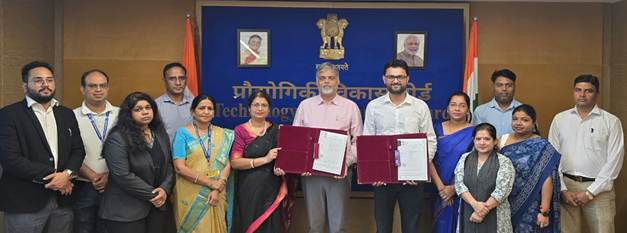
The project has a total approved cost of ₹75.02 crore and will be supported under the Research Development and Innovation Fund through Optionally Convertible Debt. The programme is aimed at advancing the company’s MEMS-based gas sensing and semiconductor platform from Technology Readiness Level 4 to Technology Readiness Level 9, taking it from the development stage towards a market-ready and scalable system.
Indigenous MEMS and Semiconductor Platform
Multi Nano Sense is developing a Platform MEMS + AFE SoC Multi-Gas Sensor that combines a micro-electromechanical gas sensing element with a custom analogue front-end system-on-chip.
The company’s approach brings together a MEMS TCDIR gas sensor and CMOS AFE SoC architecture for signal acquisition, processing and interpretation. The platform is intended to provide compact, low-power and scalable multi-gas sensing for industrial and embedded applications.
By integrating the sensor element and signal-processing electronics within a compact architecture, the project seeks to reduce dependence on imported sensing technologies while building domestic capability in MEMS, semiconductor electronics and intelligent sensing systems.
Applications Across Industrial Safety and Energy
The proposed platform is being designed for a wide range of applications where rapid and reliable gas detection is essential. These include leak detection, process control, health and safety monitoring and industrial condition monitoring.
Potential sectors include refineries, petrochemicals, power generation, piped natural gas infrastructure, battery systems, industrial safety and the emerging hydrogen economy. These applications increasingly require sensors capable of detecting multiple gases with high sensitivity while operating reliably in harsh industrial environments.
The technology could also support future deployment in battery-operated devices, compact monitoring systems and embedded industrial equipment where space, power consumption and response time are critical.
Target Response Time Below 200 Milliseconds
The multi-gas sensor platform is being developed with a target response time of less than 200 milliseconds, allowing rapid detection in applications where delayed sensing could affect safety or process performance.
The system is also being designed for operation across a wide temperature range and under demanding environmental conditions. Features under development include automatic calibration, environmental compensation and software-based gas-library processing.
The sensor package is targeted to measure less than 25 mm × 25 mm × 15 mm, making the platform suitable for compact installations and integrated electronic systems.
Moving From TRL-4 to TRL-9
The TDB-backed programme will support further development, system integration, testing, validation and scale-up of the MEMS gas sensor and AFE SoC platform.
Advancing from TRL-4 to TRL-9 represents a major transition from laboratory validation towards a fully proven system suitable for commercial deployment. The programme will therefore focus not only on improving the underlying technology but also on validating its reliability, manufacturability and scalability under real-world operating conditions.
This stage is particularly important for Indian deep-tech companies working in hardware-intensive sectors, where advanced technologies often require extended development cycles before they can reach industrial-scale production.
Strengthening India’s Sensor and Semiconductor Capability
The project falls under the Deep Technology sector and combines several strategic technology areas, including MEMS fabrication, semiconductor electronics and intelligent sensor processing.
Sensors form the foundation of many modern industrial, energy, mobility and automation systems. Building indigenous capability in this field can support greater technological self-reliance while also creating opportunities for Indian companies to participate in high-value semiconductor and advanced electronics supply chains.
The development of a domestic MEMS-based multi-gas sensing platform also aligns with India’s broader push to expand capabilities in semiconductor design, electronic systems and advanced manufacturing.
RDI Fund Supporting Commercialisation of Deep-Tech Innovation
TDB Secretary Rajesh Kumar Pathak said indigenous sensing and semiconductor technologies are important for both industrial competitiveness and strategic self-reliance. He noted that the RDI Fund is designed to support technologies requiring sustained development before widespread commercial deployment becomes possible.
Multi Nano Sense said the TDB support will allow the company to accelerate integration, validation and scale-up of its gas-sensing platform. The company is targeting a compact, low-power and scalable system capable of meeting demanding requirements across multiple industrial sectors.
With the programme now moving towards full-scale development and validation, Multi Nano Sense is positioned to contribute to India’s growing ecosystem in MEMS, semiconductor electronics and advanced sensing. The transition towards TRL-9 will also help establish a domestic technology platform that can support industrial safety, energy infrastructure and emerging hydrogen applications.
References
Press Information Bureau, Government of India — “TDB signs agreement with Multi Nano Sense Technologies for ₹37.51 crore RDI support to build indigenous multi-gas sensing platform,” September 29, 2026.
Technology Development Board, Department of Science and Technology, Government of India.
Multi Nano Sense Technologies Private Limited.
You may also like
-
India to Track Challenges Faced by Women Entrepreneurs in New National Business Survey
-
India Updates Vehicle Rules to Strengthen E85 and E100 Flex-Fuel Technology
-
Bengaluru Startup Paar Autonomy Develops AI-Powered Drone Systems for GPS-Denied Environments
-
Adani Green Energy Expands Battery Storage to 6.63 GWh at Khavda, Strengthening India’s Renewable Power Infrastructure
-
Sigma Advanced Systems Secures Fresh ₹973 Crore NATO Artillery Ammunition Order
