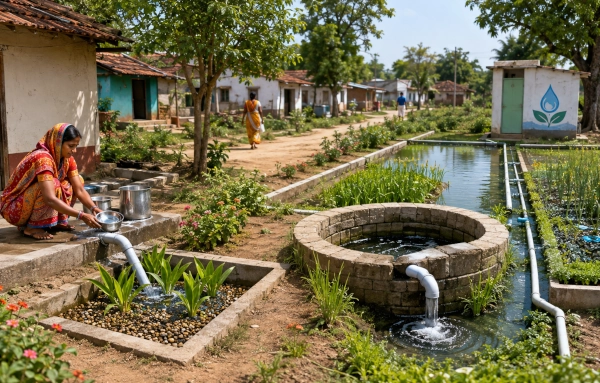
India has expanded rural wastewater management substantially under the second phase of the Swachh Bharat Mission (Grameen), with more than 5.63 lakh villages now reporting Liquid Waste Management arrangements.
According to information provided by the Ministry of Jal Shakti in Parliament, 5,63,809 of India’s 5,86,944 villages had been covered by Liquid Waste Management arrangements as of August 7, 2026. The figures are based on information uploaded by States and Union Territories to the SBM(G) Integrated Management Information System.
From ODF Villages to Sustainable Rural Sanitation
Swachh Bharat Mission (Grameen) Phase II was launched on April 1, 2020, building upon the Open Defecation Free achievements of the first phase.
The programme focuses on maintaining ODF status while expanding Solid and Liquid Waste Management, greywater treatment and visual cleanliness. The broader objective is to help rural settlements progress towards the ODF Plus Model category.
Greywater generated from kitchens, bathing and washing can become a sanitation and environmental problem when allowed to stagnate around homes and streets. SBM(G) Phase II therefore encourages villages to manage such wastewater locally rather than allowing untreated water to accumulate.
More Than 42.98 Lakh Community Greywater Assets Reported
States and Union Territories have reported the creation of 42,98,194 community Greywater Management assets under the programme.
These include:
- 25,50,998 community soak pits, leach pits and magic pits
- 14,77,238 drainage facilities
- 8,63,233 termination points
- 2,69,958 community Greywater Management systems, including vertical filters, horizontal filters and soil biotechnology systems
The figures represent assets reported by States and Union Territories on the SBM(G) monitoring platform.
Uttar Pradesh reported particularly large numbers of community infrastructure, including 4,11,424 community soak or leach pits and 6,12,329 drainage facilities. Rajasthan reported more than 2.75 lakh community soak pits, while Odisha and West Bengal each reported more than 2.7 lakh such facilities.
Villages Can Adopt Different Greywater Solutions
The programme does not prescribe a single wastewater treatment system for every village. Instead, local governments can select technologies according to population, settlement pattern, soil conditions, available land and local requirements.
At the household level, interventions can include soak pits, leach pits, magic pits and kitchen gardens that allow relatively small quantities of greywater to be treated or reused close to where they are generated.
Larger settlements can adopt community-level systems such as Waste Stabilisation Ponds, Constructed Wetlands, Decentralised Wastewater Treatment Systems (DEWATS) and Phytorid Technology.
This decentralised approach is intended to make rural wastewater treatment more practical and affordable while reducing stagnation and improving cleanliness.
Financial Assistance for Greywater Management
The Centre provides financial and technical assistance to States and Union Territories through the Department of Drinking Water and Sanitation.
Under SBM(G) Phase II, Greywater Management can receive financial support of up to ₹280 per person for villages with populations of up to 5,000.
For villages with populations above 5,000, assistance can reach ₹660 per person.
Annual allocations depend on approved State and Union Territory implementation plans, previous performance and the availability of budgetary resources.
SBM(G) resources can also be combined with funding from Finance Commission grants to Rural Local Bodies, employment programmes, other Central and State schemes, Corporate Social Responsibility funds, MPLADS and MLALADS, along with locally developed revenue-generating models.
Greater Role for Gram Panchayats
The Ministry of Jal Shakti has also issued operational guidelines, technical manuals and Standard Operating Procedures to strengthen the capacity of Gram Panchayats.
Awareness campaigns and training programmes form an important part of the initiative because infrastructure alone cannot ensure effective wastewater management. Community participation is required to maintain drains, treatment systems and household-level facilities and to prevent wastewater from stagnating in public spaces.
The expansion of Greywater Management therefore represents the next stage of India’s rural sanitation programme. After concentrating initially on eliminating open defecation, SBM(G) Phase II is increasingly addressing the wider sanitation chain by managing wastewater, maintaining cleanliness and creating more sustainable village environments.
The information was provided by Minister of State for Jal Shakti V. Somanna in a written reply in the Lok Sabha on August 13, 2026.
Source
Ministry of Jal Shakti, Government of India — Parliamentary reply, August 13, 2026.
You may also like
-
India’s Recent Oil and Gas Discoveries: New Finds, Offshore Frontiers and How Much Crude India Produces at Home
-
India’s Hidden Gold Mountain: How Households Came to Own an Estimated 31,000 Tonnes of Gold
-
India–Afghanistan Air Cargo Corridor Returns to Focus as Both Sides Push for Stronger Trade Connectivity
-
India’s Defence Shipyards Build Common Indigenous Supply Chain for Specialised Naval Cables
-
Maruti Suzuki Commissions 300 kW Green Hydrogen Plant at Manesar to Cut Manufacturing Emissions
%20Phase%20II)