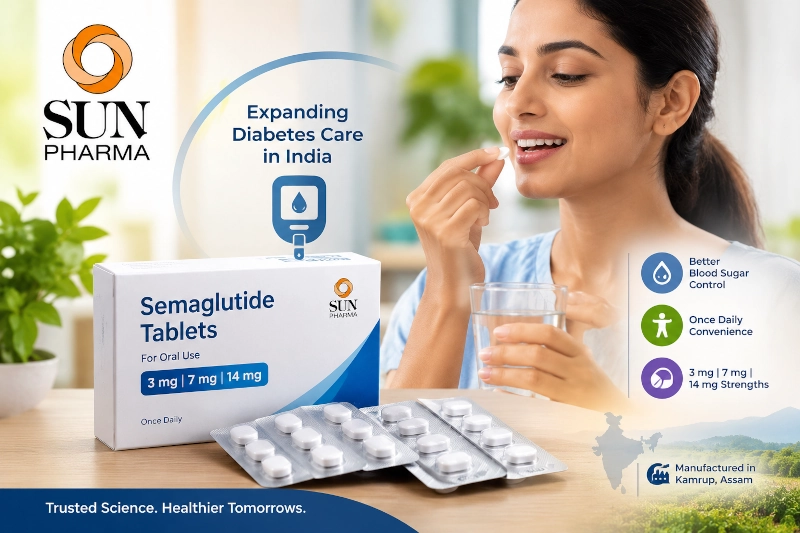
Indian pharmaceutical major Sun Pharmaceutical Industries Limited has reportedly secured regulatory approval to manufacture and market generic oral semaglutide tablets in India, marking another development in the country’s rapidly expanding market for glucagon-like peptide-1 (GLP-1) medicines used in diabetes management.
According to pharmaceutical industry reporting published on 31 October 2026, the Central Drugs Standard Control Organisation (CDSCO) has granted permission for the manufacture and marketing of semaglutide tablets in three strengths: 3 mg, 7 mg and 14 mg. The once-daily oral medicine is intended for the treatment of adults with type 2 diabetes mellitus.
The development could expand Sun Pharma’s presence in the GLP-1 pharmaceutical segment, where Indian manufacturers are increasingly introducing alternatives to branded medicines originally developed by international pharmaceutical companies.
The proposed tablets are therapeutically comparable to Novo Nordisk’s Rybelsus, an oral semaglutide medicine used to improve glycaemic control in adults with type 2 diabetes.
The reported regulatory approval represents progress for Sun Pharma’s oral diabetes treatment portfolio, although the company has not yet announced a commercial launch date for the new formulation.
Manufacturing Planned at Sun Pharma’s Assam Facility
According to the report, Sun Pharma’s generic oral semaglutide tablets are expected to be manufactured at the company’s pharmaceutical manufacturing facility in Kamrup district, Assam.
The formulation is described as a recombinant DNA-origin product, while the active pharmaceutical ingredient will be sourced from Hangzhou Zhongmeihuadong Pharmaceutical in China.
The arrangement illustrates the international supply chains involved in manufacturing certain advanced pharmaceutical products, even when the finished medicines are produced domestically.
Pharmaceutical manufacturing of oral semaglutide requires specialised formulation technology because semaglutide is a peptide-based medicine that faces challenges associated with absorption through the gastrointestinal tract.
Unlike conventional small-molecule tablets, oral peptide medicines must overcome degradation and absorption barriers before sufficient quantities of the active ingredient can enter the bloodstream.
These technical requirements make oral semaglutide formulations a specialised segment of pharmaceutical manufacturing.
The reported approval would allow Sun Pharma to expand its GLP-1 portfolio into oral formulations, subject to the applicable regulatory and commercial requirements.
Understanding Oral Semaglutide and GLP-1 Medicines
Semaglutide belongs to a class of medicines known as GLP-1 receptor agonists. These medicines mimic the action of glucagon-like peptide-1, a naturally occurring hormone involved in regulating blood glucose levels and appetite.
In people with type 2 diabetes, semaglutide helps improve blood sugar control through several mechanisms, including stimulating glucose-dependent insulin secretion and reducing inappropriate glucagon secretion.
The medicine also slows gastric emptying and influences appetite regulation.
Semaglutide has been developed in both injectable and oral formulations, offering different treatment options depending on the approved indication and the patient’s medical requirements.
Oral semaglutide is particularly significant because it allows eligible patients to receive GLP-1 treatment in tablet form rather than through injections.
However, the oral formulation has specific administration requirements that can influence its effectiveness. Patients must follow the prescribed instructions concerning timing, food intake and other medicines.
Semaglutide is a prescription medicine and may cause adverse effects, including gastrointestinal symptoms. It is not suitable for every patient, and treatment decisions should be made under appropriate medical supervision.
The reported Sun Pharma approval concerns treatment of type 2 diabetes and should not be interpreted as approval of the tablets for weight management unless that indication is separately authorised.
Indian Drugmakers Expand Their Presence in Oral GLP-1 Medicines
Sun Pharma’s reported approval comes amid increasing competition among Indian pharmaceutical manufacturers in the semaglutide market.
The expiration of certain patent protections associated with semaglutide has encouraged domestic manufacturers to develop generic formulations.
However, patent protection for the active pharmaceutical ingredient and the technologies used in specific oral formulations can involve different legal considerations.
While important patent protections associated with semaglutide expired in March 2026, separate patent rights relating to oral formulations have remained relevant to the Indian market.
According to contemporary industry reporting, Torrent Pharmaceuticals introduced generic oral semaglutide products under the Semalix and Sembolic brands following a Delhi High Court ruling concerning its formulation.
Dr. Reddy’s Laboratories subsequently entered the oral semaglutide market with its Obeda brand, offering tablets in strengths of 3 mg, 7 mg and 14 mg.
The entry of multiple pharmaceutical manufacturers is contributing to the development of a more competitive domestic market for oral GLP-1 medicines.
Nevertheless, generic competition does not necessarily mean that all oral semaglutide formulations use identical technologies or that their commercial availability is unaffected by patent and regulatory conditions.
Each product must satisfy applicable regulatory requirements before it can be marketed.
Sun Pharma Builds on Its Existing Semaglutide Portfolio
Sun Pharmaceutical Industries has already established a presence in India’s injectable semaglutide market.
The company markets Noveltreat for weight management and Sematrinity for the treatment of type 2 diabetes, according to contemporary pharmaceutical market reporting.
The addition of an oral formulation could allow Sun Pharma to serve a broader group of patients and prescribing physicians within the GLP-1 treatment segment.
During discussions following the company’s second-quarter financial results for FY2026–27, Sun Pharma Executive Chairman Dilip Shanghvi highlighted the commercial potential of GLP-1 medicines in India’s large diabetes treatment market.
The company’s reported move into oral semaglutide therefore forms part of a broader expansion into a therapeutic segment attracting growing pharmaceutical investment and competition.
However, the commercial performance of Sun Pharma’s proposed oral formulation will depend on factors such as regulatory requirements, pricing, distribution, physician adoption and patient access.
The company has not yet disclosed the brand name, proposed retail price or expected commercial launch schedule for the newly reported tablets.
India’s Expanding GLP-1 Pharmaceutical Market
India’s GLP-1 pharmaceutical market has expanded substantially following the introduction of newer medicines for diabetes and weight management.
According to PharmaTrac estimates cited by ETPharma, the combined market for injectable and oral GLP-1 medicines has grown to approximately ₹2,700 crore, compared with around ₹950 crore in 2025.
The market includes medicines based on semaglutide and other incretin-related therapies, including tirzepatide.
Growing awareness of diabetes management, expanding treatment options and increasing competition among pharmaceutical manufacturers have contributed to greater commercial interest in this therapeutic segment.
India’s substantial burden of type 2 diabetes also creates a significant long-term need for effective and accessible treatment options.
However, the availability of additional medicines does not automatically translate into improved treatment access. Pricing, medical suitability, availability and adherence remain important considerations.
The entry of Indian generic manufacturers may create opportunities for more competitive pricing, although the extent of any price reductions will depend on individual product launches and market conditions.
Regulatory Approval and Commercial Launch Remain Separate Stages
The reported CDSCO permission represents a regulatory development rather than confirmation that Sun Pharma’s oral semaglutide tablets are already available in pharmacies.
Before commercial launch, a pharmaceutical manufacturer must complete the applicable manufacturing, labelling, quality-assurance and distribution requirements.
Patent-related considerations may also influence the timing and commercial conditions of a product’s introduction.
The company has not publicly confirmed a launch date or the proposed pricing of the oral tablets in the reporting examined.
Although CDSCO’s publicly available records establish Sun Pharma’s earlier regulatory activity involving semaglutide tablets, the original final marketing-permission document associated with the latest report has not yet been independently examined.
Accordingly, the latest approval details remain attributed to contemporary pharmaceutical industry reporting.
Strengthening India’s Pharmaceutical Manufacturing Capabilities
The development reflects the increasing participation of Indian pharmaceutical manufacturers in technically demanding medicine categories.
India’s generic pharmaceutical industry has traditionally demonstrated strong capabilities in producing affordable versions of established medicines for domestic and international markets.
The development of peptide-based therapies and specialised oral formulations represents an additional area of technical and commercial interest.
Such products require expertise in formulation science, pharmaceutical processing, quality assurance and regulatory compliance.
Sun Pharma’s reported approval for oral semaglutide highlights the continuing expansion of Indian pharmaceutical companies into more complex therapeutic segments.
The planned manufacture of the finished formulation at its Assam facility would contribute to domestic pharmaceutical production, although the reported sourcing of the active ingredient from China also demonstrates the continuing international integration of pharmaceutical supply chains.
A New Development in India’s Diabetes Treatment Market
Sun Pharma’s reported regulatory approval for generic oral semaglutide tablets represents another development in India’s evolving market for GLP-1 medicines.
The proposed product would add three oral dosage strengths to the company’s diabetes treatment portfolio and potentially broaden its participation in a therapeutic segment experiencing substantial competition.
The development follows the introduction of generic oral semaglutide products by other Indian pharmaceutical manufacturers and reflects growing interest in expanding treatment options for type 2 diabetes.
While the final marketing authorisation requires independent documentary confirmation and a commercial launch date has not been announced, the reported approval indicates further progress in the development of domestically manufactured oral GLP-1 medicines.
The expansion of India’s pharmaceutical capabilities in this segment could contribute to greater product availability and competition, subject to regulatory compliance, patent considerations and appropriate clinical use.
References and Official Sources
Central Drugs Standard Control Organisation (CDSCO): Official regulatory records identify Sun Pharma Laboratories Limited’s semaglutide tablet development programme, including the 3 mg, 7 mg and 14 mg strengths.
ETPharma, 31 October 2026: Sun Pharma Wins CDSCO Nod for Semaglutide Pill. This report provides the latest approval details, including the proposed manufacturing location and active pharmaceutical ingredient supplier.
CDSCO Subject Expert Committee: Endocrinology and Metabolism recommendations concerning semaglutide formulations.
Sun Pharmaceutical Industries Limited: Corporate financial results and announcements concerning its pharmaceutical portfolio.
Editorial verification note: The original final marketing-permission document for the reported 31 October approval has not been independently retrieved. The article therefore attributes the approval to contemporary reporting rather than presenting it as separately authenticated.
You may also like
-
India Relaxes Imported Medicine Shelf-Life Rules to Reduce Wastage and Improve Drug Availability
-
India Launches DEPA Framework to Enable Secure AI Training While Protecting Data Sovereignty
-
India’s Startup Ecosystem Expands as Technology Companies Gain Greater Access to Public Capital Markets
-
Reliance Retail Partners with All India Institute of Ayurveda to Develop Ayurveda-Based Skincare Products
-
Goodluck Defence Secures ₹58.20-Crore Domestic Order for 155mm Artillery Shells
