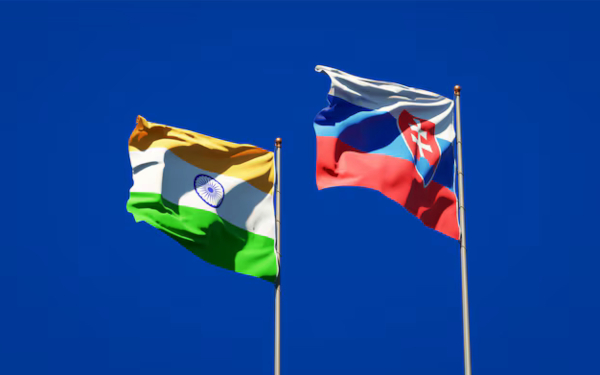
India and Slovakia have opened a new chapter in bilateral relations by elevating their ties to a Comprehensive Partnership during Prime Minister Narendra Modi’s State Visit to Slovakia on 15 June 2026. The visit carries historic weight because it is the first visit by an Indian Prime Minister to Slovakia since the country became independent in 1993. The joint statement describes the relationship as one built on trust, equality, mutual respect and growing cooperation across political, economic, technological, cultural and strategic fields.
The timing of this upgrade is important. Slovakia sits in the heart of Central Europe, with strong industrial capabilities in automobiles, engineering, machinery and advanced manufacturing. India brings scale, talent, a large market, digital strength, space capabilities and an expanding role in global supply chains. By raising the relationship to a Comprehensive Partnership, both countries have created a wider framework for defence, technology, trade, education, health, culture, labour mobility and multilateral cooperation.
A major pillar of the partnership is defence and security cooperation. The two sides welcomed the signing of a Letter of Intent on Defence Cooperation, aimed at encouraging regular consultations between defence authorities and exploring collaboration in defence technologies, capacity building, research and development, and defence industrial cooperation. This gives the relationship a strategic dimension beyond traditional diplomacy and trade.
Counter-terrorism also received clear attention. India and Slovakia condemned terrorism in all forms, including cross-border terrorism, and strongly condemned the Pahalgam terrorist attack in Jammu and Kashmir on 22 April 2025. The two countries agreed to establish a Joint Working Group on Counter-Terrorism, strengthen cooperation at the United Nations, and work toward accountability for terrorists, organisers, sponsors, financiers and supporters of terror networks.
The new partnership also has a strong technology core. India and Slovakia agreed to deepen cooperation in digital technologies, artificial intelligence, semiconductors, start-ups, research institutions, 5G use cases, 6G standardisation, Internet of Things and machine-to-machine applications. The outcomes list also includes an MoU on Digital Technologies and the establishment of the first-ever ICCR Chair in Artificial Intelligence at the Technical University of Košice.
Cybersecurity and quantum-era preparedness form another serious layer of the agreement. The joint statement highlights cooperation in protecting critical information infrastructure, countering cybercrime and preparing for emerging quantum threats to cryptography. The two sides also signed a memorandum in the field of Quantum Communication and Critical Infrastructure Protection, placing India-Slovakia cooperation inside the next generation of digital security.
Economic cooperation is one of the strongest foundations of the relationship. Bilateral trade crossed the US$1 billion mark for the first time in 2024 and reached around US$1.81 billion in 2025, according to data cited by DD News from the Ministry of External Affairs. Indian exports to Slovakia rose from US$419 million in 2021 to US$1.53 billion in 2025, while imports from Slovakia increased from US$165 million to US$284 million during the same period.
The trade profile shows clear industrial logic. India exports automotive components, engineering goods, mobile phones, pharmaceuticals, electrical equipment, garments, footwear and machinery to Slovakia. Slovakia’s exports to India are led by passenger cars, automobile components, machinery, electrical equipment, rubber products, glassware, steel products, ceramics and industrial equipment. This points to a natural fit between India’s manufacturing rise and Slovakia’s deep automotive-industrial ecosystem.
Indian investment has already created a strong footprint in Slovakia. Tata Group’s Jaguar Land Rover plant in Nitra, with an investment of about €1.4 billion, began operations in 2018 and produces the Land Rover Discovery and Defender. Tata AutoComp has also expanded in Slovakia through its acquisition of the Slovak operations of IAC Group, while Tata Consultancy Services has been active in Bratislava since 2017.
Connectivity has been placed at the centre of future cooperation. The two leaders encouraged exploration of direct air connectivity between India and Slovakia to support business, tourism, education and people-to-people exchanges. They also identified automotive and railway sectors as areas for joint ventures, technology transfer, innovation and skills development.
The partnership also moves into green energy and future infrastructure. India and Slovakia agreed to cooperate on net-zero goals, clean energy systems, nuclear energy, geothermal power, water resource management, dam safety and climate-resilient rural drinking water infrastructure. This makes the relationship useful for both industrial growth and sustainability goals.
Education and research received special attention. The two countries welcomed an MoU in higher education and research, an agreement between IIT Delhi and Slovak Technical University for student exchanges, scholarships and research collaboration, and a scientific cooperation agreement between the Indian National Science Academy and the Slovak Academy of Sciences. These agreements can help connect Indian students, researchers and institutions with Slovakia’s academic and industrial ecosystem.
Health cooperation has also entered the agenda. The two sides agreed to maintain regular dialogue in healthcare, with focus on pharmaceutical research and development, digital health solutions and human resources for health. The outcomes list also includes an MoU between the National Institute of Naturopathy, Pune, and Slovak Health Spa Piešťany, showing space for cooperation in traditional wellness and health tourism.
Cultural and people-to-people ties have been given a formal push through an MoU on Audio-visual Creation, tourism cooperation between tour operators, and support for regular cultural exchanges, exhibitions, festivals and tourism flows. Labour mobility is another important part of the visit, with an MoU on cooperation in labour migration and an agreement to work toward an early Social Security Agreement for professionals moving between the two countries.
The larger strategic message is clear. India is strengthening its reach into Central Europe through a partner with industrial depth, EU membership, automotive strength and geographic value. Slovakia is gaining a deeper connection with India’s market, technology base, skilled workforce and growing geopolitical influence. The Comprehensive Partnership gives both countries a structured platform to move from cordial ties to practical cooperation across defence, trade, digital technology, education, energy, mobility and culture.
Source: PIB
You may also like
-
India Hosts 12th BRICS Parliamentary Forum in New Delhi
-
India Strengthens Trade Ties with Netherlands as Piyush Goyal Visits Port of Rotterdam
-
India to Train 600 Nigerian Army Soldiers in Specialised Jungle and Mountain Warfare
-
India and Russia Strengthen Parliamentary Diplomacy as Om Birla Meets State Duma Chairman Vyacheslav Volodin
-
India Seeks South Korean Shipbuilding Partnerships as Sarbananda Sonowal Begins Four-Day Visit to Busan
