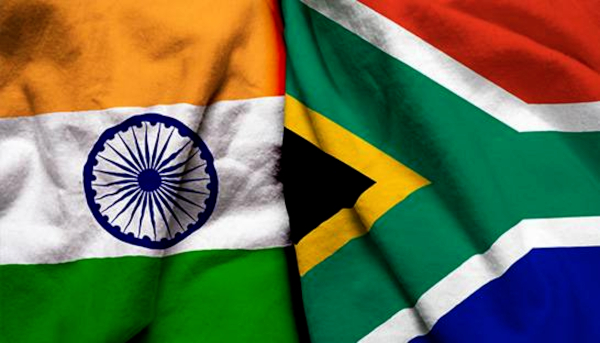
South African Deputy President Paul Mashatile’s working visit to India comes at an important moment in the relationship between New Delhi and Pretoria. The six-day visit is designed to reinforce one of the Global South’s most historically rooted partnerships and give it new energy in areas such as investment, trade, health, small business development, science, technology, digital cooperation and multilateral coordination.
India and South Africa share a relationship that goes far beyond routine diplomacy. The connection carries the memory of anti-colonial struggles, the moral legacy of Mahatma Gandhi’s years in South Africa, the fight against apartheid and a shared commitment to a more balanced global order. Over the decades, this historical bond has matured into a strategic partnership shaped by economic cooperation, people-to-people ties, multilateral engagement and South-South solidarity.
Mashatile’s visit is especially significant because South Africa remains one of India’s most important partners in Africa. Both countries are active members of major international groupings such as BRICS, IBSA, the G20, the Non-Aligned Movement and the Indian Ocean Rim Association. These platforms give the relationship a wider geopolitical meaning. India and South Africa frequently speak for the interests of developing countries, especially on issues such as global governance reform, climate finance, equitable trade, food security, health access and development-oriented multilateralism.
The visit is also taking place in a period when India is intensifying its engagement with Africa. New Delhi has been working to expand trade, investment, digital cooperation, infrastructure partnerships, health collaboration and capacity-building initiatives across the continent. South Africa, with its industrial base, financial depth, mineral resources, strategic ports and diplomatic weight, remains a natural anchor for India’s Africa policy. A stronger India-South Africa partnership can therefore support a broader India-Africa growth corridor.
The economic dimension is one of the most important parts of this visit. Deputy President Mashatile is expected to engage with Indian business leaders and investors through a roundtable discussion aimed at attracting investment and expanding commercial cooperation. This is crucial because both economies have complementary strengths. India brings scale in pharmaceuticals, digital public infrastructure, information technology, automobiles, renewable energy, engineering goods, healthcare services and small business innovation. South Africa offers access to a major African market, strong mining and minerals capacity, advanced financial services, manufacturing potential and a gateway into regional African value chains.
A deeper investment relationship can benefit both sides. Indian companies already have a meaningful presence in South Africa in sectors such as automobiles, pharmaceuticals, banking, IT, hospitality, mining and consumer goods. The next stage can involve joint ventures in electric mobility, green hydrogen, critical minerals, healthcare manufacturing, digital payments, start-up ecosystems, agri-processing and industrial training. South Africa’s development priorities and India’s low-cost innovation capacity can fit together naturally.
The composition of the South African delegation shows the practical direction of the visit. The presence of ministers and deputy ministers responsible for health, small business development, international relations, science and technology, and digital communications indicates that the visit is focused on real sectors rather than ceremonial diplomacy alone. These are areas where India and South Africa can build long-term institutional partnerships.
Health cooperation is one of the strongest opportunities. India is a major global supplier of affordable medicines, vaccines and healthcare solutions. South Africa has a large healthcare system, major public health priorities and a strategic role in African health policy. Cooperation in pharmaceuticals, medical devices, vaccine supply chains, telemedicine, hospital systems and public health training can create benefits for both countries and the wider African region.
Small business development is another promising area. India’s MSME sector has become a major engine of employment, exports and local entrepreneurship. South Africa, which is working to expand inclusive economic growth and support small enterprises, can draw from India’s experience in digital payments, formalisation, public procurement, credit access, marketplace enablement and entrepreneurship training. A structured India-South Africa small business corridor can help women entrepreneurs, youth-led enterprises, local manufacturers and service providers on both sides.
Science, technology and innovation can become a powerful pillar of the partnership. India’s rise in space technology, digital infrastructure, biotechnology, clean energy, weather science, fintech and artificial intelligence aligns with South Africa’s scientific institutions, mineral research base, astronomy capabilities and innovation ambitions. Collaboration in skilling, research exchanges, start-up incubation, satellite applications and climate technology can give the relationship a future-ready character.
Digital cooperation deserves special attention. India’s digital public infrastructure model, including identity-linked services, digital payments, public platforms and inclusive technology systems, has drawn global interest. South Africa’s interest in digital transformation can open space for cooperation in fintech, cybersecurity, digital governance, rural connectivity, public service delivery and start-up ecosystems. Such collaboration can help both countries build technology models suited to developing economies rather than imported frameworks designed for advanced markets.
The visit also carries geopolitical weight. India and South Africa are both strong advocates of a multipolar world. They support a global order where developing countries have a greater voice in decision-making institutions. Both countries have also pushed for reform of global bodies so that Africa, Asia and Latin America receive representation matching their population, economic potential and strategic importance. In this context, the India-South Africa relationship is not only bilateral; it is part of a larger Global South conversation.
BRICS adds another layer to the partnership. As founding members of the grouping, India and South Africa have worked together to widen the space for emerging economies in global finance, trade and development debates. With BRICS expanding and the world economy moving through uncertainty, coordination between New Delhi and Pretoria becomes even more important. Their shared engagement can help shape discussions on development finance, local currency trade, resilient supply chains, technology access and fairer global institutions.
The Indian Ocean also gives the partnership a strategic dimension. South Africa sits at the southern maritime gateway linking the Atlantic and Indian Oceans, while India is a central power in the Indian Ocean region. Maritime security, resilient shipping routes, port connectivity, blue economy development, coastal security and disaster response can become stronger areas of cooperation. As global trade routes face disruption, India and South Africa can work together to support secure and stable maritime corridors.
The visit’s timing is also meaningful because India-Africa trade is entering a new phase. The focus is moving beyond traditional commodity exchange towards value-added manufacturing, technology partnerships, food processing, renewable energy, digital trade and industrial cooperation. South Africa can play a key role in connecting Indian industry with African regional markets, especially as the African Continental Free Trade Area creates new possibilities for integrated supply chains.
People-to-people ties remain the emotional foundation of the relationship. South Africa is home to a large Indian-origin community that has contributed deeply to the country’s politics, economy, culture and public life. This diaspora link gives the partnership warmth and continuity. It also creates natural bridges in education, tourism, culture, business and civil society engagement.
Deputy President Mashatile’s engagements with Indian leaders are expected to further strengthen this broad relationship. Meetings with India’s top leadership and the External Affairs Minister can help align priorities across diplomacy, development, trade and multilateral issues. His visit to Hyderabad also adds a technology and business angle, given the city’s importance in IT, pharmaceuticals, biotechnology and innovation.
The larger message of the visit is clear: India and South Africa are preparing to make their partnership more practical, sector-driven and future-facing. The historical bond remains strong, but the new focus is on investment, technology, health, small businesses, digital systems and Global South leadership. This gives the relationship both memory and momentum.
For India, South Africa is a gateway to Africa, a strategic partner in the Indian Ocean and a respected voice in global diplomacy. For South Africa, India is a major development partner, technology power, healthcare supplier, investment source and influential Global South actor. Together, the two countries can build a partnership that supports inclusive growth, stronger institutions and a more balanced international order.
Mashatile’s visit therefore represents more than a diplomatic itinerary. It is a chance to renew a relationship built on history and reshape it for a new global economy. If both sides convert this engagement into concrete projects, the India-South Africa partnership can become one of the strongest examples of modern South-South cooperation.
Reference:
South African Government — Deputy President Paul Mashatile undertakes Working Visit to the Republic of India, 29 May to 3 Jun — https://www.gov.za/news/media-advisories/government-activities/deputy-president-paul-mashatile-undertakes-working
ANI — South African Dy President arrives in India for 6-day working visit to reinforce, impart fresh impetus to India-SA ties — https://aninews.in/news/world/asia/south-african-dy-president-arrives-in-india-for-6-day-working-visit-to-reinforce-impart-fresh-impetus-to-india-sa-ties20260529190659/
IANS — South African Deputy President Paul Mashatile to arrive in India today — https://ianslive.in/south-african-deputy-president-paul-mashatile-to-arrive-in-india-today–20260529150352
MEA — State Visit of President of South Africa to India, January 2019 — https://www.mea.gov.in/press-releases.htm?dtl/30932/State+Visit+of+President+of+South+Africa+to+India+January+2526+2019
PIB — Curtain Raiser for India-Africa Business Dialogue & Exhibition — https://www.pib.gov.in/PressReleasePage.aspx?PRID=2261202&lang=2®=3
You may also like
-
US Double Standards in Foreign Policy: 16 Recent Cases Involving India, Russia, China and Global Trade
-
Indian Navy Vice Chief Inspects Japan’s Mogami-Class Stealth Frigate as India-Japan Shipbuilding Cooperation Expands
-
INS Trishul Arrives in UK for Exercise KONKAN 2026 as India and Royal Navy Expand Maritime Cooperation
-
INS Sahyadri Arrives in Russia for Exercise INDRA 2026 to Strengthen India-Russia Naval Cooperation
-
India and Qatar Deepen Strategic Partnership with Focus on Energy Security, Trade and West Asia
