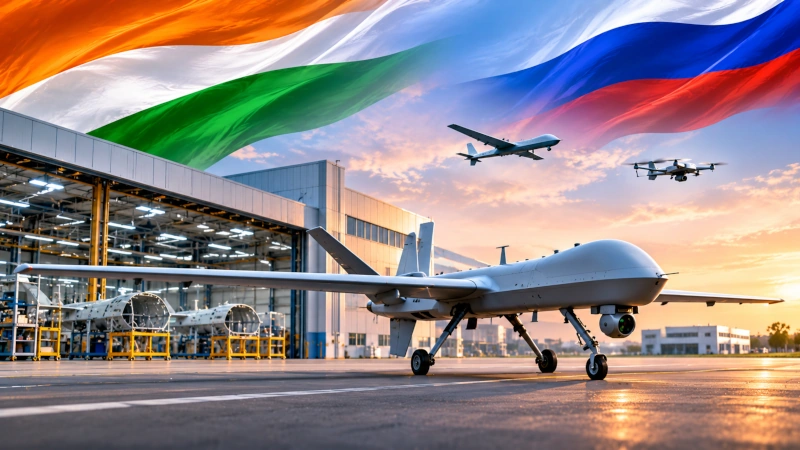
Russia’s Tomsk State University and the Tomsk Region Research and Production Centre for Unmanned Aircraft Systems are preparing to sign an agreement with an Indian partner for the transfer of unmanned aerial vehicle (UAV) manufacturing technologies and the establishment of a drone production facility in India. The proposed cooperation involves transferring a complete package of technological solutions to the Indian side, enabling local manufacturing while providing royalty payments to the Russian institutions involved.
The development was announced by Tomsk State University Rector Eduard Galazhinsky during the Industry Code conference in Russia and reported by Russian news agency TASS on November 11, 2026. According to Galazhinsky, the Indian side has expressed readiness to provide financing for acquiring the technologies and establishing the proposed manufacturing facility. The arrangement is being developed as a technology-transfer partnership rather than a conventional agreement to purchase finished unmanned aircraft.
Russian University and UAV Research Centre Prepare Technology Transfer Agreement
The proposed partnership involves Tomsk State University and the Research and Production Centre for Unmanned Aircraft Systems in Russia’s Tomsk Region. The two organisations intend to provide technological solutions associated with the design and manufacture of unmanned aerial systems to an Indian partner.
According to Galazhinsky, the Indian side is prepared to finance the acquisition of the technology and construction of a UAV manufacturing facility in India. The Russian institutions would transfer the technological package and subsequently receive royalties linked to the sale of the manufactured products.
The proposed arrangement is structured around the transfer of manufacturing knowledge and technological capabilities rather than the direct export of completed drones. This distinction is significant because it envisages the Indian partner establishing its own production operations using technologies developed by the Russian organisations.
The agreement has not yet been signed, and the identity of the Indian partner has not been disclosed. Details concerning the proposed factory’s location, investment value, manufacturing capacity and production schedule also remain unavailable.
Tomsk Research Centre Provides UAV Development and Manufacturing Capabilities
The Research and Production Centre for Unmanned Aircraft Systems in Tomsk is one of Russia’s major facilities dedicated to developing and manufacturing unmanned aircraft technologies. The centre was inaugurated in February 2025 under Russia’s national programme for unmanned aviation systems.
According to TASS, the facility was established with financial support of approximately 2.2 billion roubles from the Russian federal budget and another 700 million roubles from regional authorities.
The centre possesses capabilities covering different stages of unmanned aircraft development, including engineering design, prototype manufacturing, additive manufacturing, assembly and flight testing. These facilities allow researchers and engineers to undertake the development of UAV systems and their associated components within an integrated research and manufacturing environment.
Tomsk Region also operates a special experimental regulatory framework intended to facilitate the testing and development of unmanned aircraft systems. The framework supports research activities and provides an environment for evaluating new technologies and aircraft configurations.
The proposed Indian partnership would involve technologies developed within this Russian unmanned aviation research and manufacturing ecosystem.
Russian Centre Has Developed 50-Kilowatt Drone Motor and Heavy-Lift UAVs
Among the technological achievements reported by the Tomsk Research and Production Centre is the development of a domestically manufactured 50-kilowatt electric motor intended for unmanned aircraft applications.
The centre has also produced a limited series of heavy-duty unmanned aerial vehicles capable of carrying payloads of up to 200 kilograms.
These developments demonstrate the range of technological activities undertaken by the Russian facility, extending from specialised propulsion components to the development and manufacture of complete unmanned aircraft.
The centre’s capabilities also include additive manufacturing, an approach used to produce components through layer-by-layer material deposition. Such technologies form part of modern aerospace manufacturing and can support the development of specialised components and prototype systems.
However, the Russian announcement does not identify which UAV models, propulsion technologies or manufacturing processes would be included in the proposed agreement with India. The 50-kilowatt motor and heavy-lift UAVs are confirmed developments at the Tomsk centre, but their inclusion in the proposed technology-transfer package has not been established.
Tomsk State University Supports UAV Research and Engineering Education
Tomsk State University has established an extensive relationship with the Research and Production Centre for Unmanned Aircraft Systems through academic programmes, technological research and engineering training.
In February 2025, the university announced the establishment of a specialised Department of Intelligent Technical Systems in cooperation with the regional UAV centre. The department was created to support the training of engineers and researchers specialising in unmanned aerial systems and their associated technologies.
The collaboration combines the university’s expertise in aerodynamics, electronics, artificial intelligence, programming and engineering with the manufacturing and testing infrastructure available at the research centre.
Tomsk State University also operates specialised facilities for unmanned aircraft research, including an indoor testing environment equipped with a motion-capture system comprising 34 cameras. The system supports the monitoring and analysis of unmanned aircraft movements during experimental activities.
These research and training capabilities form part of the institutional background supporting the proposed international technology-transfer partnership.
Proposed Agreement Includes Royalty-Based Manufacturing Arrangement
An important feature of the proposed agreement is the royalty arrangement described by Tomsk State University’s rector.
Under the proposed structure, the Indian partner would acquire access to the Russian technological solutions needed to establish manufacturing operations. The Russian university and UAV research centre would subsequently receive royalties associated with the sale of products manufactured using those technologies.
The arrangement differs from a conventional equipment purchase because it involves the proposed transfer of production technologies and the establishment of a manufacturing capability in the recipient country.
For the Russian institutions, the proposed agreement represents an opportunity to commercialise research and engineering developments through international industrial cooperation.
Galazhinsky indicated that the partnership would also provide additional financial resources for developing engineering capabilities, expanding manufacturing activities and supporting technical education in the Tomsk Region.
The specific royalty rates, intellectual property arrangements, technology-transfer conditions and contractual obligations have not been disclosed.
India and Russia Expand Cooperation in Unmanned Systems Research
The proposed UAV manufacturing partnership emerges amid broader technological cooperation between India and Russia in unmanned systems and aerospace research.
In April 2026, the Indo-Russia Innopraktika Technology Hub initiative announced agreements to establish a UAV and satellite technology laboratory in India. The initiative involved cooperation among Russian technology organisations and Indian academic and research institutions, including Chhatrapati Shahu Ji Maharaj University in Kanpur.
That initiative included plans for practical training and certification programmes involving drone and satellite technologies. Its focus was on developing technical expertise, research cooperation and educational capabilities in unmanned systems.
Tomsk State University has also maintained research relations with Indian institutions. In June 2025, the university announced discussions with India’s Defence Research and Development Organisation concerning scientific cooperation in specialised materials, detection technologies and other research areas.
These activities provide a broader institutional context for the proposed technology-transfer arrangement involving Tomsk State University and the Russian UAV research centre.
The newly reported manufacturing proposal remains a separate initiative, and the available announcement does not establish that it forms part of any previously signed Indo-Russian UAV agreement.
Local UAV Manufacturing Forms Central Objective of Proposed Partnership
The principal industrial objective outlined in the Russian announcement is the establishment of UAV manufacturing capabilities in India through technology transfer.
The proposed arrangement envisages an Indian facility receiving technological solutions from Tomsk State University and the regional UAV research centre, with the Russian organisations retaining a financial interest through royalty payments.
Such a manufacturing arrangement would involve a different industrial structure from the direct procurement of completed unmanned aircraft. However, the final scope of local manufacturing, component production and technology access will depend on the terms of the agreement.
The announcement does not specify whether the proposed aircraft are intended for civilian, commercial or military applications. It also does not identify the particular category of UAV to be manufactured in India.
No Indian government agency or defence organisation has been identified as a purchaser under the proposed arrangement.
The development should therefore be understood as a proposed industrial technology-transfer partnership rather than an announced defence procurement contract.
India–Russia UAV Partnership Moves Towards Agreement Stage
The planned cooperation between Tomsk State University, the Tomsk Region Research and Production Centre for Unmanned Aircraft Systems and an Indian partner represents an initiative to extend technological collaboration into unmanned aircraft manufacturing.
The proposed agreement combines the Russian institutions’ existing UAV research and production capabilities with plans for establishing a manufacturing facility in India. Its technology-transfer and royalty-based structure provides a framework for international commercialisation of engineering and manufacturing technologies.
The Russian side has publicly confirmed that discussions have reached the stage of preparing an agreement, while the identity of the Indian partner, financial commitments and detailed manufacturing arrangements remain undisclosed.
The initiative reflects the continuing development of technological and industrial engagement between India and Russia in unmanned aviation. With the Russian institutions bringing established research, engineering and manufacturing capabilities to the proposed partnership, the agreement under preparation represents another avenue for cooperation in advanced aerospace technologies.
You may also like
-
India’s AMCA Stealth Fighter Programme Enters Bid Evaluation Stage as Three Industry Groups Compete
-
Bharat Forge Dispatches First Consignment of Indigenous 5.56 mm Rifles for Uttar Pradesh STF
-
India’s PLI Schemes Achieve 76% of Investment Target and 64% of Production Goal
-
Bharat Semi Raises $24 Million to Develop AI-Enabled Image Sensors for Drones, Robotics and Autonomous Systems
-
TDB-DST Approves ₹10 Crore Support for Neo Seekermetals to Develop Indigenous Critical Minerals Recycling Technology
