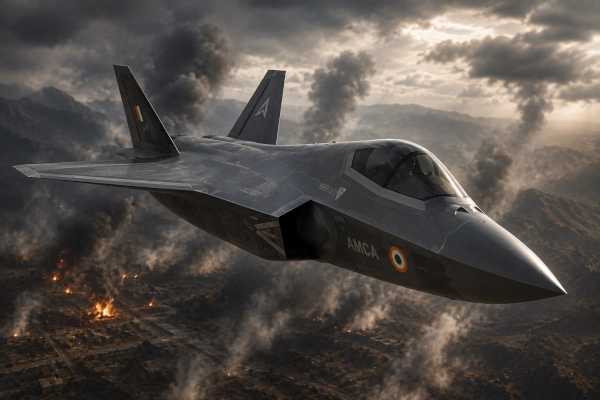
India’s Advanced Medium Combat Aircraft (AMCA) programme has entered the bid evaluation stage, with three Indian industry groups competing to develop prototypes of the country’s indigenous fifth-generation stealth fighter aircraft. The development represents an important stage in the programme being undertaken by the Aeronautical Development Agency (ADA), which functions under the Defence Research and Development Organisation (DRDO).
According to reports published on 16 November 2026, the three bidders submitted their proposals by 30 October, following which the bids were opened in early November. The proposals are being examined as part of the process to select a Development-cum-Production Partner for the approximately ₹15,000-crore prototype development programme.
The competing bidders comprise Tata Advanced Systems Limited, an industry consortium led by Larsen & Toubro with Bharat Electronics Limited (BEL) and Dynamatic Technologies, and a Bharat Forge-led consortium involving BEML Limited and Data Patterns. The participation of BEL and BEML highlights the involvement of India’s defence public sector undertakings alongside private companies in the country’s advanced combat aircraft development programme.
BEL Confirms Participation in AMCA Programme
Bharat Electronics Limited has officially confirmed its participation in the AMCA bidding process. During an investor conference call held on 3 November 2026, BEL Chairman and Managing Director Manoj Jain stated that the company had submitted its bid jointly with Larsen & Toubro, with L&T leading the consortium.
The BEL management indicated that the bidding arrangement represented an important public-private partnership and that the company was participating in the programme through a consortium structure. Jain also explained that the technical evaluation could take several months, although he emphasised that the final timeline and selection decision rested with the responsible authorities.
The company’s statements provide primary-source confirmation of its involvement in the bidding process. However, no winning consortium has been announced, and BEL’s participation should not be interpreted as confirmation that the L&T-led group has secured the development contract.
Five Prototypes Planned for Development and Testing
Under the programme, the selected industry partner is expected to work with ADA to develop five flying prototypes of the AMCA. These aircraft will support the validation of the fighter’s flight-control systems, stealth characteristics, avionics, sensors, propulsion and weapons integration.
The proposed testing programme includes approximately 1,800 flight-test sorties over a period of seven years. The aircraft is being designed as a twin-engine, multirole combat platform incorporating low-observable characteristics, internal weapons carriage and advanced electronic systems.
The development phase is intended to establish the technical foundation for India’s indigenous fifth-generation combat aircraft capability. The design and testing programme remains subject to the completion of prototype development, validation and certification requirements.
Public and Private Industry Participation in Advanced Aerospace Manufacturing
The AMCA programme’s execution model represents a significant development in India’s defence manufacturing framework. On 27 May 2025, the Ministry of Defence announced approval of an industry-partnership model that permits eligible Indian companies to compete independently, through joint ventures or as consortiums.
The framework was introduced to utilise the capabilities of both public and private industry in developing India’s next-generation combat aircraft.
The participation of BEL and BEML alongside major private defence manufacturers demonstrates the application of this approach. The programme provides an opportunity for Indian industry to participate in advanced aerospace manufacturing, systems integration, precision engineering and specialised defence technologies.
The AMCA is intended to strengthen India’s indigenous combat aircraft development capabilities and support the expansion of its domestic aerospace industrial ecosystem. The current evaluation process is an important procurement milestone, although the selection of a development partner and the subsequent construction of prototypes remain pending.
You may also like
-
Russian University and Drone Manufacturer Plan UAV Technology Transfer and Production in India
-
Bharat Forge Dispatches First Consignment of Indigenous 5.56 mm Rifles for Uttar Pradesh STF
-
India’s PLI Schemes Achieve 76% of Investment Target and 64% of Production Goal
-
Bharat Semi Raises $24 Million to Develop AI-Enabled Image Sensors for Drones, Robotics and Autonomous Systems
-
TDB-DST Approves ₹10 Crore Support for Neo Seekermetals to Develop Indigenous Critical Minerals Recycling Technology
