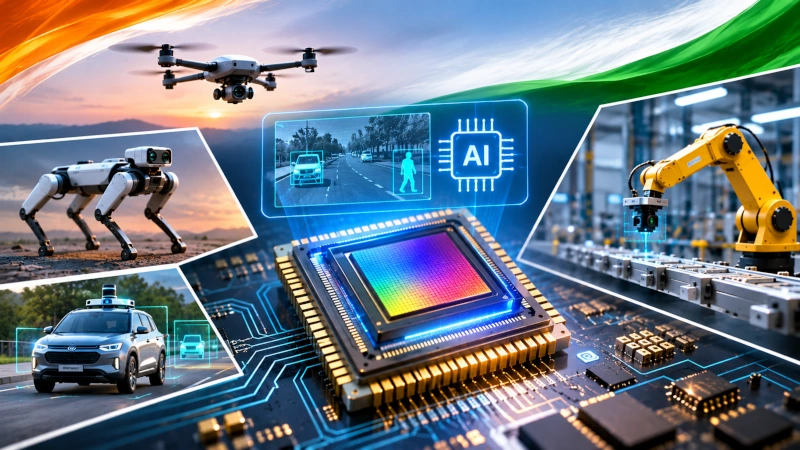
Indian semiconductor startup Bharat Semi has raised $24 million in seed funding to accelerate the development of programmable intelligent image sensors that integrate image capture, processing and artificial intelligence within a single semiconductor architecture. The company is developing advanced sensing technologies for drones, robotics, autonomous vehicles, surveillance systems and industrial automation, strengthening India’s participation in the emerging global market for semiconductor technologies supporting Physical Artificial Intelligence.
The funding round, announced on November 16, 2026, was led by Info Edge Group, South Park Commons and Indus Bridge Ventures, with participation from Micromax, Valour Capital, Gaingels and angel investors Mukul Agarwal and Karthik Sundar Iyer. Founded in 2021 by Vinayak Dalmia and Vrinda Kapoor, Bharat Semi operates across India and the United States, with engineering and business development activities supporting its semiconductor design programmes. The company is focusing on technologies that enable machines to interpret visual information and interact with their surroundings through intelligent sensing and local computing capabilities.
Developing Intelligent Image Sensors for Physical AI
Bharat Semi is developing a new generation of programmable image sensors for Physical Artificial Intelligence, an emerging field that combines artificial intelligence with machines capable of sensing, understanding and interacting with the physical world. Conventional machine-vision systems typically rely on separate components for image capture, image signal processing and computational operations. A camera sensor captures visual information and transfers it to external processors, where algorithms analyse the data and determine the appropriate response. Although widely used, such architectures can involve substantial data movement between electronic components, additional processing hardware and increased power consumption.
Bharat Semi’s proposed architecture seeks to integrate image sensing, processing and artificial intelligence inference within a unified semiconductor solution. By bringing computational capabilities closer to the point of image capture, the company aims to reduce the amount of information transferred between separate components while improving processing efficiency. Its technology is intended to support programmable functionality, allowing the same underlying semiconductor architecture to be configured for different applications and artificial intelligence models. This approach is particularly relevant to intelligent machines that require continuous visual processing while operating within limitations involving power consumption, size, weight and computational resources.
According to Bharat Semi, its proposed architecture is designed to reduce data movement by as much as 99% and lower system costs by up to ten times compared with conventional multi-chip arrangements. These figures represent the company’s stated technological objectives and performance estimates rather than independently verified results from commercially deployed products. The first generation of intelligent image sensors is currently undergoing prototyping, with further product development and qualification activities remaining before commercial production.
Applications in Drones and Unmanned Aerial Systems
Commercial unmanned aerial vehicles represent an important application area for Bharat Semi’s intelligent image-sensor technology. Modern drones increasingly depend on cameras and onboard computing systems to identify obstacles, monitor terrain, inspect infrastructure and support autonomous navigation. These applications require visual information to be processed rapidly, particularly when aircraft operate in changing environments or undertake activities that depend on accurate interpretation of their surroundings. Conventional imaging systems often rely on separate processors to analyse camera data, adding to the power, weight and computational requirements of the aircraft.
Bharat Semi is developing its sensor architecture with applications in commercial drones used for precision agriculture, aerial mapping, infrastructure inspection and other autonomous operations. Integrating artificial intelligence processing within the image sensor is intended to reduce the dependence on external computing components for selected machine-vision tasks. The proposed technology could support applications involving obstacle detection, object recognition, visual navigation and environmental monitoring, depending on the capabilities incorporated into the final products. However, the company has not announced the commercial deployment of its new programmable intelligent image sensors aboard operational drone platforms, and the technology remains under development.
Intelligent Sensors for Robotics and Autonomous Machines
Robotics is another major market identified by Bharat Semi for its semiconductor development programme. Autonomous robots depend on sensors to gather information about their surroundings, identify objects, recognise obstacles and perform tasks with varying degrees of independence. In industrial environments, machine-vision systems are used for inspection, quality control, automated handling and navigation, while mobile robots require visual information to move through changing environments. The efficiency of these systems depends partly on how quickly sensor information can be processed and translated into instructions for the machine.
Bharat Semi’s proposed intelligent sensor architecture is designed to combine visual information gathering with local artificial intelligence processing, allowing selected analytical functions to be performed closer to the sensing hardware. The company is targeting robotic systems, intelligent vehicles, industrial cameras and connected machines that require compact, programmable and energy-efficient sensing solutions. Its development strategy emphasises a common technological architecture that can be adapted for different industrial applications rather than relying entirely on separate hardware designs for each use case. This approach combines semiconductor engineering, embedded processing and software programmability to support the development of intelligent electronic systems.
Surveillance, Consumer Electronics and Connected Devices
Bharat Semi has identified surveillance and consumer electronics as important initial commercial markets for its intelligent image sensors. These sectors require imaging technologies capable of balancing visual performance, processing efficiency, power consumption and manufacturing costs. Surveillance cameras increasingly incorporate artificial intelligence capabilities to identify objects, analyse activity and process selected visual events, while consumer devices and connected electronics use cameras and sensors to interact with their environments. The integration of processing capabilities within sensing hardware is intended to support such applications without requiring every computational operation to be performed by a separate processor or remote system.
The company’s technology portfolio includes high-performance CMOS image sensors and intelligent sensing solutions for surveillance equipment, commercial unmanned aerial vehicles and Internet of Things applications. Its programmable architecture is intended to allow manufacturers to adapt sensor functionality to the requirements of different devices and systems. Bharat Semi is also developing imaging technologies that combine semiconductor design with artificial intelligence capabilities, reflecting the increasing convergence of image processing, edge computing and embedded electronics. These activities form part of the company’s efforts to develop semiconductor products for applications extending from connected consumer devices to specialised industrial systems.
Bharat Semi Reports Design Wins with General Atomics and Kaynes Semicon
Bharat Semi has reported securing design wins with American defence technology company General Atomics and Indian semiconductor company Kaynes Semicon, indicating progress in its engagement with industrial customers. A design win generally means that a technology or component has been selected for inclusion in a customer’s product development programme or proposed system architecture. Such arrangements can provide an important pathway towards subsequent qualification and commercial supply, although they do not necessarily establish that mass production has commenced or that finished products have already been delivered.
The company has not disclosed the financial value, production quantities or delivery schedules associated with these reported design wins. Their significance therefore lies in the selection of Bharat Semi’s technology for customer development programmes rather than confirmed commercial-scale shipments. The startup is also strengthening its relationships with electronics manufacturers, technology companies and prospective customers in international markets. Micromax’s participation as a strategic investor in the latest funding round adds another connection to the broader electronics industry.
First-Generation Image Sensors Reach Prototyping Stage
Bharat Semi’s first generation of intelligent image sensors has reached the prototyping stage, marking progress in the company’s semiconductor development programme. Prototyping is an important stage in which engineering designs are implemented in physical hardware and evaluated against intended performance requirements. Semiconductor products generally undergo further testing, design refinement, qualification and manufacturing preparation before entering commercial production, particularly when they are intended for industrial or specialised applications.
The company is simultaneously developing a second generation of sensors incorporating more advanced artificial intelligence capabilities. According to its stated development schedule, Bharat Semi aims to complete prototypes of these products by the middle of 2027 and begin supplying them to customers towards the end of that year. It is also targeting initial commercial production during 2027, although these milestones remain dependent on successful engineering development, testing and manufacturing arrangements. Bharat Semi is currently a pre-revenue company, and its principal intelligent image-sensor products have not yet entered established commercial-scale production.
$24 Million Investment to Accelerate Semiconductor Development
The newly announced $24 million seed funding round will support Bharat Semi’s semiconductor engineering activities, product development programmes and international business expansion. The investment is intended to accelerate the development of the company’s programmable intelligent sensor family while strengthening the technical capabilities required to advance its products towards commercialisation. The participation of semiconductor, technology and venture capital investors reflects financial support for the company’s approach to integrating image sensing and artificial intelligence within specialised semiconductor architectures.
Bharat Semi has approximately 75 employees across India and the United States, including engineering and business development professionals working in Santa Clara, California. The company plans to expand its American engineering operations while continuing to develop its semiconductor capabilities in India. It is also undertaking recruitment activities in Europe as part of its efforts to build an international engineering team with expertise in semiconductor design, imaging technologies and associated software systems. The funding provides financial resources for these development activities as the company works towards its stated product qualification and commercialisation milestones.
Fabless Semiconductor Model and Manufacturing Strategy
Bharat Semi intends to develop its intelligent image-sensor products through a fabless semiconductor business model, concentrating on semiconductor architecture, chip design, intellectual property development and associated software while using external manufacturing partners for physical chip fabrication. This model is widely used in the semiconductor industry because it allows companies to specialise in advanced chip design without independently constructing and operating expensive semiconductor fabrication facilities. The arrangement also enables semiconductor
You may also like
-
India’s PLI Schemes Achieve 76% of Investment Target and 64% of Production Goal
-
India’s Female Labour Force Participation Reaches 35%, Unemployment Declines to 4.9%
-
TDB-DST Approves ₹10 Crore Support for Neo Seekermetals to Develop Indigenous Critical Minerals Recycling Technology
-
Waigaon Turmeric – The Golden Heritage of Maharashtra’s Vidarbha Region
-
Mankind Pharma Signs Exclusive Licensing Agreement with Betta Pharmaceuticals for Lung Cancer Drug Ensartinib
