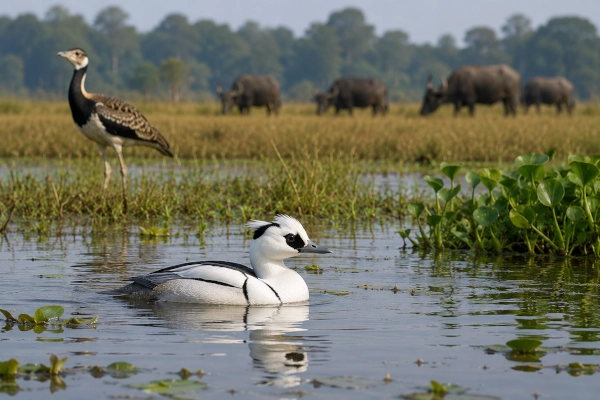
Assam’s Laokhowa Wildlife Sanctuary has added an unusual visitor to its documented birdlife with the first confirmed record of the Smew (Mergellus albellus), a small migratory diving duck that breeds across northern Eurasia and is only an uncommon winter visitor to the Indian subcontinent.
The record was announced by Assam Forest and Climate Change Minister Jayanta Malla Baruah on 23 August 2026, following observations made during the 7th Kaziranga Waterbird Count 2026. Survey teams also recorded the Critically Endangered Bengal Florican, adding further conservation significance to the sanctuary’s wetlands and grasslands.
A First for Laokhowa
The Smew was recorded during the waterbird survey covering important wetlands within the sanctuary, including Rowmari, Dondowa and Muamari beels. Forest officials described the sighting as the first documented occurrence of the species in Laokhowa Wildlife Sanctuary.
The species had already attracted attention during the wider 7th Kaziranga Waterbird Count earlier in 2026, when it was recorded for the first time within the broader Kaziranga survey landscape. The Laokhowa record is important because it establishes the bird specifically within this section of the Kaziranga–Laokhowa–Burhachapori floodplain ecosystem.
The Smew is globally classified as Least Concern, so its importance here does not arise from global rarity alone. Rather, it is its uncommon occurrence in India and its status as a long-distance Eurasian migrant that make the record noteworthy.
A Distinctive Eurasian Diving Duck
The Smew belongs to the duck family Anatidae and is one of the most distinctive northern diving ducks.
Adult males are predominantly white with sharp black markings around the eyes, back and wings, producing a striking black-and-white appearance. Females and immature birds are more subdued, with grey bodies, chestnut-coloured heads and conspicuous pale cheeks.
The species breeds mainly across northern Europe and Asia, particularly boreal forest regions containing lakes and slow-moving waters. As winter approaches, many birds migrate south towards temperate Europe and Asia.
In India, the Smew is primarily a winter visitor to northern and northeastern wetlands. Its documented winter distribution includes the Indo-Gangetic plains and the Brahmaputra basin, although sightings remain comparatively scarce.
Why the Laokhowa Record Matters
Migratory waterbirds depend on a chain of suitable wetlands extending across thousands of kilometres.
A bird breeding in northern Eurasia may require several stopover and wintering sites along its migration route. The loss or degradation of even individual wetlands can therefore affect populations far beyond the immediate landscape.
The appearance of a Smew at Laokhowa indicates that at least some of the sanctuary’s wetlands continue to provide the combination of water, food, shelter and relatively low disturbance required by long-distance migrants.
Assam officials have consequently described the sighting as another indicator of the ecological importance of Laokhowa’s wetland system.
It should not, however, be interpreted as proof by itself that every wetland within the sanctuary is in ideal condition. Long-term trends in bird abundance, water levels, vegetation and species composition are required to assess wetland health reliably. What the record does provide is another valuable data point in that continuing monitoring process.
Bengal Florican Adds a Second Conservation Highlight
The waterbird count also documented the Bengal Florican (Houbaropsis bengalensis), one of the world’s most threatened grassland birds.
Unlike the Smew, the Bengal Florican is classified as Critically Endangered. It is a specialist of open alluvial grassland habitats and survives in highly fragmented populations in South and Southeast Asia.
Assam remains one of the species’ most important Indian strongholds, with populations surviving in and around landscapes such as Kaziranga, Orang and Manas.
The simultaneous recording of a rare Eurasian wetland migrant and a Critically Endangered resident grassland specialist illustrates the unusual ecological character of the Laokhowa landscape. Its conservation value lies precisely in this combination of wetlands, grasslands, riverine habitats and woodland.
Laokhowa Covers More Than 70 Square Kilometres
Laokhowa Wildlife Sanctuary covers approximately 70.13 sq km in Nagaon district on the southern bank of the Brahmaputra River.
Together with neighbouring Burhachapori Wildlife Sanctuary, it forms the Laokhowa–Burhachapori ecosystem, an important component of Assam’s central Brahmaputra floodplain. The Assam government records more than 225 bird species from Laokhowa, along with mammals including elephants, Asiatic wild buffaloes, tigers, hog deer and fishing cats.
The sanctuary is also recognised as a buffer of the Kaziranga Tiger Reserve.
Its geographical position gives it importance well beyond its comparatively modest size. Laokhowa and Burhachapori help connect Kaziranga with other protected areas across the Brahmaputra landscape, providing routes through which wildlife can move between habitats.
This landscape-scale connectivity is especially important in a floodplain ecosystem where rivers continually reshape grasslands, wetlands and islands.
Wetlands at the Heart of the Sanctuary
The Rowmari, Dondowa and Muamari beels surveyed during the waterbird count form part of a broader network of seasonal and permanent wetlands.
Such beels support fish, aquatic plants, amphibians, insects and numerous birds. The Assam Forest Department identifies Laokhowa as a breeding ground for around 39 fish species, while its water bodies also support amphibians and reptiles.
For migratory birds, these wetlands can function as winter feeding and resting grounds.
Diving ducks such as the Smew generally forage underwater for aquatic invertebrates, small fish and other prey. Maintaining suitable water depth, food availability and low levels of disturbance can therefore influence whether such birds use a wetland.
Waterbird Counts Provide More Than a Species List
The 7th Kaziranga Waterbird Count is valuable because systematic surveys provide information that casual bird sightings cannot.
Repeated counts allow conservation managers to examine changes in species diversity, abundance and wetland use over time. They can reveal whether particular wetlands are attracting more or fewer birds and whether unusual species are beginning to appear.
Such monitoring is particularly important in the Brahmaputra floodplain, where annual floods can dramatically alter water bodies and vegetation.
The broader 2026 Kaziranga count recorded more than 105,000 waterbirds belonging to 107 species across 166 wetland sites, underlining the enormous importance of the landscape for aquatic birds.
The Smew’s appearance adds a new species-level record to that wider ecological picture.
Conservation Efforts Intensified at Laokhowa
The new bird records come as authorities strengthen conservation activities within the sanctuary.
Forest personnel have increased patrolling, surprise inspections and monitoring of vulnerable areas, while action has also been taken against illegal fishing. Habitat-restoration measures have included plantation activities and continuing biodiversity monitoring.
These actions are particularly important because wetland conservation depends not simply on keeping a protected-area boundary intact. Fishing pressure, disturbance, changes in water flow, invasive vegetation and degradation of surrounding grassland can all alter habitat quality.
The diversity recorded during systematic surveys can help managers identify areas where protection measures are producing results and where additional intervention may be needed.
Another Sign of the Brahmaputra Floodplain’s Global Importance
The Smew may spend only part of its annual cycle in India, but that is precisely what makes the sighting significant.
Migratory birds connect ecosystems separated by enormous distances. A wetland in Assam may form one small but essential link in a migration system extending deep into northern Eurasia.
At the same time, the presence of the Bengal Florican shows that Laokhowa also supports species whose survival depends on the long-term protection of India’s own increasingly scarce floodplain grasslands.
The first documented Smew at Laokhowa therefore represents more than an addition to a bird checklist. Together with the Bengal Florican and the wider diversity recorded during the waterbird count, it reinforces the role of the Laokhowa–Burhachapori landscape as an important combination of migratory waterbird habitat, threatened grassland refuge and wildlife corridor within the Brahmaputra floodplain.
You may also like
-
PGIMER, IIT Ropar and ISRO Plan Microgravity Research Laboratory to Advance India’s Human Spaceflight Medicine
-
New Technology Provides Environment Friendly Route for Treating Dye-Contaminated Wastewater
-
India Expands Global Big Cat Conservation as International Big Cat Alliance Opens New Headquarters
-
Large- and Small-scale Magnetic Activity Driving Microwave Polar Brightening in the Sun
-
Molecular Geometry Tweak Opens New Way for Smart Biomaterials
