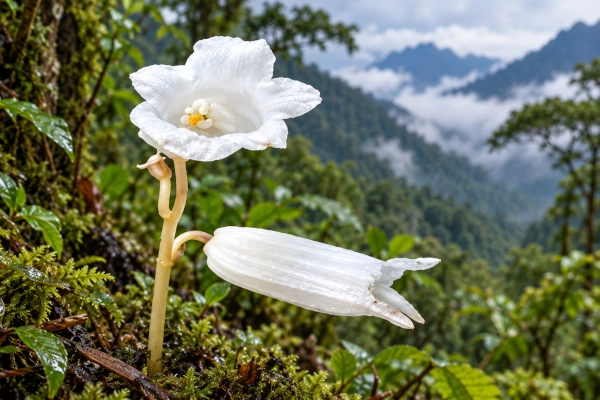
A rare leafless orchid that spends most of its life hidden beneath the forest floor has been formally described as a new species from Arunachal Pradesh. Named Gastrodia keyiensis, the orchid was discovered in Keyi Panyor district and has now been published in the international botanical journal Phytotaxa.
The species was described by Madhusudhan Khanal, Dipankar Borah, Shuvadip Sarkar, Neelam Gap, Santosh Kumar Rai and Devendra Kumar. The research team includes scientists associated with the G.B. Pant National Institute of Himalayan Environment, Sikkim University, Kaliabor College and the Botanical Survey of India. The formal taxonomic paper was published on 9 September 2026 in Phytotaxa, Volume 773, Issue 3.
A Leafless Orchid Without Chlorophyll
Gastrodia keyiensis belongs to a highly specialised group of orchids that do not produce normal green leaves and cannot manufacture their own food through photosynthesis.
Instead, the plant obtains nutrients through its association with fungi in the soil. Botanists describe this mode of nutrition as holomycotrophy. Much of the plant remains underground, with the flowering stem appearing briefly above the forest floor during the reproductive season.
This unusual biology makes members of the genus Gastrodia particularly difficult to detect during botanical surveys. Their above-ground presence can be brief, while their dependence on specialised fungal relationships ties them closely to intact forest-floor conditions.
Discovered Along the Keyi River
The new orchid was recorded in a remote gorge along the Keyi River in Keyi Panyor district of Arunachal Pradesh.
Researchers found it growing at an elevation of around 1,000 metres in deep shade over thick layers of decomposing leaf litter. The habitat included bamboo-dominated vegetation along the right bank of the river.
Only five flowering individuals were recorded at the type locality during the survey. The plants can reach approximately 35 centimetres in height and produce between one and three flowers.
The very small number of visible flowering plants also illustrates the difficulty involved in determining the actual population of a species that remains underground for much of its life.
Named After Keyi Panyor
The scientific name Gastrodia keyiensis refers directly to the Keyi region where the orchid was discovered.
The species has also been referred to locally as “Oram Opuh”, translated as “Ghost Flower” in the Nyishi language. The name reflects the orchid’s unusual habit of remaining concealed beneath the forest floor and emerging only briefly when flowering.
The combination of its underground life cycle, absence of chlorophyll and elusive flowering period gives the species a very different ecological strategy from the more familiar green orchids found across the Eastern Himalaya.
Closely Related to Gastrodia putaoensis
The researchers found that Gastrodia keyiensis is morphologically closest to Gastrodia putaoensis, another member of the genus.
The new species can be distinguished by the structure of its labellum, the specialised lip found in orchid flowers. G. keyiensis has a broadly obovate basal section containing six to seven prominent longitudinally thickened structures.
Its apical section is thick, strongly curved inward, narrowly oblong and yellow, with a finely papillate surface. These characters separate it from G. putaoensis, which has a different basal shape, fewer thickened lines and a narrower apical portion covered with yellow hairs and red papillae.
These floral differences formed the basis for recognising the Arunachal population as a distinct species.
Eastern Himalaya Continues to Yield New Plant Species
Arunachal Pradesh lies within the Eastern Himalayan biodiversity region and contains exceptionally high botanical diversity across tropical, subtropical, temperate and alpine habitats.
Difficult terrain and large areas of relatively inaccessible forest mean that many plant groups remain incompletely documented. Botanical surveys in the state continue to record species new to science as well as extensions to the known distribution of previously described plants.
The discovery of Gastrodia keyiensis also shows the importance of less conspicuous forest-floor organisms. Plants without large leaves or long-lived flowering structures can easily remain undetected even in areas that have previously been surveyed.
Restricted Known Population Raises Conservation Questions
The taxonomic description currently places Gastrodia keyiensis within a very restricted known geographical range.
Only five flowering individuals were recorded at the type locality, although this does not necessarily represent the complete underground population. Plants of this type can remain dormant below ground and may not flower every year.
Their dependence on fungi also means that conservation cannot focus only on the visible orchid. The surrounding soil, leaf litter, fungal community and forest microclimate all form part of the biological system required for the plant to survive.
Further surveys across Keyi Panyor and neighbouring areas will be needed to determine whether additional populations occur elsewhere in the Eastern Himalaya.
A New Addition to India’s Orchid Diversity
The formal description of Gastrodia keyiensis adds another species to India’s exceptionally rich orchid flora and expands the known diversity of the genus Gastrodia in the Eastern Himalaya.
The discovery is particularly striking because the plant survives without green leaves, remains hidden for most of its life and was represented by only a handful of flowering individuals when scientists encountered it.
Its publication in Phytotaxa now establishes Gastrodia keyiensis as a formally recognised species and provides the morphological, habitat and distribution information required for future identification and conservation work.
References
Phytotaxa — Volume 773, Issue 3, 9 September 2026: Gastrodia keyiensis (Orchidaceae: Gastrodieae), a new holomycotrophic species from Arunachal Pradesh, Eastern Himalaya, India, by Madhusudhan Khanal, Dipankar Borah, Shuvadip Sarkar, Neelam Gap, Santosh Kumar Rai and Devendra Kumar.
DD India — 21 September 2026: Report on the discovery of the rare leafless “Ghost Flower” orchid in Arunachal Pradesh.
The correct date for the formal scientific description is 9 September 2026. DD India reported the discovery on 21 September 2026.
You may also like
-
Satpura Tiger Reserve’s Barasingha Population Crosses 300 as Madhya Pradesh Plans New Wildlife Corridors
-
Karnataka’s Tiger Population Could Cross 700 as New Census Builds on Official Count of 563
-
Project Cheetah Expands as Veerangana Durgavati Tiger Reserve Becomes Madhya Pradesh’s Third Cheetah Habitat
-
Kashmir Markhor Population Rises to 227 as Kazinag Conservation Efforts Show Results
-
ICAR-CIFRI Pushes Conservation of Indigenous Himalayan Fish for Biodiversity and Livelihood Security
