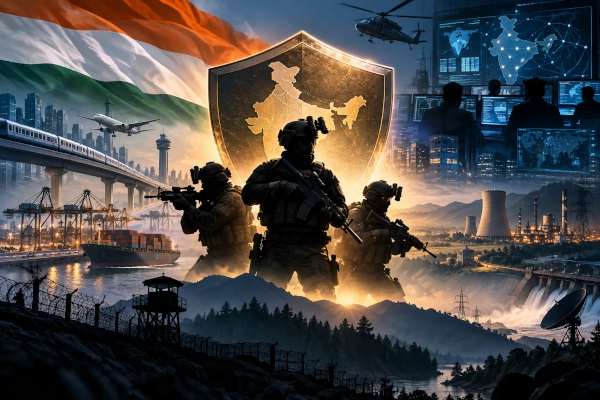
India has formalised its first comprehensive National Counter-Terrorism Policy and Strategy under the name PRAHAAR, creating a unified framework for preventing terrorist attacks, responding to threats, countering radicalisation and strengthening coordination across the security establishment.
The Ministry of Home Affairs unveiled PRAHAAR on February 23, 2026. The policy brings together prevention, intelligence, law enforcement, institutional coordination, international cooperation and recovery within a single national counter-terrorism framework.
Its significance lies in moving India’s counter-terrorism architecture from a collection of operational and institutional measures towards a clearly articulated national doctrine.
Seven Pillars Define the PRAHAAR Framework
PRAHAAR is built around seven pillars covering the full cycle of counter-terrorism activity.
The first focuses on preventing terrorist attacks and protecting Indian citizens and national interests. The second calls for responses that are swift and proportionate to the threat.
A third pillar seeks to aggregate national capabilities through a whole-of-government approach, bringing central agencies, state police forces and specialised security organisations into a more coordinated system.
The policy also places human rights and rule-of-law-based processes within the framework of counter-terrorism operations. Other pillars address conditions conducive to terrorism, including radicalisation, international cooperation against terrorist networks, and recovery and resilience after attacks.
Together, these elements are intended to connect preventive intelligence, operational response and long-term resilience within one doctrine.
Intelligence-Led Prevention Becomes Central
The Ministry of Home Affairs describes PRAHAAR as an intelligence-led and proactive counter-terrorism framework.
A major element is the formalisation of real-time intelligence sharing through the Multi Agency Centre, which serves as an important mechanism for exchanging terrorism-related intelligence between agencies.
The policy seeks faster circulation of threat information and closer coordination between intelligence agencies, state police forces and specialised central forces.
This emphasis reflects the changing nature of terrorist threats, where small networks, encrypted communications, online radicalisation and decentralised financing can require action before an attack develops into a conventional operational threat.
State Police Remain Critical to Implementation
Although PRAHAAR establishes a national framework, much of its implementation depends on state and local policing.
At the September 2026 conference on PRAHAAR in New Delhi, Union Home Minister Amit Shah stressed the need to take the framework down to the police-station level. He called for closer coordination between state police forces, Anti-Terrorism Squads, central agencies and specialised security organisations.
The conference brought together senior officials from the Union government, Central Armed Police Forces, state police organisations and Anti-Terrorism Squads.
The Ministry of Home Affairs has emphasised that better coordination between stakeholders is essential to reduce delays in counter-terrorism responses and make each component of PRAHAAR operationally effective.
Faster Response and Clearer Coordination
PRAHAAR also seeks a more coordinated chain of command during terrorist incidents.
The framework connects state police agencies with specialised central forces such as the National Security Guard, while placing emphasis on predefined responsibilities and rapid decision-making.
The objective is to reduce fragmentation during an emergency and ensure that intelligence, local police resources and specialised intervention capabilities can operate as part of the same response structure.
The policy further calls for greater automation and institutionalisation of counter-terrorism response mechanisms at different levels of government.
Critical Infrastructure Receives Greater Attention
Protection of critical infrastructure forms another element of the strategy.
India’s transport networks, energy installations, digital systems, financial infrastructure and other essential facilities increasingly depend on interconnected technologies. This creates vulnerabilities that differ considerably from traditional physical-security threats.
PRAHAAR therefore treats infrastructure protection as part of preventive counter-terrorism rather than only as a post-threat security measure.
The approach combines threat assessment, intelligence sharing, security preparedness and technological capabilities to reduce vulnerabilities in critical systems.
Countering Radicalisation Through a Whole-of-Society Approach
PRAHAAR extends beyond conventional security operations by addressing radicalisation and conditions that can enable terrorist recruitment.
The policy adopts a whole-of-society approach in which government agencies, communities and institutions contribute to preventing extremist mobilisation.
This component is intended to complement intelligence and enforcement measures by addressing pathways through which individuals may be recruited, indoctrinated or connected with terrorist networks.
The Ministry of Home Affairs has made clear that India does not associate terrorism with any particular religion, ethnicity, nationality or civilisation. The policy instead focuses on terrorist activity and radicalisation irrespective of ideological or organisational identity.
Terror Financing Moves Into the Digital Domain
PRAHAAR also addresses the changing methods used to finance terrorist activity.
The government’s framework includes tracing cryptocurrency wallets, identifying dark-web fundraising channels and seizing assets associated with terrorist financing.
These measures build upon India’s existing financial-intelligence and enforcement mechanisms while recognising that terrorist financing increasingly uses digital platforms and cross-border financial networks.
The policy aligns these efforts with international standards, including those developed through the Financial Action Task Force, while using bilateral and multilateral cooperation to address financing networks operating across jurisdictions.
International Cooperation Forms One of the Seven Pillars
PRAHAAR places international cooperation directly within India’s counter-terrorism doctrine.
This includes collaboration on intelligence, terror financing, extradition, international legal cooperation and efforts to isolate organisations and networks involved in terrorism.
The September PRAHAAR conference also saw the launch of a new Extradition Portal intended to improve coordination in bringing fugitives located abroad back to India.
The government has increasingly treated counter-terrorism diplomacy as an extension of domestic security, particularly where terrorist financing, recruitment, propaganda and operational networks cross national borders.
Technology Becomes Integral to Counter-Terrorism
Modern counter-terrorism increasingly depends on the ability to process large volumes of information and identify connections across multiple datasets.
PRAHAAR incorporates technology into intelligence sharing, threat monitoring, infrastructure protection, financial investigation and operational coordination.
The approach reflects a security environment in which terrorist activity may involve encrypted communication, drones, digital payments, online propaganda and rapidly shifting networks.
Technology therefore functions not as a separate pillar, but as an enabling capability across the entire strategy.
PRAHAAR Consolidates India’s Counter-Terrorism Architecture
India’s counter-terrorism system has expanded over several years through legal reforms, intelligence coordination, specialised investigative capabilities, border management, terror-financing controls and international cooperation.
PRAHAAR brings these elements within a single policy framework.
The Ministry of Home Affairs describes the strategy as a transition from a predominantly reactive security posture towards a proactive and intelligence-led approach. Its seven pillars provide a common structure through which central agencies, state governments and police organisations can align their activities.
The policy also establishes continuity between prevention, response and recovery rather than treating each as an independent stage.
PRAHAAR therefore represents an important institutional step in India’s counter-terrorism evolution. By combining intelligence, law enforcement, technology, international cooperation, counter-radicalisation and resilience within a unified framework, India has established a national doctrine intended to strengthen coordination and preparedness against evolving terrorist threats.
References
- Ministry of Home Affairs — National Counter-Terrorism Policy & Strategy, PRAHAAR — 23 February 2026
https://www.mha.gov.in/sites/default/files/2026-02/PRAHAAREnglish_23022026.pdf - Press Information Bureau, Ministry of Home Affairs — 12 August 2026: PRAHAAR
https://www.pib.gov.in/PressReleasePage.aspx?PRID=2298334&lang=1®=48 - Press Information Bureau, Ministry of Home Affairs — 28 September 2026: Union Home Minister Amit Shah inaugurates Conference on ‘PRAHAAR – CT Policy and Strategy’ in New Delhi
https://www.pib.gov.in/PressReleasePage.aspx?PRID=2316153&lang=2®=48 - Ministry of Home Affairs — Counter Terrorism and Counter Radicalization Division
https://www.mha.gov.in/en/divisionofmha/counter-terrorism-and-counter-radicalization-division - Government of India, Lok Sabha — 24 March 2026: Policy for Response Against Hostile Activities, Unstarred Question No. 5238
https://www.mha.gov.in/MHA1/Par2017/pdfs/par2026-pdfs/LS24032026/5238.pdf
You may also like
-
Takshak Heavyweight Torpedo: How India’s Indigenous Submarine Weapon Compares With the World’s Leading Torpedoes
-
Embraer Builds Dual Aerospace Strategy in India Through C-390 Military and E175 Regional Aircraft Programmes
-
NextLeap Tests Indigenous Jet Engine for Long-Range Stryker Kamikaze UAV
-
Côte d’Ivoire Military Delegation Visits HAL, Shows Interest in India’s Indigenous Aerospace Platforms
-
Jawahar Dweep Becomes India’s First Plastic-Free Oil Terminal at Mumbai Port
