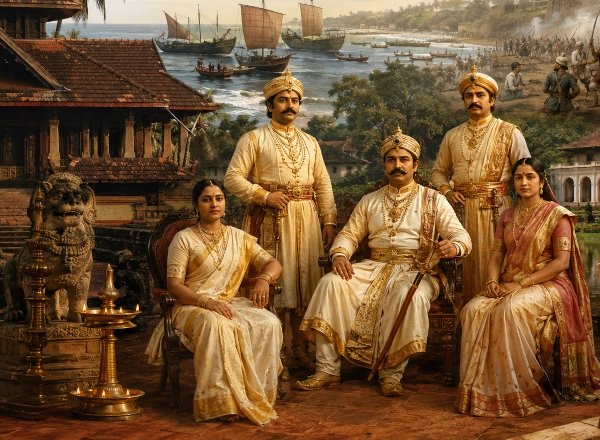
The Parappanad Rajas belonged to one of the historic royal houses of Malabar. Their original domain lay along Kerala’s northern coast, centred on present-day Parappanangadi in Malappuram district and extending towards Kadalundi, Chaliyam and Beypore. Although Parappanad eventually became a comparatively small principality under the political influence of the Zamorins of Kozhikode, its royal family gained lasting importance through its maritime setting, its participation in the affairs of medieval Malabar and its deep genealogical connections with the royal house of Travancore.
The name Parappanad referred both to the territory and to the ruling swarupam, or royal lineage. Like several ruling houses of medieval Kerala, the dynasty consisted of different branches residing in separate kovilakams, the palace households through which political authority, property and succession were organised. The collective legacy of these branches reached far beyond the boundaries of their original kingdom.
The Coastal Kingdom of Parappanad
The headquarters of the Parappanad royal house was at Parappanangadi, a coastal town situated between the important ports of Ponnani and Kozhikode. Medieval sources and later regional histories describe the town as an active centre of maritime commerce. Arab merchants knew the settlement by names resembling Barburankad, reflecting its presence within the trading networks that connected Malabar with Arabia, Persia and the wider Indian Ocean.
The rulers exercised authority over a coastal zone that included Vallikkunnu, Kadalundi, Chaliyam and parts of the Beypore region. This gave the house access to river mouths, landing places, fishing grounds and commercial routes leading into Kerala’s interior. The broader Kadalundi–Beypore coastal region has also been associated by some historians with Tyndis, the ancient port mentioned by classical Greek and Roman writers, though the precise identification of Tyndis continues to be discussed by scholars.
Parappanangadi’s location gave its rulers responsibilities extending beyond land administration. They had to maintain relations with merchants, coastal communities, temple establishments, military retainers and the stronger kingdoms surrounding them. Their position along the Arabian Sea placed Parappanad within the cosmopolitan environment that characterised medieval Malabar.
Formation of the Northern and Southern Branches
Around 1425, the Parappanad domain was divided into two principal divisions. Northern Parappanad developed around Beypore and was also known as the Beypore Swarupam or Vadakke Parappanad. Its territories included Beypore, Cheruvannur and Panniyankara near present-day Kozhikode.
Southern Parappanad, sometimes called Parappur Swarupam or Thekke Parappanad, retained Parappanangadi as its principal centre and exercised influence over parts of the present Tirurangadi region. This division reflected the structure of Kerala’s royal houses, where expanding matrilineal families often created separate palace branches while maintaining a shared dynastic identity.
A branch associated with Mekkotta Kovilakam later settled at Parappanangadi and established the Parappanad Valiya Kovilakam. The family traditionally worshipped Pisharikkal Durga Bhagavati as its principal deity, illustrating the close relationship between royal authority and the sacred institutions of the region.
The northern branch benefited from Beypore’s maritime importance. Located near the mouth of the Chaliyar River, Beypore possessed longstanding connections with overseas commerce and later became famous for the construction of large wooden vessels known as urus. The southern branch remained associated with Parappanangadi, Kadalundi and the surrounding agrarian and coastal settlements.
Relationship with the Zamorin of Kozhikode
As the power of the Zamorins expanded across northern and central Malabar, the Parappanad Rajas accepted their political suzerainty. They functioned as subordinate rulers who retained authority within their hereditary territories while supporting the Zamorin in regional affairs.
Such relationships formed an important feature of medieval Kerala politics. The Zamorin’s realm incorporated numerous local chiefs, temple-centred territories and hereditary royal houses. These subordinate rulers administered their lands, supplied troops when required and participated in campaigns conducted under the wider authority of Kozhikode.
The Parappanad Rajas occupied a strategically valuable position because their territories stood along the southern approaches to Kozhikode and included parts of the Chaliyam–Beypore coastal corridor. Their warriors were associated with the Zamorin’s forces during the long struggle against Portuguese expansion along the Malabar Coast.
Parappanad During the Portuguese Period
The arrival of the Portuguese at the end of the fifteenth century transformed the political and commercial environment of Malabar. The Portuguese attempted to control the spice trade and weaken the maritime network sustained by the Zamorin and Arab merchants.
Chaliyam, situated close to Parappanad territory, became a major centre of conflict. The Portuguese constructed a fort there with the support of local allies, giving them a strategic position near the entrance to the Chaliyar River. The Zamorin eventually captured and demolished the fort in 1571 after a prolonged struggle.
Parappanangadi also suffered during these confrontations. Regional records state that Portuguese forces burned the town around 1573–1574. The attack reflected the wider contest for control of Malabar’s coastal routes and trading centres. Parappanad’s association with the Zamorin placed its territory directly within this struggle between indigenous political powers and European maritime expansion.
Despite the destruction caused by warfare, the royal house survived through its network of kovilakams, matrilineal branches and relationships with other Kerala dynasties.
Matrilineal Succession and Royal Alliances
The Parappanad royal family followed the matrilineal system traditionally observed by several ruling houses of Kerala. Dynastic identity and succession passed through women of the royal lineage. A ruler’s sister and her children therefore occupied a central place in determining the continuity of the house.
This system created extensive kinship networks among Kerala’s royal families. Princesses could be adopted from related dynasties when a ruling house required female heirs. Men from recognised Kshatriya or Koil Thampuran families were selected as consorts for royal women, while their children belonged to the mother’s dynasty.
These customs explain how a royal family from a relatively small Malabar principality acquired a major role in the history of Venad and Travancore. The relationship developed through a combination of adoption, marriage, migration and the establishment of new palace households in southern Kerala.
The Parappanad Connection with Venad
Palace genealogies record that in 1705 a son and two daughters connected with Ittammar Raja of the Beypore–Parappanad house were adopted into the royal family of Venad. Members of the same extended family subsequently travelled south and established themselves in the region that later became associated with Kilimanoor Palace.
Rama Varma and Raghava Varma, sons of a woman belonging to the Parappanad lineage, became connected through marriage with the adopted princesses. Raghava Varma is traditionally identified as the father of Anizham Thirunal Marthanda Varma, the ruler who transformed Venad into the powerful Kingdom of Travancore during the eighteenth century.
Marthanda Varma ascended the throne in 1729 and reorganised the kingdom through military expansion, administrative centralisation and the subordination of powerful local nobles. His victories created the foundations of modern Travancore. Through his paternal connection with the Parappanad lineage, the history of the Malabar house became intertwined with the formation of one of Kerala’s strongest kingdoms.
Another member of the extended family, Ravi Varma Koil Thampuran, married Marthanda Varma’s sister. Their son became Karthika Thirunal Rama Varma, popularly remembered as Dharma Raja. He succeeded Marthanda Varma and guided Travancore during a difficult period marked by the Mysorean advance into Kerala and the arrival of large numbers of refugees from Malabar.
The Parappanad connection therefore reached two of Travancore’s most important eighteenth-century rulers: Marthanda Varma and Dharma Raja.
Kilimanoor Palace
The family associated with Marthanda Varma’s paternal ancestry became established at Kilimanoor, northeast of Thiruvananthapuram. The Kilimanoor estate was granted royal privileges and developed into one of the most distinguished Koil Thampuran houses connected with Travancore.
The present palace complex took shape during the eighteenth century and displayed the characteristic features of Kerala architecture, including tiled roofs, timber construction, courtyards, ponds and sacred groves. The house remained closely related to the Travancore royal family while retaining its own identity and traditions.
Kilimanoor later became famous as the birthplace of Raja Ravi Varma, one of India’s most influential modern painters. His paintings brought scenes from the Ramayana, Mahabharata, Puranas and classical Sanskrit literature into a new visual form that reached households across India. Through Kilimanoor, the extended legacy associated with Parappanad moved from royal genealogy into the cultural history of the entire country.
Migration During the Mysorean Invasions
The eighteenth-century invasions of Malabar by Hyder Ali and Tipu Sultan created a major upheaval among the region’s ruling houses, temples, landlords and local communities. Hyder Ali entered Malabar in 1766, while later Mysorean campaigns intensified during the rule of Tipu Sultan.
Members of the Parappanad royal family joined the movement of Malabar aristocratic families seeking refuge in Travancore. Their existing kinship ties with the Travancore court made the southern kingdom a natural destination. Several family branches settled permanently in central and southern Kerala.
These migrants became known within Travancore’s aristocratic order as Koyi Thampurans or Koil Thampurans. Men belonging to these houses were selected as consorts for Travancore princesses, continuing the genealogical and cultural relationship between the two royal lineages. The Parappanad descendants thus moved from ruling a coastal territory in Malabar to occupying an honoured position within the palace society of Travancore.
The Changanassery and Lakshmipuram Branch
One branch of the displaced Parappanad family settled at Neerazhi Palace in Changanassery. From this line came Raja Raja Varma Koil Thampuran, who became the consort of Maharani Gowri Lakshmi Bayi of Travancore.
Raja Raja Varma was the father of Maharaja Swathi Thirunal Rama Varma, the celebrated nineteenth-century ruler, administrator, scholar and composer. Swathi Thirunal became one of the greatest royal patrons of Indian classical music, producing compositions in Sanskrit, Malayalam, Telugu, Kannada and other languages.
In 1811, Gowri Lakshmi Bayi arranged for the construction of Lakshmipuram Palace at Changanassery for her husband and his family. The palace became another important centre of the Parappanad-descended Koil Thampuran lineage in Travancore.
Through this branch, Parappanad ancestry entered the immediate family of Swathi Thirunal and became associated with a flourishing period of music, literature and royal patronage.
Cultural and Intellectual Legacy
The historical importance of the Parappanad Rajas extends far beyond the size of their original kingdom. Their descendants and connected branches contributed to Kerala’s political, artistic and intellectual history.
The lineage became associated with Marthanda Varma, who created the territorial and administrative foundations of Travancore; Dharma Raja, who protected and governed the kingdom during a turbulent period; Swathi Thirunal, whose musical compositions remain part of India’s classical heritage; and Raja Ravi Varma, whose art transformed the modern visual representation of Indian sacred and epic traditions.
The Koil Thampuran houses connected with the wider lineage also became centres of Sanskrit learning, Malayalam literature, music and traditional scholarship. Their members often received education in grammar, poetics, philosophy, statecraft and the arts. Royal marriages brought these scholarly traditions into the Travancore court, strengthening its reputation as one of southern India’s foremost centres of culture.
Decline of Territorial Rule
The political authority of the Parappanad Rajas in Malabar gradually weakened as the region passed through Zamorin influence, Mysorean occupation and British colonial administration. Following the Anglo-Mysore conflicts and the Treaty of Seringapatam in 1792, the East India Company gained control over Malabar.
Parappanangadi subsequently became part of the colonial Malabar District. The old royal house retained its social and cultural standing, while direct territorial rule gave way to the administrative system established by the British.
The landscape also changed with the arrival of modern transport and institutions. The railway line opened between Tirur and Chaliyam in 1861 passed through the historic Parappanad region, making Parappanangadi part of Kerala’s earliest railway corridor. The town’s political structure had changed, while its maritime, royal and cultural memories remained embedded in local tradition.
Legacy of the Parappanad Rajas
The story of the Parappanad Rajas illustrates the interconnected character of Kerala’s royal history. A coastal house that once governed the region around Parappanangadi and Beypore became linked through kinship with the rulers of southern Kerala. Its members adapted to shifting political powers, survived Portuguese attacks and Mysorean invasions, and established new centres at Kilimanoor, Changanassery and elsewhere in Travancore.
Their legacy belongs simultaneously to Malabar and Travancore. In Malabar, they formed part of the maritime world of Parappanangadi, Kadalundi, Chaliyam and Beypore. In Travancore, their descendants entered the royal family, produced distinguished consorts and helped shape generations of rulers, scholars, composers and artists.
The surviving associations of Parappanad Valiya Kovilakam, Kilimanoor Palace and Lakshmipuram Palace preserve different chapters of this journey. Together they reveal how dynastic continuity in Kerala flowed through royal women, adopted heirs, palace households and cultural relationships stretching across the entire length of the region.
The Parappanad Rajas therefore occupy a distinctive place in Kerala’s past. Their territorial kingdom remained modest, while their genealogical and cultural influence became immense. Through Marthanda Varma, Dharma Raja, Swathi Thirunal and the artistic world of Raja Ravi Varma, the heritage of this Malabar royal house became woven permanently into the political and cultural identity of Kerala.
References
Government of Kerala. “History of Parappanangadi.” Parappanangadi Municipality, Local Self Government Department.
https://parappanangadimunicipality.lsgkerala.gov.in/en/history
Logan, William. Malabar Manual. Volumes I–II. Madras: Superintendent, Government Press, 1887.
https://archive.org/details/malabarmanual0000loga
Aiya, V. Nagam. The Travancore State Manual. Volume I. Trivandrum: Travancore Government Press, 1906. Kerala Government Printing Department digital edition.
https://printing.kerala.gov.in/wp-content/uploads/2018/07/Travancore-State-Manual-1906.pdf
Menon, P. Shungoonny. A History of Travancore from the Earliest Times. Madras: Higginbotham and Company, 1878.
https://archive.org/details/historyoftravanc0000shun
Menon, A. Sreedhara. A Survey of Kerala History. Kottayam: DC Books.
Kerala Tourism. “Kilimanoor Palace—the Birthplace of Raja Ravi Varma.” Department of Tourism, Government of Kerala.
https://www.keralatourism.org/destination/kilimanoor-palace-thiruvananthapuram/374/
Kerala Tourism. “Kilimanoor Palace, Thiruvananthapuram.” Department of Tourism, Government of Kerala.
https://www.keralatourism.org/varkala/kilimanoor-palace.php
Raja Ravi Varma Art Gallery. “Raja Ravi Varma and the Kilimanoor Artistic Heritage.” Department of Museums and Zoos, Government of Kerala.
https://rajaravivarmaartgallery.kerala.gov.in/
You may also like
-
Setu — The Sacred Southern Crossing Between Rameswaram and Lanka
-
One Voice – One Resolve – One India: Namami Bharatam Marks 150 Years of Vande Mataram Across the Nation
-
Dravida — The Ancient Tamil Country of Rivers, Temples and the Southern Ocean
-
Pandya — The Southern Kingdom of the Vaigai, Tamiraparani and the Pearl-Rich Sea
-
Chola — The Kaveri Kingdom of Fertile Fields, Ancient Cities and the Eastern Sea
