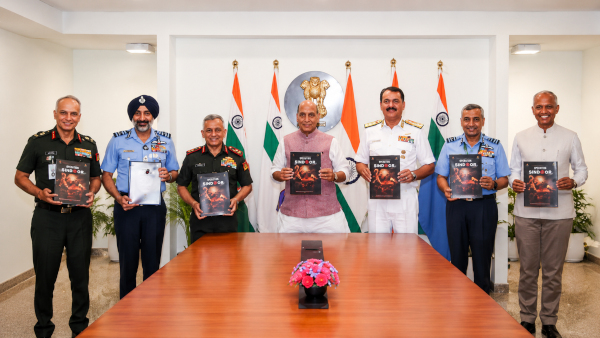
India’s military history received a deeply human addition on 29 May 2026, when Raksha Mantri Rajnath Singh released a commemorative volume on Operation Sindoor, a publication that records the personal testimonies of 100 officers, sailors, airmen and other soldiers who took part in the operation. The book marks an important shift in the way modern military success is remembered. It moves beyond maps, targets, platforms and command briefings, and brings the reader closer to the men and women who carried the weight of the mission in real time.
Operation Sindoor already occupies a major place in India’s contemporary security narrative. According to official government accounts, the operation was launched as a calibrated response to cross-border terrorism, with India targeting terrorist infrastructure in Pakistan and Pakistan-occupied Jammu and Kashmir after detailed multi-agency intelligence identified nine key terror camps, including sites in Bahawalpur and Muridke. The Defence Minister has described the operation as an unprecedented success in which India compelled Pakistan to seek a ceasefire within four days, while also underlining that the operation differed from India’s earlier wars in its character, speed and precision.
The new commemorative book is significant because it treats warfare as something larger than the final strike order or the strategic outcome. Modern operations are often remembered through the language of doctrine: jointness, deterrence, precision, escalation control, intelligence fusion and integrated command. These terms are essential, yet they can leave out the living texture of war. The soldier on the Line of Control, the air defence operator watching hostile drones on a screen, the pilot at the moment of weapons release, the sailor standing at action stations and the logistician keeping the chain alive all experience war as pressure, judgement and duty compressed into seconds. The publication attempts to preserve that battlefield texture.
This is where the volume becomes more than a record of an operation. It becomes a bridge between national strategy and individual courage. The Defence Minister’s message frames the book as a tribute to those who executed the mission, highlighting the devotion and resilience of soldiers. He also urged citizens to draw inspiration from the publication and become worthy of the cost the nation pays to secure its sovereignty. That idea gives the volume a civic dimension. It reminds the reader that national security is carried by real people, real families and real sacrifice.
Operation Sindoor also stands out as a case study in modern joint warfare. Official accounts describe it as an operation that unfolded across land, air and sea, demonstrating coordination between the Army, Navy and Air Force. Rajnath Singh has previously called it a shining example of jointness and synergy, saying the three Services acted under a unified plan and showed that India’s military power had moved into a more integrated form. The commemorative volume reflects the same tri-service nature by including voices from across the Services, Headquarters Integrated Defence Staff and joint organisations.
The range of testimonies gives the book its operational depth. PIB states that the accounts include combat aviators, naval watchkeepers, surface-to-air missile crews, special forces operators, signallers, logisticians, medical officers and personnel from integrated organisations. This variety matters because modern warfare works through networks. A precision strike depends on intelligence collection, command approval, mission planning, electronic awareness, communications discipline, platform readiness, battlefield medicine, logistics and air defence cover. The final act visible to the public is only the sharp edge of a much larger system.
The book also highlights the changing nature of India’s security response. Operation Sindoor was framed by the government as a limited but precise military campaign against terrorist infrastructure. Official material says the operation followed a “microscopic scan” of the terror landscape and selected confirmed targets based on multi-agency intelligence. This indicates a model of warfare where intelligence, technology and restraint operate together. The emphasis lies on identifying the correct target, striking with accuracy and maintaining control over the wider escalation ladder.
Another important element is the role of air defence and counter-drone capability. The PIB release specifically refers to the air defence operator tracking and neutralising inbound drones as one of the lived experiences captured by the book. This detail is crucial in the age of drone warfare. Modern conflict increasingly involves unmanned systems, loitering munitions, electronic warfare and long-range precision weapons. A soldier’s battlefield may now be a radar screen, a command console or an electronic warfare station as much as a trench or a forward post.
The release ceremony itself reflected the institutional importance attached to the publication. The event in New Delhi was attended by Chief of Defence Staff General Anil Chauhan, Chief of the Naval Staff Admiral Dinesh K Tripathi, Chief of the Army Staff General Upendra Dwivedi and Chief of the Air Staff Air Chief Marshal AP Singh. Their presence underlined that the book belongs to the broader story of India’s integrated military transformation, where individual bravery and institutional reform move together.
The volume was compiled under the guidance of the Chief of Defence Staff. Contributions came from the Additional Directorate General of Strategic Communication, the Media and Public Information Cell and the Directorate of Media and Public Relations, while publication support was provided by the United Service Institution of India. This gives the project both official military grounding and historical value, placing soldiers’ voices inside a structured national record.
At its core, the book appears to answer one important question: how does strategy become success? The Defence Minister’s message gives the answer in human terms — leadership, courage, judgement under pressure and commitment. Weapons, platforms and plans create capability, but people convert capability into action. Operation Sindoor’s commemorative volume therefore preserves the human engine behind India’s modern military power.
For India, this publication is also a message to future generations. It tells young citizens that military history is built by those who act under pressure with discipline and purpose. It tells soldiers that their experience matters beyond the classified file and the after-action report. It tells scholars and readers that the future of warfare will be understood fully only when strategy, technology and human resolve are studied together.
Operation Sindoor will be remembered for its precision, its tri-service execution and its strategic impact. With this commemorative book, it will also be remembered through the voices of those who stood at their posts, readied their weapons, watched the skies, guarded the seas, treated the wounded, moved supplies and carried out the mission. That is the real strength of the volume: it turns an operation into a living record of courage.
Reference: PIB
You may also like
-
PRAHAAR: India’s First National Counter-Terrorism Policy and Strategy
-
Takshak Heavyweight Torpedo: How India’s Indigenous Submarine Weapon Compares With the World’s Leading Torpedoes
-
Embraer Builds Dual Aerospace Strategy in India Through C-390 Military and E175 Regional Aircraft Programmes
-
NextLeap Tests Indigenous Jet Engine for Long-Range Stryker Kamikaze UAV
-
Côte d’Ivoire Military Delegation Visits HAL, Shows Interest in India’s Indigenous Aerospace Platforms
