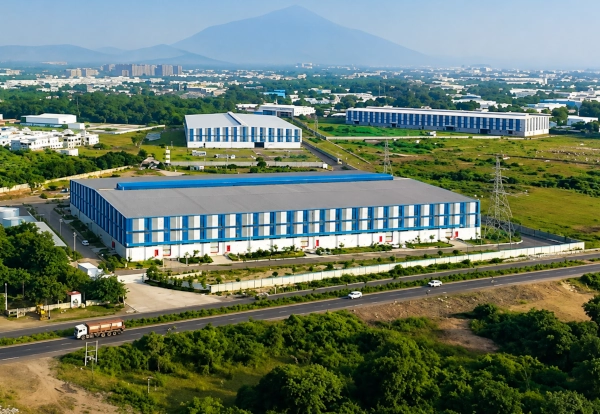
Octillion Power Systems has expanded its manufacturing footprint in India with the commissioning of its third electric vehicle battery plant, located at Halol in Gujarat. The new facility adds more than 3 GWh of annual battery production capacity and strengthens the company’s position in India’s rapidly growing electric mobility market.
Spread across more than 13,000 square metres, the Halol plant was converted from an empty industrial structure into a fully operational battery manufacturing facility in less than eight months. At full utilisation, it is expected to produce more than 48,000 battery systems annually, catering to a wide range of electric vehicles including passenger cars, light commercial vehicles, trucks and buses.
With the commissioning of the Gujarat facility, Octillion’s combined manufacturing capacity in India is projected to exceed 150,000 battery systems a year, representing approximately 9 GWh of annual energy-storage capacity.
India Becomes a Major Manufacturing Base
The expansion reflects the growing importance of India in Octillion’s global electric mobility strategy.
India’s EV market is broadening rapidly beyond the two-wheeler segment, with stronger adoption now visible in passenger cars, commercial vehicles, buses and electric trucks. This diversification is creating demand for larger and more sophisticated battery packs capable of meeting very different operating conditions, from urban passenger transport to heavy-duty logistics.
Octillion Global President Paul Beach described India as one of the company’s most important growth markets and said the Halol facility reflects its long-term commitment to developing production capacity close to customers.
The ability to establish the plant in less than eight months also underlines the company’s attempt to scale manufacturing quickly as domestic EV demand accelerates.
3 GWh Capacity Targets Cars, Trucks and Buses
The Halol plant has been designed to manufacture battery systems for multiple vehicle categories rather than serving a single segment.
This is significant because battery requirements vary considerably across electric vehicles. Passenger cars prioritise energy density, weight and packaging efficiency, while buses and commercial vehicles require durability, thermal stability, high cycle life and the ability to operate reliably under heavy daily utilisation.
Octillion combines battery-pack manufacturing with thermal modelling, battery-management systems and system integration, allowing it to configure products around the specific requirements of vehicle manufacturers.
Local production could also reduce delivery times and provide automakers with greater flexibility as they increase electric vehicle production volumes.
EV Demand Accelerates Across India
The timing of the expansion coincides with strong growth in the Indian electric vehicle market.
According to figures cited from JMK Research, EV sales in India increased approximately 43 per cent year-on-year during the first half of 2026, crossing 1.54 million units.
Electric passenger vehicle sales reportedly increased by 83 per cent, while electric bus sales grew by approximately 42 per cent during the same period.
The electric truck market, although starting from a considerably smaller base, has also begun expanding rapidly. Cumulative electric truck sales reportedly increased by more than 300 per cent year-on-year, reflecting growing interest from logistics companies, industrial operators and fleet owners seeking to reduce fuel and operating costs.
This shift is particularly important for battery manufacturers because buses and trucks require substantially larger battery packs than scooters or motorcycles, meaning growth in heavy electric vehicles can generate disproportionately high demand for battery manufacturing capacity.
Building a More Localised Battery Supply Chain
Octillion’s expansion also comes amid a broader effort to increase localisation within India’s battery and electric vehicle supply chain.
India remains dependent on imported battery cells and several critical raw materials, but domestic capabilities in battery-pack assembly, battery management systems, thermal engineering, electronics and vehicle integration are expanding rapidly.
Octillion says the Halol facility is intended to deepen local sourcing and engineering rather than simply increase physical manufacturing space.
The company’s Senior Vice President, Nikhil Parchure, emphasised that a resilient Indian EV supply chain requires greater local sourcing, domestic quality control and Indian engineering capability operating alongside global manufacturing standards.
This approach could become increasingly important as automakers seek to reduce exposure to disruptions in international logistics and battery-component supply chains.
Gujarat Strengthens Its EV Manufacturing Position
The choice of Halol also reinforces Gujarat’s growing role in India’s automotive and clean-energy manufacturing ecosystem.
The state already hosts a substantial automobile manufacturing base, supported by industrial infrastructure, ports and supplier networks. Additional battery manufacturing capacity can complement this ecosystem by locating one of the most important and expensive electric vehicle components closer to vehicle-production centres.
Battery packs represent a significant proportion of the total cost of an electric vehicle, making domestic manufacturing and localisation important for reducing production costs and improving supply-chain stability.
As EV volumes increase, proximity between battery suppliers and vehicle manufacturers can also simplify logistics and enable faster changes to battery design and vehicle integration.
From Battery Assembly to Engineering Capability
The strategic value of facilities such as Halol goes beyond the number of battery packs produced.
Modern EV batteries are integrated systems involving cells, structural packaging, cooling, high-voltage electronics, software and battery-management systems. Their performance depends on maintaining individual cells within precise temperature and operating ranges while continuously monitoring charge, health and safety parameters.
Building greater capability in these areas can gradually shift India’s EV ecosystem from basic battery assembly towards higher-value battery engineering and system development.
Octillion’s emphasis on thermal modelling and integrated battery-management technology suggests that the Halol plant will form part of this broader technological transition.
Supporting India’s 2030 Electrification Push
India’s long-term electrification ambitions are expected to create substantial demand for battery systems through the remainder of the decade.
Government policy has aimed at considerably increasing electric vehicle penetration across private cars, commercial vehicles, buses and two- and three-wheelers by 2030. While actual market penetration will depend on vehicle prices, charging infrastructure, battery costs and consumer adoption, the direction of the market is increasingly clear.
Manufacturers are consequently expanding capacity ahead of future demand rather than waiting for EV penetration to reach mature levels.
For Octillion, the 3 GWh Halol facility therefore represents both an immediate manufacturing expansion and a longer-term bet on the growth of electric mobility in India.
With total Indian capacity expected to reach around 9 GWh annually, the company is positioning itself to supply increasingly large numbers of passenger vehicles, commercial fleets and public transport systems.
The opening of the Halol plant also reflects a wider transformation in India’s EV industry. The country is no longer focused solely on increasing electric vehicle sales; attention is increasingly shifting towards building the domestic battery, electronics and engineering ecosystem required to support those vehicles at scale.
As that transition gathers pace, battery manufacturing facilities such as Octillion’s new Gujarat plant could become an increasingly important part of India’s emerging electric mobility supply chain.
You may also like
-
India’s Economic Warfare Challenge: Strategic Autonomy, Energy Security and the Rise of a Global Power
-
India-US Trade Deal Stalemate: Why Washington’s Tariff Pressure Has Failed to Secure an Agreement
-
US Double Standards in Foreign Policy: 16 Recent Cases Involving India, Russia, China and Global Trade
-
India’s Arctic Energy Ambitions: Russian Oil, LNG and a New Sea Route to Indian Ports
-
India and Russia Explore Joint Icebreaker Construction as Maritime Industrial Cooperation Expands
