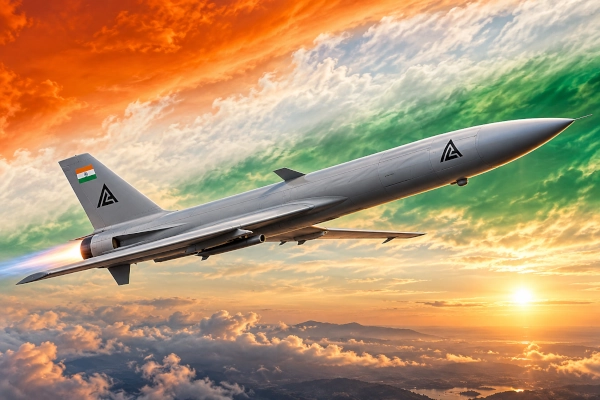
Indian defence technology company NextLeap Aeronautics has successfully completed a static test of the indigenous jet engine being developed for its Stryker high-speed unmanned strike aircraft, clearing an important propulsion milestone ahead of further aircraft integration and flight development.
NextLeap announced the test on October 1, 2026, stating that both the aircraft and its propulsion system represent indigenous development. The Stryker airframe has been developed by NextLeap Aeronautics, while the jet engine has been developed and tested in collaboration with Indian gas-turbine specialist Dheya Engineering Technologies.
The programme brings together two capabilities that remain technologically demanding for India’s private aerospace industry: high-speed unmanned aircraft design and small indigenous jet propulsion.
Static Test Validates a Critical Part of the Propulsion Programme
The latest milestone involved a static engine test rather than a flight of the complete Stryker aircraft.
During static testing, an engine is operated on a secured test installation so engineers can evaluate its behaviour without installing it in a flying platform. Such trials can generate data on thrust, fuel delivery, operating temperatures, vibration, stability and other propulsion parameters required before progressing towards integrated aircraft testing.
NextLeap described the test as part of its continuing research and development programme and said it would support the next stages of aircraft development and integration.
The announcement does not indicate that the complete strike configuration has yet conducted a long-range powered flight. It should therefore be viewed as a propulsion-development milestone rather than the completion of Stryker’s overall flight-test programme.
Stryker Designed as a High-Speed Deep-Strike UAV
NextLeap describes Stryker as a next-generation kamikaze deep-strike unmanned aerial platform intended for precision attacks against high-value defence targets.
The company has specifically identified radar networks, airbases and strategic targets among the potential target categories for the system.
Unlike electrically powered or piston-engined loitering munitions designed primarily around endurance, Stryker uses jet propulsion to emphasise speed during penetration and attack.
NextLeap has publicly stated that Stryker is designed to cruise at more than 550 km/h, placing it in a different performance class from many conventional propeller-driven one-way attack drones.
The company also describes the platform as combining high speed with extended range, although its latest official disclosures do not provide a verified maximum operational range.
Jet Propulsion Changes the Stryker Concept
The decision to use a jet engine gives Stryker a different operational philosophy from slower loitering munitions.
A conventional loitering munition may remain airborne for an extended period while searching for a target. A high-speed deep-strike platform instead places greater emphasis on covering distance quickly and reducing the time available to respond once it enters the defended area.
At a company-stated cruise speed above 550 km/h, Stryker would travel approximately nine kilometres every minute under idealised cruise conditions.
That does not make the aircraft immune to interception. Modern air-defence systems employ combinations of radar, electronic warfare, surface-to-air missiles, guns and other counter-UAS technologies. Actual survivability would depend on flight altitude, route planning, radar signature, electronic environment and the capabilities of the defending network.
The significance of Stryker is therefore its attempt to combine the relatively lower cost and unmanned nature of a one-way strike aircraft with speeds substantially higher than those of many propeller-driven attack drones.
Dheya Engineering Brings Indigenous Micro-Turbojet Expertise
The propulsion partnership builds on an earlier agreement between NextLeap Aeronautics and Dheya Engineering Technologies to develop turbojet-powered unmanned aircraft for defence applications.
Dheya previously disclosed development of its DET-500 turbojet engine, which the company described as capable of producing approximately 50 kg of thrust.
Under the earlier collaboration, NextLeap planned to integrate indigenous turbojet technology into unmanned platforms that could serve as aerial targets as well as jet-powered kamikaze systems.
The latest Stryker test confirms that the two companies have progressed from collaboration plans into physical engine testing. However, NextLeap has not publicly identified the precise engine designation used during the October 2026 static test, so it should not automatically be assumed to be an unchanged DET-500 configuration.
Small Jet Engines Are a Strategic Technology
Compact gas-turbine engines are important building blocks for several classes of unmanned and precision-strike systems.
They can potentially power high-speed aerial targets, reconnaissance platforms, one-way attack UAVs and other specialised unmanned aircraft. Related propulsion technologies are also relevant to larger classes of expendable aerial systems.
Designing such engines requires mastery of high-speed rotating components, combustion, thermal management, fuel systems, bearings, precision machining and high-temperature materials.
Indigenous capability in this field can therefore have value beyond a single aircraft programme.
Even when an engine begins with one UAV application, improvements in efficiency, reliability and manufacturing processes can support later propulsion systems with different thrust levels.
Stryker Also Exists as an Aerial Target Platform
NextLeap’s work on the Stryker family predates the latest strike configuration.
The company announced in 2026 that it had delivered Stryker aerial target airframes to an Indian defence agency. It described the delivery as demonstrating its ability to design and manufacture high-performance indigenous aerial systems.
Aerial targets are used to simulate airborne threats during training, weapon evaluation and air-defence exercises.
Developing an airframe first around target applications can provide valuable experience with aerodynamics, manufacturing, launch procedures, flight control and recovery or expendable mission profiles before increasingly sophisticated variants are introduced.
The deep-strike Stryker represents a further development of the company’s high-speed unmanned aircraft work rather than an isolated concept.
Indigenous Propulsion Gives Greater Control Over the Platform
Domestic production of both the air vehicle and its engine has particular significance for defence systems.
Imported propulsion can create dependence on foreign suppliers for engines, spare parts, technical documentation and future upgrades. Export restrictions can also affect systems containing controlled foreign components.
An indigenous propulsion chain gives developers greater freedom to modify an aircraft around Indian requirements.
Engine control, fuel capacity, airframe integration and mission performance can be developed together instead of designing the aircraft around an externally supplied propulsion unit with limited modification rights.
It can also improve the prospects for localisation of maintenance and eventual production scaling.
Integration Will Be the Next Major Engineering Stage
Successful static engine testing does not by itself produce an operational aircraft.
The propulsion unit must next function as part of the complete airframe.
Engine installation can affect the aircraft’s centre of gravity, inlet airflow, fuel distribution, thermal environment and structural loading. Engineers must ensure that vibration and heat do not interfere with electronics, control systems or other onboard equipment.
Ground integration would normally be followed by progressively more demanding trials before the platform can establish its actual flight envelope.
The company has not announced a schedule for Stryker’s integrated flight trials or operational qualification.
Navigation and Guidance Will Determine Strike Effectiveness
High speed and range provide only part of the capability required for a deep-strike unmanned aircraft.
A precision attack system must also navigate accurately over long distances and reach its intended target despite changing weather, terrain and potential electronic interference.
Modern unmanned strike platforms can combine inertial navigation with satellite navigation and other guidance methods, although NextLeap has not publicly disclosed the complete navigation architecture of the current Stryker configuration.
Resilience against electronic warfare becomes particularly important in long-range operations because satellite navigation and communications may be degraded or denied.
NextLeap describes its wider defence UAV portfolio as being developed for contested operational environments, but detailed Stryker electronic-warfare specifications remain undisclosed.
Deep-Strike UAVs Occupy a Growing Role in Modern Warfare
Recent conflicts have demonstrated the increasing military relevance of long-range one-way attack drones.
Their attraction lies partly in economics. Armed forces can use unmanned systems to attack fixed infrastructure without risking an aircrew or committing a much more expensive combat aircraft to every target.
Jet-powered systems potentially add another layer by shortening transit time and increasing terminal speed.
They also create new demands on air-defence networks because defenders must detect, classify and engage threats that can vary widely in speed, altitude, size and radar signature.
India’s development of multiple UAV categories therefore reflects a broader shift towards layered unmanned capabilities rather than dependence on a single type of drone.
Private Indian Companies Are Moving Into Propulsion Development
Stryker is also notable for the industrial model behind it.
Both NextLeap Aeronautics and Dheya Engineering Technologies are Indian private-sector technology companies. Their partnership illustrates the growing role of smaller aerospace firms in areas previously dominated by major government laboratories and large defence manufacturers.
NextLeap says it has developed full-stack capabilities covering UAV design, engineering, manufacturing and flight testing. The company works across agricultural, logistics, surveillance and defence-oriented unmanned systems.
Dheya’s focus on gas-turbine engineering adds specialised propulsion expertise to that ecosystem.
Such partnerships allow companies with different technical strengths to combine airframe, propulsion, electronics and manufacturing capabilities without requiring every subsystem to be developed within a single organisation.
An Indigenous Supply Chain Could Extend Beyond Stryker
A successful jet-powered UAV programme can create demand for a much wider group of Indian suppliers.
Precision-machined engine components, electronic control units, fuel pumps, composite structures, actuators, sensors, wiring systems and flight-control computers all form part of the aircraft manufacturing chain.
Production programmes also require test equipment, tooling, software and quality-assurance systems.
Building these capabilities domestically can support future unmanned aircraft programmes even when their designs differ substantially from Stryker.
The value of the engine test is consequently not limited to one prototype. It contributes engineering knowledge that can be reused across India’s developing unmanned aerospace sector.
Stryker Programme Moves Towards Aircraft Integration
NextLeap Aeronautics has now established several elements of the Stryker programme: an indigenous airframe, previous aerial-target deliveries, a high-speed deep-strike configuration and an Indian-developed jet propulsion partnership.
The October 2026 static test adds propulsion validation to that progression.
Several important milestones remain before the performance of the complete strike platform can be assessed, including integrated engine-airframe testing, flight trials and validation of its stated high-speed characteristics under operationally representative conditions.
The programme nevertheless demonstrates that Indian private-sector companies are moving into increasingly complex areas of unmanned aerospace engineering. Combining an indigenous high-speed airframe with domestically developed jet propulsion gives Stryker particular significance within India’s expanding drone ecosystem and establishes a technological base that can support future generations of Indian unmanned aircraft.
References
NextLeap Aeronautics Pvt. Ltd. — Official announcement on successful static testing of the indigenous jet engine developed for Stryker, October 1, 2026.
NextLeap Aeronautics Pvt. Ltd. — Official Stryker programme communication describing the platform as a high-speed deep-strike kamikaze UAV with a cruise speed exceeding 550 km/h, 2026.
NextLeap Aeronautics Pvt. Ltd. — Official announcement on delivery of Stryker aerial target airframes to an Indian defence agency, 2026.
Dheya Engineering Technologies Pvt. Ltd. — Official communication announcing collaboration with NextLeap Aeronautics for turbojet-powered UAV development and details of the DET-500 engine.
You may also like
-
Takshak Heavyweight Torpedo: How India’s Indigenous Submarine Weapon Compares With the World’s Leading Torpedoes
-
Embraer Builds Dual Aerospace Strategy in India Through C-390 Military and E175 Regional Aircraft Programmes
-
Côte d’Ivoire Military Delegation Visits HAL, Shows Interest in India’s Indigenous Aerospace Platforms
-
Hindustan Shipyard to Serially Produce Indigenous JAYA Autonomous Underwater Vehicle After CSIR-NIO Technology Transfer
-
India Expands Smart Anti-Airfield Weapon Family with Satellite and Electro-Optical Guidance
