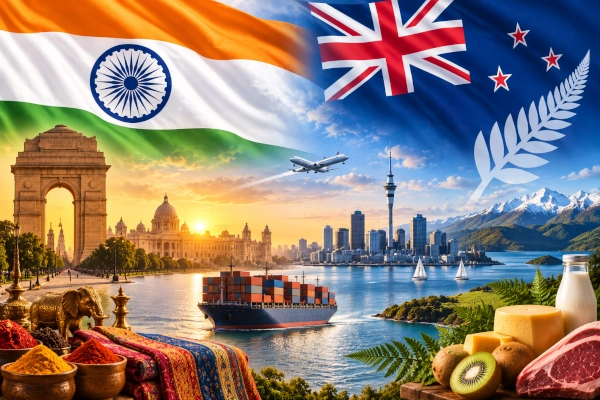
New Zealand’s Parliament has approved legislation required to implement the country’s Free Trade Agreement with India, clearing one of the final domestic hurdles before the landmark trade pact can enter into force.
The India Free Trade Agreement legislation was passed on September 16 by a vote of 93 to 29, according to the New Zealand Government. Trade and Investment Minister Todd McClay said the parliamentary approval demonstrated broad support for the agreement and moved New Zealand closer to implementing the trade commitments negotiated with India.
The legislation is an omnibus measure that amends New Zealand law to give effect to the Free Trade Agreement signed by the two governments in New Delhi on April 27, 2026. New Zealand Parliament records show that the implementation bill was introduced in June, examined by the Foreign Affairs, Defence and Trade Committee and subsequently returned to the House before completing the remaining parliamentary stages.
Indian Exports to Receive Complete Duty-Free Access
For India, one of the most important outcomes of the agreement is complete tariff elimination in the New Zealand market. The Government of India has confirmed that 100 per cent of Indian exports, covering all tariff lines, will receive duty-free access to New Zealand from the date the agreement enters into force.
The change is expected to improve the competitiveness of Indian products in sectors where New Zealand had previously maintained tariffs of up to 10 per cent. Indian officials have identified textiles, apparel, leather, footwear, engineering products, processed foods, gems and jewellery among the labour-intensive sectors expected to benefit from zero-duty access.
The agreement also includes wider commitments covering services, professional mobility and investment. According to the Government of India, it carries an investment commitment of USD 20 billion over 15 years, alongside provisions intended to expand opportunities for Indian professionals, students, businesses and service providers.
India Opens Market While Protecting Sensitive Sectors
India has not offered unrestricted tariff elimination across its entire market. Government of India documents state that New Delhi has provided market access across approximately 70 per cent of tariff lines, covering about 95 per cent of New Zealand’s bilateral trade, while retaining exclusions for a range of politically and economically sensitive products.
Among the protected categories are dairy products such as milk, cream, yoghurt and cheese, along with several agricultural products, sugar, edible oils and other sensitive goods. The exclusions were designed to prevent the FTA from exposing vulnerable domestic agricultural and rural sectors to unrestricted import competition.
For New Zealand exporters, the agreement nevertheless represents a substantial expansion of market access. The New Zealand Government says 57 per cent of its existing exports to India will become duty-free immediately when the agreement takes effect. Once the tariff commitments are fully implemented, tariffs will either be eliminated or significantly reduced across about 95 per cent of New Zealand’s current exports to India.
New Zealand’s Ministry of Foreign Affairs and Trade says the agreement provides significant improvements for products ranging from forestry and wool to seafood, horticulture and industrial goods. More than 95 per cent of existing forestry exports will receive immediate tariff-free treatment, while tariffs on several other products will be phased down over agreed periods.
Agreement Extends Beyond Tariff Cuts
The FTA also addresses customs procedures, services and regulatory barriers that can affect trade even when tariffs are low. The New Zealand Government says the agreement will provide faster border clearance and improved access for businesses seeking to expand into the Indian market. It also includes most-favoured-nation commitments in selected services sectors and provisions affecting future treatment of products such as wine.
For India, the agreement contains substantial provisions covering services and professional mobility. Official Indian documents say New Zealand has offered commitments across 118 service sectors, along with a dedicated temporary employment pathway for up to 5,000 Indian professionals and post-study work opportunities for eligible students in science, technology, engineering and mathematics fields.
The agreement additionally provides for agricultural cooperation, including productivity partnerships and proposed Centres of Excellence involving products such as apples and kiwifruit. India has sought to combine such technical cooperation with safeguards that prevent the arrangement from undermining sensitive domestic agricultural producers.
Trade Relationship Has Considerable Room to Expand
Despite growing political and economic engagement, India and New Zealand have until now maintained a relatively modest trade relationship compared with the size of the two economies. New Zealand’s Ministry of Foreign Affairs and Trade currently places annual two-way trade at about NZ$3.95 billion.
Both governments see the FTA as a mechanism for expanding that relationship. The two prime ministers have set a goal of doubling bilateral trade by 2030, while the tariff and services commitments are intended to give companies on both sides greater incentive to establish commercial relationships that were previously constrained by duties and market-access barriers.
FTA Moves Closer to Implementation
The passage of the implementing legislation by New Zealand’s Parliament marks an important step towards bringing the India–New Zealand Free Trade Agreement into operation. The agreement will formally enter into force once both countries complete their respective ratification procedures, with the New Zealand Government expecting implementation during 2026.
The September 16 parliamentary approval therefore moves the FTA significantly closer to the point at which businesses in both countries can begin benefiting from the negotiated tariff concessions. Once the remaining formalities are completed, Indian exporters will gain complete duty-free access to the New Zealand goods market, while New Zealand exporters will receive the phased tariff concessions agreed with India.
For India, the agreement opens wider opportunities for exporters while preserving safeguards for sensitive agricultural sectors. For New Zealand, it provides improved access to one of the world’s largest and fastest-growing consumer markets. The agreement also creates a stronger foundation for expanding bilateral trade, investment and business partnerships across a wider range of sectors.
With New Zealand’s parliamentary process now completed, the FTA has moved another step closer to implementation. The next phase will be the completion of the remaining ratification procedures, paving the way for businesses, exporters and investors in both countries to begin turning the agreement into new commercial opportunities during 2026.
Reference:
New Zealand Government — Beehive, 16 September 2026
India FTA passes with significant majority — confirms passage of the India Free Trade Agreement legislation by 93–29 in the New Zealand Parliament.
New Zealand Government release
New Zealand Parliament — India Free Trade Agreement Legislation Amendment Bill
Official parliamentary record of the implementing legislation, including its purpose, introduction, committee consideration and legislative progress.
New Zealand Parliament bill record
New Zealand Ministry of Foreign Affairs and Trade — NZ–India FTA Key Outcomes
Official details on tariff reductions, New Zealand market access, customs provisions, investment cooperation and the US$20 billion private-sector investment promotion commitment over 15 years.
MFAT key outcomes
New Zealand Ministry of Foreign Affairs and Trade — New Zealand–India Free Trade Agreement
Official FTA portal confirming that the agreement was signed on 27 April 2026, with agreement text, trade data, resources and implementation information.
MFAT India FTA portal
Government of India — Press Information Bureau, Ministry of Commerce & Industry, 27 April 2026
Union Minister Piyush Goyal and New Zealand Trade Minister Todd McClay sign landmark India–New Zealand Free Trade Agreement — confirms 100% duty-free access for Indian exports, services and mobility provisions, tariff exclusions and the investment commitment.
PIB official release
Government of India — PIB Backgrounder, 27 April 2026
India–New Zealand Free Trade Agreement Signed — detailed official breakdown of tariff lines, protected sectors, state-wise opportunities and bilateral trade provisions.
PIB FTA backgrounder
You may also like
-
India’s Satellite Broadband Industry Nears Commercial Launch as Bharti OneWeb, Jio and Starlink Await Final Approvals
-
India’s Defence Electronics Industry Expands as BEL, Astra Microwave and Private Manufacturers Strengthen Indigenous Supply Chains
-
India’s Private Space Sector Creates New Opportunities for Young Engineers, Helps Reduce Brain Drain
-
IndigoTex Raises ₹5 Crore to Scale Indigenous Advanced Textile Technologies
-
Sunfox Technologies Raises $7 Million to Take India-Built Spandan ECG Platform Global
