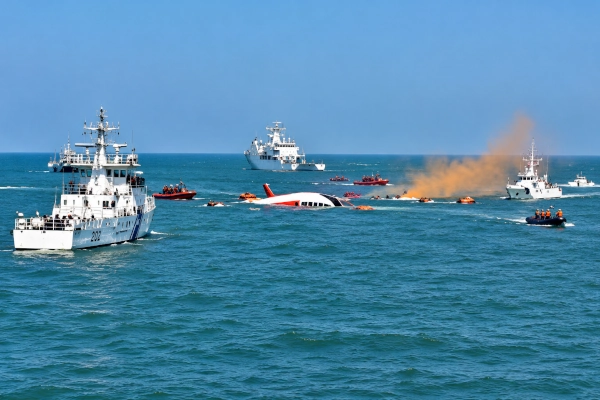
India demonstrated its maritime search-and-rescue capabilities during the 12th National Maritime Search and Rescue Exercise (SAREX-2026), conducted by the Indian Coast Guard off the Paradip coast in Odisha on October 8, 2026. The large-scale exercise brought together naval vessels, military aircraft, helicopters and civilian agencies to test coordinated responses to complex maritime emergencies.
The exercise attracted 32 international observers from 30 countries, reflecting India’s expanding engagement with international partners in maritime safety and emergency response. It was conducted under the aegis of the National Maritime Search and Rescue Board (NMSARB) and reviewed by Indian Coast Guard Director General Paramesh Sivamani.
Organised around the theme Leveraging Technology to Strengthen SAR Preparedness and Maritime Safety, SAREX-2026 focused on operational readiness, inter-agency coordination and the application of advanced technologies to save lives at sea.
Indian Coast Guard Deploys 15 Ships and Multiple Aircraft
SAREX-2026 involved a substantial deployment of maritime and aviation assets to simulate a major emergency in the Bay of Bengal.
The Indian Coast Guard deployed 15 ships, three Dornier aircraft, three Advanced Light Helicopters and one Chetak helicopter. The Indian Air Force contributed a C-130J transport aircraft and a Mi-17 helicopter, while the Indian Navy deployed two ships.
Civilian vessels, state resources and shore-based support units also participated, creating a coordinated response network involving multiple organisations.
The exercise brought together the Indian Coast Guard, Indian Navy, Indian Air Force, Shipping Corporation of India, Directorate General of Shipping, Fisheries Department, Customs, Marine Police, Paradip Port Authority and the Odisha administration.
The deployment demonstrated the importance of integrating maritime surveillance, aviation support, rescue vessels and shore-based emergency services during large-scale incidents.
Exercise Simulates Aircraft Crash and Collision with Container Ship
The principal operational scenario involved a simulated mass rescue operation following simultaneous aviation and maritime emergencies.
Under the exercise scenario, a passenger aircraft carrying 228 people was forced to ditch at sea near Paradip Port. Its fuselage subsequently struck a container vessel identified as MV Zumba, causing structural damage and a fire aboard the ship.
The simulated emergency required participating agencies to respond to several challenges simultaneously, including rescuing aircraft passengers, assisting personnel aboard the damaged vessel and controlling the onboard fire.
Such scenarios are particularly demanding because they require the rapid identification and prioritisation of casualties, effective communication between responding units and coordination of rescue activities across air and sea.
The exercise tested how different agencies could combine their available resources rather than conduct independent rescue operations.
The scenario was a planned simulation and did not involve an actual passenger aircraft accident or collision.
Helicopter Evacuations and Specialised Rescue Equipment Tested
The search-and-rescue demonstration incorporated several operational procedures used during maritime emergencies.
Participating agencies activated an Incident Command Post to coordinate the response, direct available assets and manage rescue operations.
Helicopters conducted simulated evacuations, while rescue teams demonstrated the deployment of life rafts and air-droppable life rafts for people requiring assistance at sea.
The exercise also included Jason Cradle and Gemini recovery operations, rescue basket procedures and the use of scramble nets.
A Jason Cradle is specialised rescue equipment used to recover people from the water or transfer casualties to a vessel. Rescue baskets enable helicopters to lift individuals from difficult maritime environments, while scramble nets provide a means of boarding rescue vessels.
These systems are particularly relevant when survivors are injured, exhausted or unable to climb aboard rescue craft independently.
The exercise allowed personnel to practise different recovery methods and assess their suitability for challenging rescue situations.
Remotely Operated Vehicle Demonstrates Maritime Rescue Technology
A notable technological component of SAREX-2026 was the demonstration of a Remotely Operated Vehicle (ROV).
ROVs are unmanned underwater platforms controlled by operators, typically through a tethered communication link. Depending on their configuration, they can carry cameras, lights, sensors and specialised equipment for underwater inspection.
Such vehicles can support maritime emergency operations by examining submerged objects, inspecting damaged structures and providing underwater visual information without immediately exposing divers to hazardous conditions.
Their usefulness extends to underwater searches, inspection of vessel hulls and assessment of obstacles that may complicate rescue operations.
The inclusion of an ROV demonstration reflected the exercise’s emphasis on integrating emerging technologies into maritime search-and-rescue activities.
The Ministry of Defence did not identify the manufacturer or technical specifications of the ROV demonstrated during the exercise.
India Strengthens Maritime Cooperation with 30 Countries
The presence of 32 observers from 30 countries added an important international dimension to SAREX-2026.
Their participation provided opportunities to observe Indian search-and-rescue procedures, exchange operational knowledge and study approaches to coordinating complex maritime emergencies.
Maritime search and rescue frequently requires cooperation between countries because commercial shipping routes and international waters extend beyond national boundaries.
A vessel experiencing an emergency may require assistance from the nearest available maritime authorities, regardless of its country of registration.
International interoperability therefore becomes essential for sharing distress information, coordinating aircraft and vessels, and transferring rescued personnel.
The Ministry of Defence stated that the exercise strengthened the exchange of best practices and demonstrated India’s role as a dependable maritime search-and-rescue partner.
The international delegates participated as observers, while Indian military and civilian agencies conducted the operational demonstration.
National Maritime Search and Rescue Board Reviews Emergency Preparedness
SAREX-2026 was preceded by the 24th National Maritime Search and Rescue Board meeting on October 7, chaired by Director General Paramesh Sivamani.
The board reviewed India’s maritime emergency response capabilities across the 4.6 million square kilometre Indian Search and Rescue Region.
Discussions focused on technological integration, real-time information sharing, distress-alert management, vessel tracking and coordination between participating organisations.
India’s maritime search-and-rescue responsibilities cover an extensive area of the Indian Ocean, requiring effective surveillance, reliable communication networks and the ability to deploy assets over considerable distances.
The Indian Coast Guard serves as the national maritime search-and-rescue coordinating authority. Its operational framework includes Maritime Rescue Coordination Centres at Mumbai, Chennai and Port Blair, supported by regional rescue sub-centres.
These facilities coordinate responses to maritime emergencies and help identify available ships, aircraft and other resources.
The board meeting also recognised exceptional contributions to maritime rescue operations through the National Maritime Search and Rescue Awards 2026.
Satellite-Based Search and Rescue Strengthens India’s Maritime Safety Network
Technology-enabled search and rescue received particular attention during the programme’s inauguration on October 7.
Minister of State for Defence Sanjay Seth highlighted India’s progress in satellite-assisted maritime rescue capabilities, including the evolution from Low Earth Orbit Search and Rescue (LEOSAR) to Geostationary Search and Rescue (GEOSAR) and more advanced Medium Earth Orbit Search and Rescue (MEOSAR) systems.
Satellite-based search-and-rescue systems help authorities detect distress signals transmitted by emergency beacons carried aboard ships, aircraft and other platforms.
These signals can support the identification and location of emergencies, enabling rescue coordination centres to direct appropriate resources towards the affected area.
The Minister highlighted the achievement of full operational capability of India’s Medium Earth Orbit Local User Terminal (MEOLUT), describing it as an important advancement in the country’s satellite-aided search-and-rescue infrastructure.
The capability supports faster detection and processing of distress alerts, strengthening the technological foundation of India’s maritime emergency response network.
The involvement of ISRO and associated organisations also demonstrates how India’s space technologies contribute directly to maritime safety.
Search and Rescue Remains a Core Indian Coast Guard Responsibility
The Indian Coast Guard is responsible for coordinating maritime search-and-rescue operations within India’s designated search-and-rescue region.
Its responsibilities include responding to distress calls, coordinating rescue missions, assisting vessels in emergencies and protecting lives at sea.
The organisation operates the Indian Search and Rescue Computerised Ship Reporting System (INDSAR), which helps identify ships that may be available to assist vessels experiencing distress.
The system supports maritime rescue coordination by providing information about participating ships and their reported positions.
India is also a party to the International Convention on Maritime Search and Rescue, 1979, which establishes a framework for international cooperation in saving lives at sea.
The country’s extensive coastline, major commercial ports and busy maritime routes make effective rescue coordination particularly important.
Exercises such as SAREX provide opportunities to evaluate operating procedures and strengthen cooperation between maritime agencies before actual emergencies occur.
SAREX-2026 Reinforces India’s Role in Regional Maritime Safety
The October 8 exercise demonstrated India’s ability to assemble a substantial multi-agency response involving military aviation, Coast Guard vessels, naval assets and civilian emergency services.
Its simulated aircraft crash and vessel collision required participating organisations to coordinate firefighting, helicopter evacuation, casualty recovery and maritime rescue operations within a common operational framework.
The international participation also reinforced India’s maritime engagement under the SAGAR vision and the broader MAHASAGAR approach, which emphasise security, cooperation and development across maritime regions.
For countries sharing the Indian Ocean’s major shipping routes, cooperation in search and rescue is an important component of maritime safety and regional confidence-building.
SAREX-2026 strengthened the operational framework needed to respond to complex maritime emergencies while demonstrating the contribution of satellite communications, underwater vehicles and specialised rescue equipment.
By combining technological development, international cooperation and coordinated operational training, India is continuing to enhance its ability to protect lives at sea and contribute to a safer maritime environment across the Indian Ocean Region.
References
- Ministry of Defence, Press Information Bureau, October 8, 2026. Indian Coast Guard Conducts 12th National Maritime Search & Rescue Exercise (SAREX-2026) off Paradip Coast in Odisha.
https://www.pib.gov.in/PressReleseDetailm.aspx?PRID=2320759&lang=1®=3 - Ministry of Defence, Press Information Bureau, October 7, 2026. RRM Inaugurates SAREX-2026 as 24th NMSAR Board Meeting Reviews Maritime SAR Preparedness.
https://www.pib.gov.in/PressReleaseIframePage.aspx?PRID=2320300&lang=2®=48 - Ministry of Defence, Press Information Bureau, October 6, 2026. Raksha Rajya Mantri Shri Sanjay Seth to Inaugurate SAREX-2026 off Paradip Coast.
https://www.pib.gov.in/PressReleaseIframePage.aspx?PRID=2319740&lang=2®=48 - Indian Coast Guard, Ministry of Defence. National Maritime Search and Rescue Coordinating Authority.
https://www.indiancoastguard.gov.in/national-maritime-search-and-rescue-coordinating-authority - Indian Coast Guard, Ministry of Defence. Search and Rescue: Responsibilities, International Obligations and INDSAR.
https://www.indiancoastguard.gov.in/search-and-rescue
You may also like
-
India’s Defence Electronics Industry Expands as BEL, Astra Microwave and Private Manufacturers Strengthen Indigenous Supply Chains
-
DRDO Opens Actuators, Infrared Seeker, Lightweight Torpedo and Armour Technologies to Indian Industry
-
Indian Army to Add 225 Indigenous FPV Drones; Aerodrone Says Systems Were Tested Up to 17,500 Feet
-
DRDO Opens Indigenous Electro-Mechanical Actuator Technologies to Indian Industry
-
Hical Technologies Expands Rafale and Aerospace Manufacturing with New Bengaluru Facility
