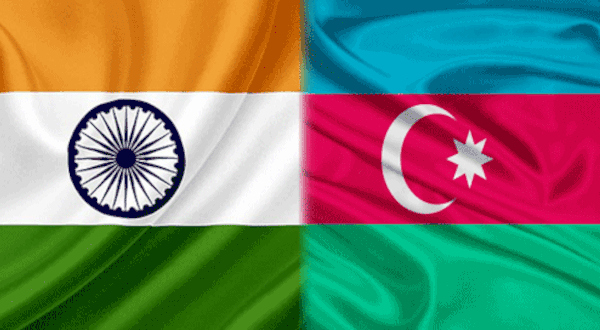
India and Azerbaijan have continued their diplomatic engagement with Indian Ambassador to Azerbaijan Abhay Kumar meeting Deputy Foreign Minister Elnur Mammadov in Baku on September 15 to review bilateral relations and discuss matters of mutual interest.
According to the Embassy of India in Azerbaijan, the meeting covered the broader relationship between New Delhi and Baku. Ambassador Kumar also presented Mammadov with a copy of Baku’s Temple of Eternal Fire, a work examining the historical and cultural connections between India and Azerbaijan through the Ateshgah Fire Temple near Baku.
The choice of the book carried particular significance because Ateshgah remains one of the clearest physical reminders of the centuries-old movement of Indian merchants, pilgrims and travellers through the Caspian region.
A Relationship Older Than Modern Diplomacy
India and Azerbaijan established formal diplomatic relations on February 28, 1992, shortly after India recognised Azerbaijan as an independent state in December 1991. India opened its resident mission in Baku in March 1999, while Azerbaijan established its embassy in New Delhi in October 2004.
The relationship between the two societies, however, predates modern diplomatic ties by several centuries. Trade routes connecting the Indian subcontinent with Central Asia, the Caspian region and Europe brought Indian merchants into Azerbaijani cities such as Baku and Ganja long before the emergence of the present-day states.
India’s Embassy in Baku describes these historical contacts as an important foundation of the bilateral relationship, with commercial exchange gradually accompanied by religious, literary and cultural interaction.
Ateshgah Preserves an Indian Presence in Baku
The Ateshgah Fire Temple, located near Baku, occupies a special position in this shared history.
The Embassy of India describes the 18th-century monument, which has a considerably older history, as evidence of the historical relations and cultural exchanges between India and Azerbaijan. The complex contains inscriptions in Devanagari and Gurmukhi, reflecting the presence of Indian communities that travelled through and settled temporarily in the region.
According to the Embassy’s updated bilateral brief, 23 inscriptions have been identified at the temple, including 18 in Devanagari and two in Gurmukhi. Indian religious symbols and references also survive within the complex, making the site an unusual record of the Indian mercantile and spiritual presence around the Caspian Sea.
The monument also reflects the importance of the old trade networks that connected India with markets further west. Indian merchants moving through the Silk Route and associated commercial corridors used cities such as Baku and Ganja as important centres of exchange.
Culture Remains an Important Part of the Relationship
The historical connection between India and Azerbaijan extends beyond trade.
Azerbaijani poet Nizami Ganjavi has long held a recognised place in India’s literary consciousness. The Embassy notes that his work influenced Indian literary traditions, including the poetry of Amir Khusrau. A portrait of Nizami is displayed at Rashtrapati Bhavan, while a folio associated with his Laila-Majnu is preserved at Humayun’s Tomb in New Delhi.
Cultural interaction continued in the modern era. Azerbaijani singer and actor Rashid Behbudov developed a close association with Indian cinema and was known to have been a friend of Raj Kapoor. Indian literature, films, music, yoga and cuisine have also contributed to continuing people-to-people engagement between the two countries.
Ambassador Abhay Kumar, writing on the 80th anniversary of India’s Independence in August, described the relationship as one rooted in history and culture while increasingly taking shape through contemporary cooperation. He pointed to Ateshgah as a visible reminder of how commerce, ideas and traditions travelled between India and the Caspian region long before modern transportation networks emerged.
Diplomatic Engagement Continues
The September 15 meeting comes as both countries continue contacts aimed at maintaining and expanding bilateral engagement.
When Abhay Kumar presented his credentials earlier in 2026, Azerbaijan’s Foreign Minister Jeyhun Bayramov and the Indian Ambassador discussed the state of bilateral ties and prospects for cooperation. That meeting touched on political consultations, historical relations, tourism, education and energy cooperation. Azerbaijan also highlighted the presence of India’s ONGC Videsh in the Azeri-Chirag-Gunashli oilfield complex and the Baku-Tbilisi-Ceyhan pipeline.
The two sides have therefore maintained engagement across diplomacy, energy, education, tourism and cultural exchanges even while recognising that some international and regional issues can produce differing positions.
That makes the latest ambassadorial meeting significant less as a major diplomatic breakthrough than as part of the continuing process of maintaining dialogue and identifying areas where bilateral cooperation can expand.
Historical Links as a Bridge for Contemporary Relations
The presentation of a book on the Ateshgah temple during the meeting was more than a ceremonial gesture. It underscored a part of the India-Azerbaijan relationship that predates present-day geopolitical alignments.
The surviving Indian inscriptions at Ateshgah show that interaction between the two regions was once driven by merchants, travellers and religious communities moving along transcontinental trade routes. Modern diplomacy has inherited that older connection and given it new forms through political dialogue, economic cooperation, tourism and cultural exchange.
The September 15 meeting between Ambassador Abhay Kumar and Deputy Foreign Minister Elnur Mammadov therefore represents a continuation of that engagement, with both countries maintaining diplomatic dialogue while drawing attention to a historical relationship extending far beyond the establishment of formal ties in 1992.
You may also like
-
India and Ghana Expand Agricultural Partnership Through New ICAR–CSIR-CRI Agreement
-
India Hands Over Three Tonnes of Anti-Tuberculosis Medicines to Sri Lanka
-
India and Austria Move to Deepen Security and Strategic Cooperation
-
India Offers Space-Based Climate Monitoring and Ocean Science Expertise to Pacific Partners at Pre-COP31
-
India and Switzerland Move to Deepen Strategic Science and Technology Partnership
