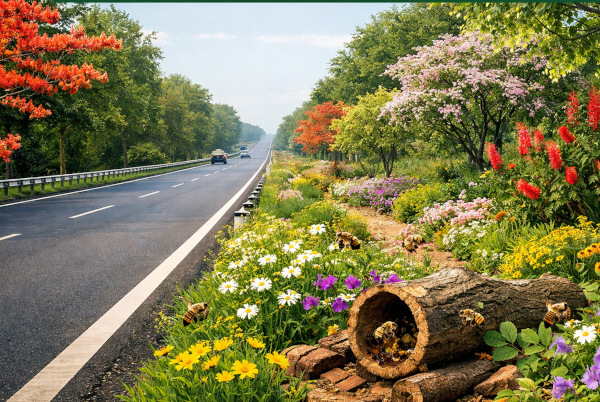
India’s push to strengthen connectivity to key Buddhist heritage sites received a fresh boost on March 26, 2026, when the Union Cabinet approved construction of a 4-lane, access-controlled Barabanki–Bahraich section of National Highway 927 in Uttar Pradesh. The project is aimed at improving access to Shravasti, one of Buddhism’s most revered destinations, where Lord Buddha is believed to have spent several monsoon seasons and delivered many of his teachings.
The new highway project, planned over a length of 101.51 km, is expected to address a long-standing infrastructure gap that has limited Shravasti’s tourism potential despite its global religious significance. According to the official release, the improved corridor will help cut travel time between Barabanki and Bahraich by nearly half, reducing the journey from around 150 minutes to 75 minutes, while also raising average travel speeds from 40 kmph to 80 kmph.
The government has pegged the total capital cost of the project at ₹6,969.04 crore, with execution to take place under the Hybrid Annuity Mode (HAM). Officials say the upgraded corridor will not only support smoother and safer passenger movement, but also improve regional logistics and multi-modal transport integration. The highway will connect with major routes including NH-27, NH-330B and NH-730, along with state highways SH-13 and SH-30B.
The route is also expected to strengthen access to key transport nodes across the region. These include Lucknow and Shravasti airports, multiple railway stations such as Barabanki, Burhwal, Jarwal and Bahraich, as well as the Rupaidiha Land Port. The project will additionally link 3 economic nodes, including SEZ and Mega Food Park-related infrastructure, 2 social nodes in aspirational districts, and 12 logistics nodes.
Beyond transport gains, the highway is being positioned as a tourism and local-economy enabler. With countries such as Thailand, Sri Lanka, Japan and Myanmar sharing deep religious ties to Buddhist sites in India, improved road access to Shravasti could help attract greater international pilgrimage traffic. The project is also expected to generate substantial employment, with estimates of 36.54 lakh person-days of direct employment and 43.04 lakh person-days of indirect employment.
In effect, the Barabanki–Bahraich highway is being seen as more than a road project. It is part of a larger effort to connect heritage, tourism, trade and local livelihoods, while bringing one of India’s most important Buddhist destinations closer to domestic and international visitors alike.
Source: PIB press release dated March 26, 2026.
You may also like
-
Jeeraphool Rice of Chhattisgarh — Surguja’s Fragrant Cumin-Shaped Heritage Grain
-
India’s E-Commerce Platforms Record ₹24,000 Crore Festive Sales in Two Days as Meesho Reports 75% Surge in Orders
-
India’s Economic Warfare Challenge: Strategic Autonomy, Energy Security and the Rise of a Global Power
-
India-US Trade Deal Stalemate: Why Washington’s Tariff Pressure Has Failed to Secure an Agreement
-
US Double Standards in Foreign Policy: 16 Recent Cases Involving India, Russia, China and Global Trade
