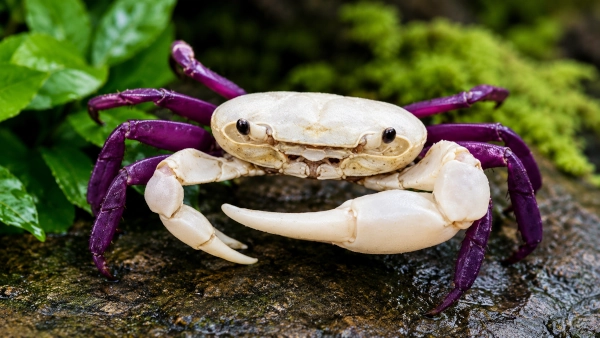
A routine forest patrol in Karnataka’s Western Ghats has led to the scientific recognition of a previously unknown freshwater crab species, adding another remarkable endemic animal to one of the world’s richest biodiversity regions.
The newly described species, Ghatiana karnataka, was discovered at Mavinkaru in the Mookambika Wildlife Sanctuary of Udupi district, where it inhabits moist lateritic habitats within the central Western Ghats. Its formal description was published on 21 July 2026 in the journal Species by Santanu Mitra of the Zoological Survey of India and Ajmeer K of the Karnataka Forest Department.
The discovery raises the known diversity of the genus Ghatiana to 15 species, all of which are endemic to the Western Ghats. Karnataka alone now supports eight known species of the genus, making the state particularly important for understanding the evolution and conservation of these unusual freshwater crabs.
A Discovery During a Forest Patrol
The discovery began not during a large scientific expedition but through the observation of frontline forest staff.
Ajmeer K, a Beat Forester associated with the Kollur Range of Mookambika Wildlife Sanctuary, encountered an unusual crab during a patrol. Its appearance and behaviour caught his attention, prompting him to seek expert identification. He subsequently contacted crustacean specialist Santanu Mitra of the Zoological Survey of India.
After the necessary permissions were obtained from forest authorities, specimens were collected and examined in detail. Their anatomical characteristics were compared with previously known freshwater crab species from the Western Ghats.
The analysis demonstrated that the Mavinkaru population possessed a unique combination of characteristics that justified recognition as a separate species.
The participation of a field-level forest official in identifying the animal is particularly significant. Protected forests are monitored daily by personnel who often encounter wildlife far more frequently than professional taxonomists. Their observations can therefore become an important source of new scientific discoveries.
Named After Karnataka
The species has been named Ghatiana karnataka after the state in which it was discovered.
It belongs to the family Gecarcinucidae, a group of true freshwater crabs distributed primarily across tropical parts of Asia. Unlike marine crabs, these animals have adapted to completing their life cycles in freshwater or extremely moist terrestrial environments.
The genus Ghatiana itself is comparatively new to science. It was formally established only in 2014, and discoveries during the subsequent decade have rapidly expanded the number of recognised species.
Before G. karnataka was described, scientists recognised 14 species in the genus. The new species therefore becomes the 15th known member of Ghatiana.
Importantly, that number refers to the genus across the entire Western Ghats. Karnataka now contains eight known Ghatiana species rather than 15.
A Crab Specialised for the Western Ghats
Members of Ghatiana display several anatomical features that distinguish them from other freshwater crabs.
They generally possess a relatively high and broad carapace, while characteristics of the mouthparts and reproductive structures are particularly important for taxonomic identification.
In freshwater crab taxonomy, seemingly small anatomical differences can be decisive. Scientists therefore examine the shape and proportions of the carapace, limbs, abdomen and reproductive structures rather than relying on colour or size alone.
The researchers found that Ghatiana karnataka is most closely related to another species discovered in Karnataka in 2026, Ghatiana dhritiarum.
Despite their similarities, the two can be distinguished through several anatomical characteristics, including differences involving the carapace, the sixth abdominal segment, female reproductive structures and the male first gonopod, as well as differences in their living coloration.
These anatomical distinctions are sufficiently consistent for the Mavinkaru population to be recognised as a separate species.
Life Among Laterite Rocks
One of the most interesting aspects of the discovery is the habitat occupied by the crab.
The specimens were collected from laterite rocks in the central Western Ghats within Mookambika Wildlife Sanctuary. These rock formations are common across sections of the western Indian landscape and can contain cavities, cracks and depressions that retain water during the monsoon.
Such tiny habitats may appear insignificant, but they can support highly specialised organisms.
During heavy rainfall, water collects within cavities in laterite and surrounding forest environments. High humidity, abundant leaf litter and permanent or semi-permanent moisture create refuges for freshwater crabs, amphibians, insects and other small animals.
Some Ghatiana species are known from water-filled tree hollows and cavities within lateritic boulders. A closely related species, Ghatiana dhritiarum, for example, inhabits water-filled holes in tree trunks and laterite formations within evergreen forest.
These habitats demonstrate how biodiversity within the Western Ghats often exists at an extraordinarily small spatial scale.
Mookambika Wildlife Sanctuary as a Biodiversity Refuge
Mookambika Wildlife Sanctuary lies within the central Western Ghats of Karnataka and contains dense evergreen and semi-evergreen forests, river systems and mountain landscapes.
Its combination of heavy monsoon rainfall, varied elevation and relatively undisturbed forest creates numerous ecological niches. Species living within such environments can become geographically isolated by rivers, ridges, valleys and changing forest types.
Over long periods, isolated populations may evolve independently.
This process helps explain why the Western Ghats contains such extraordinary levels of endemism. Many species found within the mountain chain occur nowhere else on Earth, and some may be restricted to surprisingly small geographical areas.
The discovery of Ghatiana karnataka at Mavinkaru adds freshwater crabs to the growing list of animals demonstrating the biological importance of the sanctuary.
The Western Ghats’ Remarkable Freshwater Crab Diversity
India possesses a particularly rich freshwater crab fauna, and the Western Ghats is one of its most important centres of diversity.
The roughly 1,600-kilometre mountain chain running along western India combines high rainfall, ancient geology and long periods of geographical isolation. Rivers descending from the mountains towards the Arabian Sea form numerous separated freshwater systems.
For animals that have limited ability to move between river basins, these isolated waterways can promote rapid evolutionary diversification.
Freshwater crabs are particularly susceptible to such isolation because they generally do not possess the long-distance marine larval stages found in many oceanic crab species.
Individual populations can therefore remain confined to specific streams, plateaus or forest systems for extremely long periods.
Over evolutionary timescales, those isolated populations can develop into separate species.
All Known Ghatiana Species Are Endemic to the Western Ghats
One of the most striking characteristics of Ghatiana is that every currently known species occurs only in the Western Ghats of India.
That degree of geographical concentration makes the genus an especially valuable indicator of the evolutionary uniqueness of the mountain system.
The known diversity has expanded rapidly as scientists have examined previously underexplored forests and lateritic landscapes.
In 2023, researchers described Ghatiana sanguinolenta from Karnataka. The species became the twelfth known member of the genus at the time.
Another species, Ghatiana dvirupa, was described from the Kali Tiger Reserve in Karnataka in 2024. Researchers proposed the informal name “Mr. and Mrs. Ghat Crab” because males and females display noticeably different living coloration. At that stage, 13 species were recognised within the genus.
Then, in February 2026, scientists described Ghatiana dhritiarum from Uttara Kannada district, raising the total to 14 species and the number known from Karnataka to seven.
The discovery of Ghatiana karnataka only months later has now increased those numbers again.
Karnataka Emerges as a Centre of Ghatiana Diversity
With eight recognised species, Karnataka currently contains more than half of the known diversity of the genus.
This concentration is particularly notable in the central Western Ghats, where extensive evergreen forests coexist with lateritic plateaus, streams and high-rainfall environments.
Taxonomists increasingly suspect that additional species remain undiscovered in these landscapes.
The authors of the Ghatiana karnataka study specifically concluded that the discovery demonstrates the need for further exploration throughout the Western Ghats, particularly its central portion.
That recommendation reflects an important reality of biodiversity research. Scientists cannot protect species that have never been documented.
Why Tiny Species Matter
Freshwater crabs rarely receive the public attention given to elephants, tigers or large birds, but they perform important ecological functions.
Many freshwater crabs consume leaves, decaying vegetation, small animals and organic material. By processing this matter, they participate in nutrient cycling within forest streams and wetland ecosystems.
They can also become prey for fish, reptiles, birds and mammals, linking aquatic and terrestrial food webs.
Their burrowing behaviour may modify soils and influence water movement at a microscopic scale.
Because many species occupy restricted freshwater habitats, they can also serve as indicators of environmental quality. Changes in forest cover, stream flow, pollution or local hydrology may affect specialised crab populations rapidly.
Protecting freshwater-crab diversity therefore contributes to conserving the wider ecological processes operating within forest waterways.
Laterite Landscapes Are More Important Than They Appear
The discovery also highlights the ecological importance of lateritic formations.
Laterite is often perceived simply as exposed reddish rock or relatively barren terrain. In reality, lateritic landscapes can support highly specialised seasonal ecosystems.
During the monsoon, shallow depressions fill with rainwater and temporary wetlands appear. Small rock cavities remain moist long after surrounding surfaces begin drying.
Plants, amphibians, crustaceans and insects adapted to these conditions can become restricted to individual plateaus or forested laterite systems.
When such habitats are altered by quarrying, road construction, land conversion or major changes in drainage, species with extremely small distributions may lose a substantial proportion of their habitat.
The discovery of another Ghatiana species associated with lateritic environments reinforces the need to evaluate these landscapes for biodiversity rather than treating them as biologically empty ground.
Endemism Creates Conservation Vulnerability
Being endemic to a small region provides evolutionary uniqueness but can also create vulnerability.
A widespread animal may survive the destruction of one local population because other populations remain elsewhere. A species restricted to a single hill range or forest system may have no such protection.
Scientists have not yet established the complete geographical range or population size of Ghatiana karnataka. It would therefore be premature to assign a conservation status based simply on its recent discovery.
Nevertheless, determining its distribution will be an important next step.
Researchers will need to establish whether the species occurs only around Mavinkaru or whether populations survive across a broader section of Mookambika Wildlife Sanctuary and neighbouring Western Ghats forests.
Such surveys can eventually provide the information required for formal conservation assessments.
Taxonomy Is the Foundation of Conservation
The discovery also demonstrates the importance of classical taxonomy at a time when biological research increasingly focuses on genetics and large-scale ecological modelling.
Before conservationists can assess whether a species is threatened, scientists must first determine that the species exists.
That process requires specimens to be studied, compared with known species and described according to internationally accepted taxonomic standards.
Morphological observations remain especially important for freshwater crabs because characteristics of the carapace and reproductive structures allow researchers to distinguish closely related species.
Modern genetic techniques can complement this process, but detailed field observation and museum-based taxonomy remain fundamental.
Institutions such as the Zoological Survey of India consequently play a crucial role in documenting India’s biological diversity.
Frontline Forest Staff Can Become Scientific Partners
Perhaps one of the most encouraging aspects of the discovery is the collaboration between a specialist zoologist and a frontline forest employee.
Ajmeer K was not merely the person who encountered the animal. He became co-author of the formal scientific description, alongside Santanu Mitra of the ZSI.
Such partnerships can dramatically expand India’s capacity to discover species.
Forest guards, beat foresters and range officers spend years working within the same landscapes. They observe seasonal changes, animal behaviour and unusual organisms that visiting scientists may encounter only briefly.
Training field staff to document such observations and connect with taxonomic institutions could lead to many additional discoveries across India’s protected areas.
A Biodiversity Hotspot Still Yielding New Species
The Western Ghats has been studied by naturalists for centuries, yet scientists continue to describe previously unknown frogs, reptiles, fishes, plants, insects and crustaceans from the region.
This does not necessarily mean that these organisms suddenly appeared. Many have probably occupied their habitats for thousands or even millions of years.
What changes is scientific knowledge.
Remote habitats receive systematic surveys, museum collections are re-examined and improved taxonomic techniques reveal differences that earlier researchers may have overlooked.
The rapid expansion of the genus Ghatiana is an excellent example. The genus itself was recognised only in 2014, yet within little more than a decade scientists have identified 15 distinct species, all confined to the Western Ghats.
That rate of discovery strongly suggests that the current inventory remains incomplete.
A Small Crab with a Larger Conservation Message
Ghatiana karnataka may be a small freshwater crab occupying humid cavities among lateritic rocks, but its discovery carries a much larger message.
The Western Ghats is not biologically valuable only because of its charismatic mammals and famous forests. Much of its extraordinary diversity exists in tiny habitats: a forest stream, a seasonal pool, a tree cavity, a lateritic crack or a rain-filled depression.
Each can contain species whose entire global distribution may occupy only a small portion of the mountain chain.
The discovery at Mookambika Wildlife Sanctuary therefore adds another piece to the still-incomplete biological map of the Western Ghats.
With 15 known Ghatiana species now documented and eight occurring in Karnataka, the evidence increasingly points towards the central Western Ghats as a major evolutionary centre for India’s freshwater crabs.
You may also like
-
Satpura Tiger Reserve’s Barasingha Population Crosses 300 as Madhya Pradesh Plans New Wildlife Corridors
-
Karnataka’s Tiger Population Could Cross 700 as New Census Builds on Official Count of 563
-
Project Cheetah Expands as Veerangana Durgavati Tiger Reserve Becomes Madhya Pradesh’s Third Cheetah Habitat
-
Kashmir Markhor Population Rises to 227 as Kazinag Conservation Efforts Show Results
-
ICAR-CIFRI Pushes Conservation of Indigenous Himalayan Fish for Biodiversity and Livelihood Security
