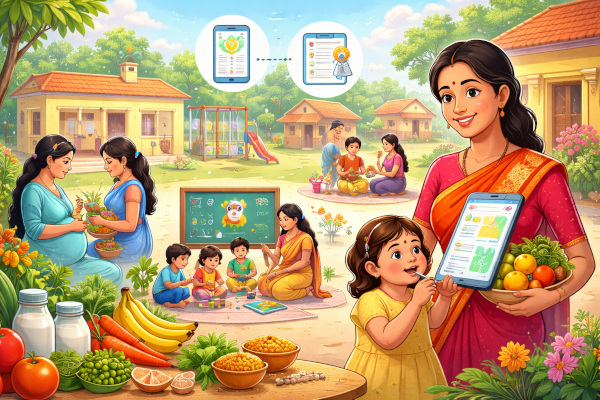
India’s nutrition mission is entering a more integrated and technology-driven phase, with Mission Poshan 2.0 emerging as the government’s central framework for maternal nutrition, child development and Anganwadi modernisation. In a detailed overview released by the Press Information Bureau, the government said the programme is strengthening India’s nutrition ecosystem through convergence across ministries, digital governance and mass community participation. The mission builds on POSHAN Abhiyaan, launched on March 8, 2018, and reflects a broader shift from treating malnutrition as a welfare issue to addressing it as a national development priority linked to health, learning outcomes and human capital.
The programme was reorganised under Mission Poshan 2.0 in the 2021–22 Union Budget, bringing together key nutrition-related schemes under a unified structure. This consolidation sharpened the focus on nutrition support for children, pregnant women, lactating mothers and adolescent girls, while also expanding early childhood care and education and upgrading Anganwadi infrastructure through the Saksham Anganwadi initiative. The government said 2 lakh Anganwadi centres have been sanctioned for strengthening with modern amenities such as smart learning aids, water purifiers, LED screens and nutrition gardens.
A major pillar of the programme is digital monitoring. The Poshan Tracker platform, launched on March 1, 2021, now enables near real-time tracking of service delivery across the country. As of March 2026, it was monitoring nearly 14.03 lakh Anganwadi Centres and about 8.95 crore eligible beneficiaries, including pregnant women, lactating mothers, children up to six years of age and adolescent girls. The system has also introduced Aadhaar-based verification and facial recognition-supported tracking to improve transparency, reduce leakages and ensure benefits reach intended recipients.
The government has also placed strong emphasis on early childhood care and school readiness. Under the Poshan Bhi Padhai Bhi initiative, Anganwadi workers are being trained in nutrition-linked early education delivery. By March 31, 2026, over 41,645 State Level Master Trainers and 10,58,317 Anganwadi Workers had completed Round-1 training. Supporting this effort are new national frameworks such as Navchetana for early childhood stimulation up to three years of age and Aadharshila for preschool education for children aged three to six. The Centre also said more than 22 lakh Vidyarambh certificates had been issued by March 2026 to children completing preschool education at Anganwadi centres.
To improve continuity between preschool care and formal education, the government said over 2.9 lakh Anganwadi centres have already been integrated into school premises. In April 2026, an IT-enabled Home Visit Scheduler was also added to the Poshan Tracker to support structured outreach to pregnant women and children up to three years of age. The scheduler is designed to automate visits, provide age-appropriate counselling prompts and deliver nutrition and stimulation-related video guidance to parents and caregivers.
Community mobilisation remains another core pillar of the mission. The government said POSHAN Abhiyaan’s Jan Andolan approach has driven nutrition awareness at scale, with Poshan Maah and Poshan Pakhwada together generating more than 150 crore activities nationwide. The 8th Poshan Pakhwada, being held from April 9 to April 23, 2026, is centred on the theme “Maximizing Brain Development in the First Six Years of Life.” The campaign focuses on mother-and-child nutrition, early stimulation, play-based learning, reduced screen time and greater community support for stronger Anganwadi systems.
The release underlined that Mission Poshan 2.0 is increasingly being positioned as more than a food-support programme. By linking nutrition with health, preschool education, behavioural change and digital public administration, the government is trying to build a more comprehensive last-mile system for vulnerable families. A grievance redress mechanism is also in place, with 1515 now serving as the active helpline for POSHAN Abhiyaan and PMMVY-related queries since November 2025.
Source: PIB
You may also like
-
Bharat Biotech’s Nucelion and VeGen Bio Partner to Manufacture Advanced Dual-Target CAR-T Cancer Therapy in India
-
Ayurveda and Anger: How Emotional Excess Affects Physical and Mental Health
-
Ayurveda and Stress: Daily Practices for Mental Balance and Emotional Well-Being
-
Ayurveda and Bowel Routine: Why Regularity Matters for Digestive Health
-
India Proposes Mandatory Advanced Emergency Braking Systems for New Cars from October 2030
