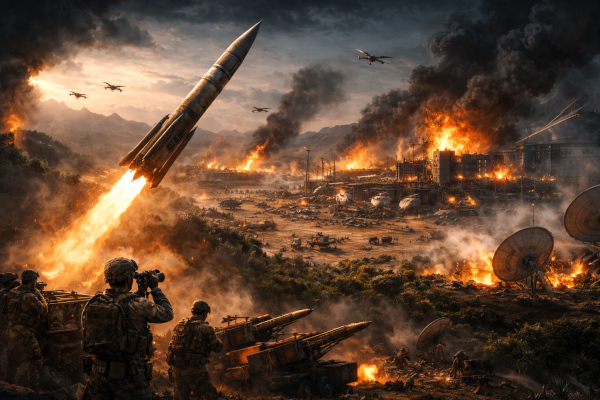
Iran’s current wartime approach appears to rest on a classic asymmetric calculation: it cannot reliably outmatch the United States and its partners in conventional airpower, naval reach, or ISR, so it tries instead to raise the cost, widen the battlespace, and stretch the timeline. Recent analysis from CSIS argues that Tehran has shifted from its older pattern of calibrated, deniable responses toward a broader multidomain punishment campaign across missiles, drones, proxies, maritime pressure, cyber pressure, and attacks on economically sensitive targets. Reuters and AP reporting from late March and early April 2026 also describe a conflict in which Iran has continued striking despite heavy losses, suggesting that endurance and coercion, rather than outright battlefield dominance, are central to its war logic.
The first pillar of that strategy is horizontal escalation. Instead of limiting retaliation to direct exchanges with U.S. or Israeli forces, Iran appears to be widening the theater to include Gulf energy routes, allied states, shipping lanes, proxy fronts, and infrastructure nodes that sit just outside the traditional battlefield. AP reports that Iran-backed Houthis have joined the war and that maritime risk around Bab el-Mandeb and Hormuz has become part of the conflict’s pressure architecture. Reuters likewise reports that Gulf states are now demanding any endgame degrade Iran’s missile, drone, and proxy capacities because they see Tehran’s leverage as rooted precisely in its ability to expand war beyond one front.
The second pillar is deterrence through vulnerability mapping. Iran’s military problem is not simply that U.S. bases exist nearby; it is that many regional facilities, commercial ports, desalination systems, tanker routes, cloud facilities, and air-defense supply chains are exposed in ways that are politically painful even when the physical damage is limited. AP reports that Iran has increasingly used low-flying drones and sustained strikes against infrastructure to impose economic pain and strain interceptor inventories, while Reuters notes expert concern over mines, drones, and missile threats that make fixed positions and chokepoints costly to defend. The goal is less “win a decisive battle” than “make continued war feel expensive, exposed, and politically unsustainable.”
That is why attacks or threats involving U.S. bases in neighboring countries fit Iranian strategy so well. They sit at the intersection of military symbolism and political pressure. A strike near or against such a base can send several messages at once: that American protection is imperfect, that host governments cannot fully insulate themselves from the war, and that Washington’s regional footprint itself is a source of vulnerability. Iran does not need to destroy large bases outright for this logic to work. In asymmetric terms, even intermittent disruption can impose disproportionate costs if it drives force protection burdens, complicates logistics, unnerves host states, and forces the United States to spend more on defense than Iran spends on offense. This broader coercive logic is consistent with CSIS’s assessment that Tehran is executing a punishment campaign meant to outlast the political patience of its adversaries.
A related element is proxy activation, long central to Iranian strategy but now folded into a more openly escalatory posture. CSIS says mobilization of proxies marks a more explicit phase of vertical escalation, and AP notes direct Houthi participation in the current war. Proxies let Tehran disperse risk, complicate attribution, and force its opponents to watch multiple fronts simultaneously. Even when proxy operations do not produce decisive military outcomes, they multiply warning burdens, air-defense demands, and diplomatic friction. That is the strategic utility: Iran was able to turn one war into several overlapping security problems.
The cyber-commercial side of this conflict is especially important. Public reporting indicates that Iran has threatened major U.S. companies including Google, Microsoft, and Apple, while AP reported in March that Iranian drone strikes damaged three Amazon Web Services facilities in the Middle East. That does not mean Iran is treating commercial tech targets exactly like battlefield targets in a legal or strategic sense, but it does show that data centers and digital infrastructure are increasingly being drawn into war as symbols of alliance, economic dependence, and technological support. The Guardian separately reported that data centers are becoming wartime targets in this conflict environment. Strategically, this fits asymmetric logic very well: civilian-linked infrastructure can generate outsized economic disruption, fear, and media attention without requiring Iran to defeat U.S. forces head-on.
From Tehran’s perspective, however, that distinction may matter less than the symbolic and systemic role of such firms. In asymmetric warfare, a company can become a target not only because of what it directly does on the battlefield, but because it represents enabling infrastructure: cloud hosting, data storage, AI services, communications resilience, and the broader techno-strategic ecosystem that sustains a wartime coalition. In that sense, Iran’s threats against tech firms and reported strikes on AWS sites are consistent with a strategy of treating the enemy’s support architecture as part of the battlespace. This is the same logic behind attacks on ports, shipping, refineries, and telecommunications: degrade confidence, raise insurance and protection costs, and force civilian actors to feel the war in their balance sheets.
There is also a strong economic coercion component. Iran knows it cannot consistently dominate the air, but it can still threaten what global markets care about: oil flows, tanker safety, cloud uptime, logistics reliability, and the perception that the Gulf is a safe place to host capital and infrastructure. Reuters notes that about 20% of global oil flows through Hormuz, while AP and Reuters both describe how the war has put shipping, energy, and regional infrastructure under stress. In asymmetric terms, that makes economic disruption itself a weapon. Tehran’s preferred effect is strategic bargaining power generated through instability.
What makes this strategy dangerous is that it is rational even under military disadvantage. AP reports that despite heavy U.S.-Israeli attacks, Iran remains able to strike and adapt, and CSIS argues Tehran is pursuing escalation precisely because widening the war offers more leverage than absorbing blows passively. That means Iran’s warfighting model is not built around matching U.S. strength platform for platform. It is built around exploiting the asymmetry of interests: Iran’s leadership may believe it can tolerate pain longer than Washington and its partners can tolerate a prolonged, region-wide security and economic crisis.
The core weakness of Iran’s approach is that asymmetric warfare can impose pain without guaranteeing strategic success. It can pressure, punish, delay, and complicate; it does not automatically produce favorable political settlements. The more Tehran expands the target set to include commercial and civilian-linked systems, the more it risks international backlash, stronger coalition-building against it, and justification for deeper counterstrikes. CSIS’s recent work on “the wars after the war” also suggests that even if Tehran avoids defeat, it may still face a long period of repeated preventive blows and containment. So its asymmetric model may be good at preventing quick capitulation by USA, but not necessarily good at securing a stable long-term outcome on favorable terms.
Iran’s asymmetric warfare is designed to turn American and allied advantages into liabilities. U.S. bases become fixed targets. Regional alliances become exposed dependencies. Commercial technology becomes part of the war economy. Shipping lanes become pressure valves. Civil infrastructure becomes political leverage. Tehran’s bet is that it does not need to defeat the United States militarily; it only needs to make the cost of continued war look broader, messier, and more unacceptable than its adversaries expected. That is the real logic behind strikes on neighboring-country bases, proxy fronts, shipping routes, and even cloud-linked infrastructure.
You may also like
-
Philippine Marine Wargames Reportedly Show BrahMos Can Penetrate Chinese Destroyer Air Defences
-
Adani Power and Druk Green Power to Develop 770 MW Chamkharchhu-I Hydropower Project in Bhutan
-
Russia’s Irkutsk Pneumonia Scare: No Confirmed Plague Epidemic, No Immediate Threat to India
-
Flydubai FZ1073 Attack: Captain Smit Machchhar’s Calls With Modi and Netanyahu as UAE Probe Names Terror Plot
-
Ukraine Says India’s Ceasefire Proposal Is Broadest Among Four International Initiatives
