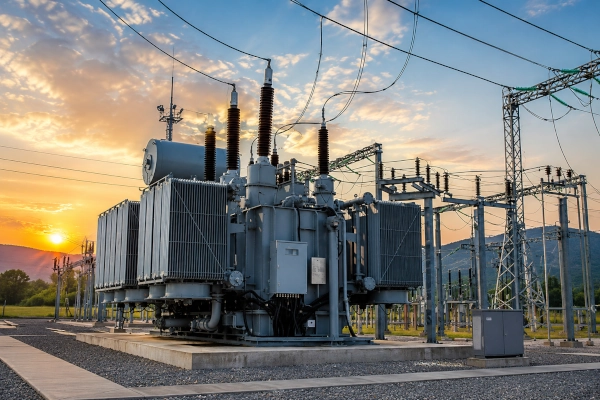
CG Power and Industrial Solutions has brought its major greenfield power-transformer manufacturing project at Jahangirpura in Sehore, Madhya Pradesh, into its operational phase, substantially expanding India’s domestic capacity for extra-high-voltage and ultra-high-voltage transmission equipment.
The facility represents one of CG Power’s largest recent manufacturing investments and has been designed with an annual production capability of approximately 45,000 MVA. Company filings state that the plant will be capable of manufacturing and testing power transformers and reactors ranging from 220 kV to 1,200 kV, positioning it to address some of the most demanding requirements of modern transmission networks.
CG Power’s official event portal listed activity at the company’s new T5 Plant in Jahangirpura, Sehore, on September 3, 2026, marking the latest stage in a project that moved from land allocation and construction to commissioning in little more than a year.
Nearly 45 Acres Dedicated to Transformer Manufacturing
The Madhya Pradesh Industrial Development Corporation allotted CG Power approximately 45.13 acres of land at Jahangirpura on a 99-year lease in August 2025 for establishment of the greenfield transformer facility.
CG subsequently described the project as a major expansion of its transformer business. Its official announcement placed the overall investment at approximately ₹888 crore and the site area at about 18.26 hectares.
The new capacity has been planned specifically around rising domestic requirements and CG Power’s strategy of increasing transformer exports to selected international markets.
Capability Extends to the 1,200 kV Class
The technological range of the Sehore plant is particularly significant.
CG’s official placement document states that the facility has been designed to manufacture and test transformers and reactors from 220 kV up to 1,200 kV. This moves the plant well beyond conventional distribution-equipment manufacturing and into the high-capacity equipment required for large transmission corridors and future ultra-high-voltage networks.
Equipment in these voltage classes plays a critical role in moving large quantities of electricity over long distances while limiting transmission losses. Such capability is becoming increasingly important as India’s generating system expands and large renewable-energy projects are connected to major consumption centres.
The same manufacturing expertise also strengthens India’s ability to supply technically demanding overseas transmission projects.
45,000 MVA Capacity Significantly Expands CG’s Transformer Business
At full scale, the Sehore facility will add 45,000 MVA of annual transformer manufacturing capacity.
That expansion comes at a time when CG Power’s Power Systems business is experiencing substantial growth. The company has been investing in manufacturing infrastructure to meet demand from both utilities and industrial customers while increasing its presence in international transformer markets.
CG already manufactures generator transformers, auto transformers, shunt reactors, furnace transformers, locomotive transformers and other specialised products for power and industrial applications.
The Sehore plant gives the company considerably more headroom to undertake large orders without placing excessive pressure on its existing manufacturing network.
Large Orders Highlight Growing Demand
Recent orders demonstrate the market opportunity behind the expansion.
In June 2025, CG Power secured a ₹641-crore order from Power Grid Corporation of India Limited for 765 kV and 400 kV-class transformers and reactors. At the time, it was the company’s largest single order.
The company subsequently made a significant breakthrough in international markets by securing an approximately ₹900-crore order for power transformers for a large-scale data-centre project in the United States. CG described it as its largest-ever export order and its entry into the global data-centre transformer segment.
These contracts illustrate how transformer demand is broadening beyond conventional electricity utilities.
Data Centres and Renewables Create New Transformer Demand
India’s transmission sector is expanding to accommodate large additions of solar, wind and other renewable-energy capacity. New generating centres frequently lie far from major cities and industrial demand centres, increasing the requirement for strong high-voltage transmission corridors.
At the same time, rapid growth in data centres, semiconductor manufacturing, railways and energy-intensive industries is creating new concentrations of electricity demand.
Large power transformers form one of the least replaceable elements of this infrastructure. They are highly engineered, customised products with long manufacturing cycles, making adequate domestic production capacity strategically important for grid expansion.
CG Power’s decision to establish the Sehore facility therefore addresses both rising equipment volumes and the need to manufacture higher-voltage products domestically.
Export Growth Is a Major Part of CG Power’s Strategy
The Sehore investment has also been designed around international expansion.
In its official fundraising documents, CG Power said additional transformer capacity would help it meet growing domestic demand while allowing the company to penetrate selected export markets. The company has set a broader objective of increasing the contribution of Indian-manufactured products to its global sales.
India’s emerging advantage in transformer manufacturing is particularly relevant because utilities worldwide are facing longer delivery times for grid equipment as investment in electricity networks accelerates.
A large Indian manufacturing base capable of producing equipment at 765 kV and eventually up to the 1,200 kV class gives CG Power an opportunity to compete for technically sophisticated projects rather than concentrating only on lower-value equipment.
Sehore Strengthens Madhya Pradesh’s Electrical-Equipment Cluster
The plant also deepens CG Power’s long-standing manufacturing presence in Madhya Pradesh.
The company already operates major electrical-equipment facilities in the state, including transformer and motor manufacturing operations around the Bhopal industrial region. Sehore provides a large greenfield location where the company can install production flows specifically designed for modern high-capacity transformers.
CG’s official announcement at the time of the foundation ceremony said the project would create 394 direct jobs, in addition to the wider activity generated through suppliers, logistics and engineering services associated with a major industrial plant.
The development could also encourage localisation of specialised transformer components and materials close to the new manufacturing centre.
From Conventional Transformers to Ultra-High-Voltage Manufacturing
CG Power has been steadily upgrading its technological capability alongside physical capacity.
In December 2025, the company inaugurated a new 800 kV manufacturing shop, strengthening its ultra-high-voltage equipment capability. CG described the development as part of its effort to support India’s evolving power grid with increasingly advanced domestically manufactured equipment.
The Sehore plant takes that progression further by creating infrastructure designed around products reaching the 1,200 kV class.
This capability is important because India’s electricity system is becoming larger, more interconnected and increasingly dependent on moving substantial quantities of power across long distances.
A Major Addition to India’s Power-Equipment Manufacturing Base
The Sehore project represents more than an increase in CG Power’s factory space. Its combination of 45,000 MVA annual capacity, 220–1,200 kV manufacturing capability and export-oriented production establishes a new large-scale centre for advanced transformer manufacturing in India.
For CG Power, the facility provides the capacity required to pursue larger domestic utility contracts and expand into international power, renewable-energy and data-centre projects.
For India’s electrical-equipment industry, it adds substantial indigenous manufacturing capability in a category that is becoming increasingly critical as electricity generation, grid infrastructure and energy-intensive digital industries expand simultaneously.
The commissioning of the Sehore facility therefore marks an important step in India’s transition from meeting domestic transformer demand to becoming a larger global supplier of high-capacity transmission equipment.
You may also like
-
HPCL Commissions India’s First Indigenous Blue Hydrogen Unit at Visakhapatnam Refinery
-
Bihar’s GI-Tagged Mithila Makhana Expands Global Reach as India Exports 7,265 Tonnes in FY26
-
Sigma Advanced Systems Secures ₹174 Crore Export Order for 155mm Artillery Ammunition Subsystems
-
Bharat Electronics Secures ₹1,011 Crore in New Defence Orders for Radar, Communication and Sonar Systems
-
NHPC Announces Commercial Operation of Fifth 250 MW Unit at Subansiri Lower Hydroelectric Project
