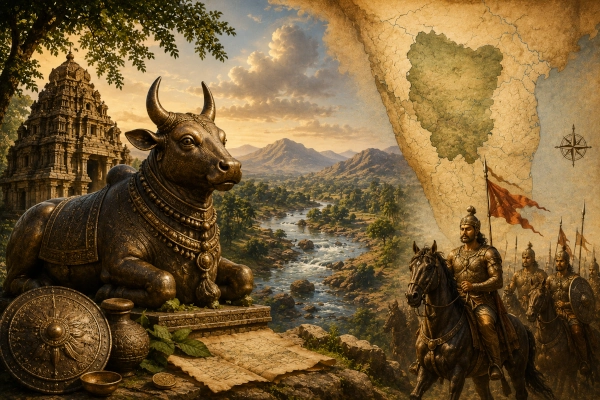
Mahishaka, also rendered Mahisha, was an ancient southern country mentioned in the Mahabharata and generally associated in one important geographical tradition with southern Karnataka and the upper Kaveri region. The epic clearly places the Mahishakas among the peoples of southern Bharat, alongside other identifiable southern regions such as the Karanatakas, Vanavasikas and Kuntalas. This makes Mahishaka an important part of the Mahabharata’s geographical picture of the Deccan.
The precise location of Mahishaka, however, requires more caution than regions such as Vidarbha or Vanavasi. Older scholars proposed different identifications, and some attempted to associate Mahishaka with Mahishmati on the Narmada. Other geographical traditions identified the Mahishakas with southern Mysore, broadly corresponding to the upper Kaveri country of modern Karnataka. The Mahabharata’s own placement of the Mahishakas among explicitly southern peoples provides strong support for treating a southern Mahishaka as a distinct geographical possibility.
For this geographical series, the most useful identification is therefore:
Mahishaka — parts of Karnataka and the upper Kaveri region — India.
Mahishaka at a Glance
| Feature | Identification |
|---|---|
| Ancient Name | Mahishaka / Mahisha |
| Political Character | Southern janapada or regional people |
| Mahabharata Location | Southern Bharat |
| Approximate Modern Region | Parts of southern Karnataka |
| Principal Geographical Association | Upper Kaveri basin |
| Wider Modern Reference | Mysuru region and adjoining southern Karnataka |
| Major River | Kaveri |
| Mahabharata Geographical Reference | Listed among the southern peoples in the Bhishma Parva |
| Post-Kurukshetra Connection | Arjuna fought the Mahishakas during the Ashvamedha expedition |
| Neighbouring Ancient Regions | Kuntala, Vanavasi and other southern janapadas |
| Wider Ancient Region | Dakshinapatha |
| Important Caution | Mahishaka should not automatically be equated with Mahishmati on the Narmada |
| Modern State | Karnataka |
| Country Today | India |
Where Was Ancient Mahishaka?
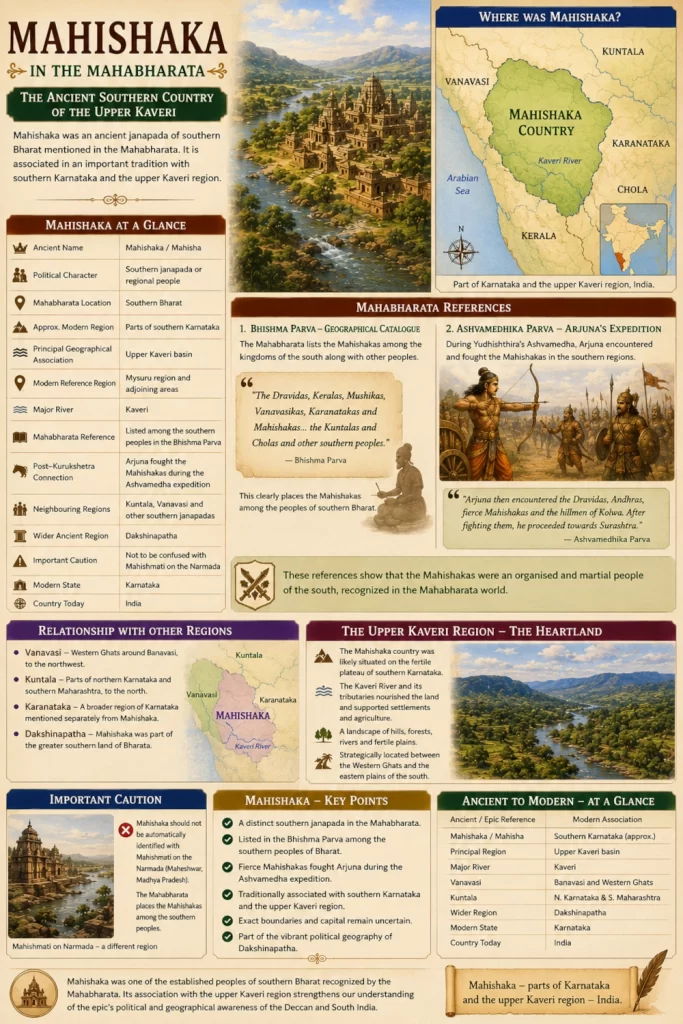
The Mahabharata provides an important clue by placing the Mahishakas among the southern kingdoms and peoples of Bharatavarsha. In the Bhishma Parva’s great geographical catalogue, the text names the Dravidas, Keralas, Mushikas and Vanavasikas before continuing with the Karanatakas and Mahishakas. It then proceeds through other southern names including Kuntala and Chola.
This sequence strongly suggests that the Mahishakas belonged to the southern geographical world rather than to the north-central Narmada valley alone. Later Puranic geographical traditions likewise place the Mahishakas among the peoples of southern India. One modern presentation of the Vayu Purana’s geographical material identifies the Mahishakas with southern Mysore, broadly corresponding to southern Karnataka.
The most suitable modern association is consequently the upper Kaveri region of Karnataka, especially the wider southern Karnataka plateau surrounding Mysuru and adjoining districts. The borders must remain approximate because no Mahabharata passage supplies enough information to reconstruct a fixed territorial frontier.
Mahishaka in the Bhishma Parva
The strongest direct geographical evidence comes from the Bhishma Parva, where Sanjaya describes the many peoples and countries occupying Bharatavarsha.
The text specifically introduces a group as the kingdoms of the south and lists the Dravidas, Keralas, Mushikas, Vanavasikas, Karanatakas and Mahishakas, followed by several additional peoples including the Kuntalas and Cholas. This passage is extremely important because it establishes Mahishaka as a recognised regional identity within the epic rather than merely a later historical name.
The surrounding names also help with geographical reconstruction. Vanavasi is associated with Banavasi and western Karnataka, Kuntala with parts of northern Karnataka and southern Maharashtra, and the Karanatakas with the Karnataka region. The placement of Mahishaka among these southern names makes a location within or near Karnataka geographically reasonable.
At the same time, a list of peoples cannot by itself establish exact borders. Mahishaka should therefore be mapped as a broad regional zone rather than a sharply bounded kingdom.
Mahishaka and Karnataka
The relationship between Mahishaka and ancient Karnataka is particularly interesting because the Bhishma Parva mentions Karanataka and Mahishaka separately. This suggests that, within the geographical tradition preserved by the epic, Mahishaka was not simply another name for the whole of Karnataka.
Instead, it likely represented one particular country or people within the larger southern Deccan. If the southern identification is accepted, Mahishaka fits especially well with the southern Karnataka plateau, while Vanavasi occupied the Western Ghats farther north-west and Kuntala extended through other parts of the Karnataka-Maharashtra region.
This provides a useful way to visualise the ancient landscape. Modern Karnataka contained multiple political and cultural regions, just as modern Maharashtra contained Vidarbha, Ashmaka, Kuntala and Aparanta. A present-day state should never be projected backwards as though it represented one unified Mahabharata kingdom.
The Upper Kaveri Region
The upper Kaveri basin provides the most useful physical landscape for locating the southern Mahishaka tradition. The Kaveri rises at Talakaveri in the Western Ghats and flows eastward through Karnataka before entering Tamil Nadu. Its upper basin includes much of the historic southern Karnataka plateau.
The Mahabharata itself knows the Kaveri as one of the important rivers of the southern country. The Vana Parva includes Kaveri within a geographical sequence of major rivers that also contains the Godavari, Bhima and Krishna systems.
The upper Kaveri country contains fertile river valleys, upland plains, forested hills and routes connecting the Western Ghats with the deeper southern peninsula. These geographical characteristics made the region capable of sustaining substantial settlements and political communities from very early periods.
For mapping Mahishaka, the Kaveri should therefore form the principal natural geographical anchor.
Mahishaka and the Mysuru Country
One influential scholarly tradition connected Mahishaka or Mahishamandala with southern Mysore, meaning the historic Mysore country rather than merely the modern city. Historical geographical works record this identification, although they also note that other scholars disagreed and connected the name with Mahishmati or other regions.
This disagreement is important because it prevents us from presenting the Mysuru identification as an unquestioned fact. The older geographical debate involved several similar names: Mahisha, Mahishaka, Mahishamandala and Mahishmati. Scholars did not always agree whether these represented the same territory, related territories or completely different places.
For the Mahabharata specifically, however, the explicit classification of the Mahishakas among the southern peoples makes the southern Karnataka interpretation particularly relevant. It is therefore reasonable to show the Mysuru-upper Kaveri region as the principal modern association while clearly marking the boundary as approximate.
Mahishaka Is Not Automatically Mahishmati
One of the greatest sources of confusion in reconstructing Mahishaka is the famous ancient city of Mahishmati. Mahishmati is normally associated with Maheshwar on the Narmada River in present-day Madhya Pradesh and appears prominently in ancient traditions involving the Haihayas and Kartavirya Arjuna.
Because the names Mahishaka and Mahishmati resemble one another, some older historians connected the Mahishaka country with the Narmada region and regarded Mahishmati as its capital. Other scholars rejected that identification and placed Mahishaka or Mahishamandala farther south.
The Mahabharata itself gives us good reason to keep the two geographical traditions distinct unless a specific passage requires otherwise. Mahishaka is explicitly included among southern peoples in the Bhishma Parva, whereas Mahishmati is independently known as a major city of the Narmada region.
The map should therefore avoid placing Mahishaka around Maheshwar merely because the names sound similar.
Mahishaka and Mahishamandala
Later Indian and Buddhist traditions contain another related geographical expression, Mahishamandala. This name became important because Buddhist chronicles describe missionary activity in Mahishamandala during the Mauryan age.
Some scholars identified Mahishamandala with southern Mysore and regarded it as evidence for the antiquity of a Mahisha country in Karnataka. Others argued against this identification and suggested locations elsewhere in the Deccan. Historical geographical dictionaries preserve this scholarly debate rather than offering a universally accepted answer.
Mahishamandala belongs to later historical traditions and should therefore not simply be treated as identical to the Mahabharata’s Mahishaka. Nevertheless, its existence demonstrates that geographical names built around Mahisha remained important in discussions of the southern Deccan for centuries.
Mahishaka and the Ashvamedha of Yudhishthira
Mahishaka reappears in one of the most important geographical episodes following the Kurukshetra War. After the Pandavas had established their rule, Yudhishthira undertook the Ashvamedha sacrifice, and Arjuna was charged with following the sacrificial horse through the kingdoms of Bharat.
The Ashvamedhika Parva describes Arjuna proceeding towards the southern regions after defeating the son of Ekalavya. There he encountered the Dravidas, Andhras, fierce Mahishakas and the hillmen of Kolwa. Battles took place between Arjuna and these southern peoples before they were brought under Yudhishthira’s authority. Arjuna then proceeded towards Surashtra as the sacrificial horse continued its journey.
This is one of the strongest Mahabharata references to Mahishaka because it provides more than a geographical list. It portrays the Mahishakas as an organised martial community capable of confronting Arjuna during an imperial expedition.
Arjuna’s Battle With the Mahishakas
The Ashvamedha episode describes the Mahishakas as fierce and places them directly within a sequence of southern peoples encountered by Arjuna. The Mahishakas, Dravidas and Andhras resisted the passage of the sacrificial horse, creating the political conditions for battle.
Arjuna defeated these groups and continued his journey without the narrative describing an exceptionally prolonged campaign. Nevertheless, their resistance demonstrates that they possessed their own political authority and military organisation.
The episode also confirms that Mahishaka remained a recognised geographical identity within the Mahabharata narrative even after the Kurukshetra conflict. Its inhabitants belonged to the network of regional powers whose acceptance was necessary for Yudhishthira’s Ashvamedha sovereignty.
Mahishaka Before and After Kurukshetra
The two principal Mahabharata references provide complementary pictures. The Bhishma Parva establishes the Mahishakas as one of the recognised peoples of southern Bharat, while the Ashvamedhika Parva depicts them as a politically active southern community encountered by Arjuna after the war.
Together, these passages are stronger evidence than an isolated geographical name would provide. They indicate that Mahishaka was understood as both a territorial identity and a people capable of military action.
The Mahabharata does not, however, name a securely identifiable Mahishaka capital in these passages. Any attempt to provide one would therefore depend primarily upon later historical reconstruction rather than direct epic testimony.
The Mahishakas as Kshatriyas
The Mahishakas appear elsewhere in Sanskrit tradition as a recognised Kshatriya people. The Anushasana Parva includes Mahishakas among several communities discussed within a passage concerning groups whose social position had changed because of the absence of Brahmanical rites and institutions.
The larger list includes Dravidas, Kalingas, Pulindas and other peoples alongside the Mahishakas. Whatever later social interpretation is attached to the passage, its geographical importance is straightforward: the Mahishakas were remembered as a distinct and established people of the wider Indian political world.
This reinforces the impression created by the Bhishma and Ashvamedhika Parvas that Mahishaka represented a genuine regional community rather than simply a poetic or mythical name.
Mahishaka and the Dakshinapatha
Mahishaka belonged to the wider Dakshinapatha, the enormous southern geographical sphere connecting the Deccan with peninsular India.
The upper Kaveri region was strategically positioned within this world. Routes could move north towards Kuntala and the Krishna-Tungabhadra basin, west towards the Western Ghats and Vanavasi, east towards the Tamil plains and south towards the deeper Kaveri country.
This location helps explain why Mahishaka appears alongside several other southern communities in the Mahabharata. Political geography in the Deccan was structured around river valleys, upland routes, forests and mountain passes rather than the boundaries familiar from modern states.
Mahishaka consequently formed one component of a much larger southern network linking Karnataka with Andhra, Tamil country, Kerala and the western Deccan.
Mahishaka and Vanavasi
Vanavasi, centred around Banavasi in the Western Ghats, was one of the important neighbouring ancient regions of Karnataka. The Mahabharata lists both Vanavasikas and Mahishakas among its southern peoples.
Their landscapes would have been quite different. Vanavasi belonged to the heavily forested Western Ghats and their adjoining valleys, while the southern Mahishaka identification places it farther towards the interior plateau and upper Kaveri basin.
This distinction is useful for reconstructing ancient Karnataka. It shows that the state contained several regional environments, each capable of supporting separate political identities.
For our map, Vanavasi should therefore lie to the north-west or west of the core Mahishaka zone rather than being merged into it.
Mahishaka and Kuntala
Kuntala was another major ancient region associated with parts of Karnataka and southern Maharashtra. The Bhishma Parva names the Kuntalas separately from the Mahishakas, again suggesting distinct regional identities within southern Bharat.
Kuntala should broadly occupy territory north of the main Mahishaka-upper Kaveri zone, although the exact boundaries between the countries cannot be reconstructed. Both names probably shifted geographically over different historical periods.
Their separate appearance demonstrates how misleading it would be to label the whole Karnataka region with a single ancient kingdom. Vanavasi, Kuntala, Mahishaka and other regional names together formed the complex political mosaic of the ancient Deccan.
The Kaveri as a Civilisational Corridor
The Kaveri was not merely a river flowing through Mahishaka’s probable geographical setting. It became one of the great civilisational corridors of southern India.
Its valleys supported agriculture and permanent settlement, while its tributaries connected different parts of the Karnataka plateau. Farther east, the Kaveri would become the foundation of some of South India’s most powerful historical kingdoms.
The Mahabharata’s recognition of the Kaveri among the rivers of southern Bharat shows that the river already belonged to the epic’s sacred and geographical imagination.
Locating Mahishaka within the upper Kaveri region therefore places the country within an environment capable of sustaining the organised population and military forces described in the epic.
Mahishaka and the Southern Deccan Landscape
The likely Mahishaka landscape consisted of upland plains, river valleys, rocky hills and forested zones characteristic of southern Karnataka. The Western Ghats stood to the west, while the Kaveri and its tributaries drained much of the interior.
Such terrain favoured a mixed economy based on agriculture, livestock and forest resources. Routes through the plateau connected settlements across Karnataka and eventually linked the region with both coasts.
Although the Mahabharata does not provide an economic description of the Mahishakas, their ability to appear as an organised territorial people and resist Arjuna during the Ashvamedha expedition implies a region with established political structures.
The image presented by the epic is therefore that of a functioning southern janapada rather than an isolated forest community.
Was Mysuru the Capital of Mahishaka?
Later popular traditions sometimes directly connect ancient Mahishaka with Mysuru, partly because of the similarity between Mahisha, Mahishuru and Mysore. Such associations are culturally important, but the Mahabharata does not explicitly state that modern Mysuru was the capital of Mahishaka.
Older scholars did connect Mahishaka or Mahishamandala with southern Mysore, while other historians strongly disputed that identification. It is therefore safer to use Mysuru as a modern geographical reference point rather than claim it as a securely identified Mahabharata capital.
The most responsible formulation is that ancient Mahishaka is traditionally and geographically associated in one major interpretation with the southern Karnataka or Mysuru-upper Kaveri region, while its precise capital and boundaries remain uncertain.
Ancient Mahishaka and Modern Geography
| Ancient Reference | Approximate Modern Association |
|---|---|
| Mahishaka / Mahisha | Southern Karnataka, approximate |
| Principal Geographical Zone | Upper Kaveri basin |
| Modern Reference Region | Mysuru and adjoining southern Karnataka |
| Kaveri | Major river of the region |
| Vanavasi | Western Ghats around Banavasi, north-west of the probable Mahishaka core |
| Kuntala | Parts of northern Karnataka and southern Maharashtra |
| Karanataka | Wider ancient Karnataka-associated region, separately listed in the Mahabharata |
| Mahishmati | Narmada valley city; should not automatically be identified with Mahishaka |
| Wider Ancient Region | Dakshinapatha |
| Modern State | Karnataka |
| Country Today | India |
These associations remain approximate. The identification of Mahishaka with southern Karnataka has substantial traditional support, but ancient geographical scholarship contains competing interpretations. The map should therefore emphasise the broad region rather than present a precise political border.
Mahishaka’s Place in the Mahabharata World
Mahishaka is important because it demonstrates the Mahabharata’s awareness of the complex political geography of southern India. The Bhishma Parva knows the Mahishakas as a distinct southern people alongside the Karanatakas, Vanavasikas and Kuntalas. After the Kurukshetra War, the Ashvamedhika Parva again remembers them when Arjuna encounters and defeats the Mahishakas during Yudhishthira’s imperial horse sacrifice.
These independent appearances show that Mahishaka was not an accidental name buried in a single geographical catalogue. The epic remembered the Mahishakas as an established regional community capable of political and military action.
Their probable location in the upper Kaveri country also places them within one of the most important geographical corridors of Karnataka. From this plateau, routes connected the Western Ghats, the Krishna-Tungabhadra country, the Tamil plains and the deeper southern peninsula.
The Legacy of Mahishaka
Mahishaka remains more difficult to reconstruct than Vidarbha, Vanavasi or Kuntala because its ancient name did not survive as clearly in modern administrative geography. Similar names such as Mahisha, Mahishamandala and Mahishmati also created centuries of scholarly disagreement over its location.
Yet the Mahabharata itself gives us several firm points. Mahishaka was a recognised southern country. The Mahishakas were separately named from the Karanatakas, Vanavasikas and Kuntalas. They remained politically significant enough to resist Arjuna during the Ashvamedha expedition.
When these textual clues are combined with the southern Mysore tradition in historical geography, the upper Kaveri basin of Karnataka provides a useful modern reference area, provided that the identification is presented as approximate rather than absolute.
Mahishaka — parts of Karnataka and the upper Kaveri region — India.
The country should be visualised as one of several ancient southern janapadas occupying the Karnataka plateau. Its exact frontiers may be lost, but the Mahabharata preserves enough evidence to show that the Mahishakas were an established people of southern Bharat and an active part of the political world extending from Kurukshetra to the Kaveri.
Sources and Textual Basis
The most important direct evidence comes from the Bhishma Parva of the Mahabharata, which explicitly includes the Mahishakas among the kingdoms and peoples of southern Bharat alongside the Vanavasikas, Karanatakas and Kuntalas.
The Ashvamedhika Parva provides an additional and particularly valuable narrative reference. During Yudhishthira’s Ashvamedha expedition, Arjuna encounters the Dravidas, Andhras, Mahishakas and hill peoples of the south, fights them and brings them under the authority represented by the sacrificial horse.
Historical geographical scholarship preserves competing identifications of Mahishaka. Some scholars connected it with the Narmada and Mahishmati, while others identified Mahishaka or Mahishamandala with southern Mysore. This disagreement makes it necessary to keep the map boundaries approximate.
The safest geographical representation for the present series is therefore southern Karnataka and the upper Kaveri region, with a clear note that this is an approximate historical identification rather than a securely established ancient boundary.
You may also like
-
Trigarta: The Kangra–Jalandhar Kingdom of the Mahabharata
-
Kasmira: The Kashmir Valley and the Northwestern Himalayan World of the Mahabharata
-
Nepala: The Kathmandu Valley and the Central Himalayan World of the Mahabharata
-
Kirata: The Himalayan and Eastern Hill Peoples of the Mahabharata
-
Kamarupa — The Historic Kingdom of the Brahmaputra Valley and the Eastern Himalayas
