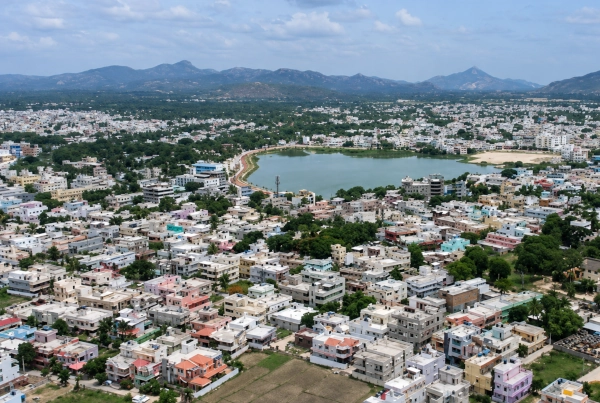
Madanapalle in Andhra Pradesh is developing a municipal waste-management model in which household refuse is treated as a recoverable resource rather than material destined for a dumpsite. Under Swachh Bharat Mission-Urban 2.0, the municipality has linked source segregation, composting, recycling, reuse, industrial co-processing and legacy-waste remediation into a single system aimed at transforming the town into a Zero Waste City.
The town generates approximately 62 tonnes of municipal solid waste every day, comprising 36 tonnes of wet waste, 25.5 tonnes of dry waste and about 0.5 tonnes of domestic hazardous material. Its strategy begins at the point of generation, with waste separated into biodegradable, non-biodegradable and reusable or upcyclable streams. This separation is crucial because mixed waste contaminates recyclable material, reduces the quality of compost and increases the volume requiring disposal.
Turning Organic Waste into a Local Resource
Madanapalle is processing biodegradable waste through a combination of household-level and municipal systems. Residents are being encouraged to adopt home composting and terrace gardening, while bulk waste generators such as large institutions and commercial establishments are being guided towards on-site treatment.
At the municipal compost yard, around 15.5 tonnes of wet waste is processed daily through windrow composting, producing approximately 4.65 tonnes of compost. Another three tonnes is treated through vermicomposting, generating nearly 1.2 tonnes of nutrient-rich manure. The finished compost is used in parks, plantations and gardening projects, returning organic matter to the soil while reducing the burden on disposal facilities.
This decentralised approach reflects the core principle of a circular waste system: biodegradable material should be treated close to where it is generated and converted into a useful product instead of being transported and buried.
Recovering Value from Dry Waste
Dry waste collected from homes is separated into recyclable and non-recyclable fractions. Paper, plastics, metals and other recoverable materials are transferred to a Material Recovery Facility, where they are sorted and sent to authorised recycling units.
Combustible material that cannot be economically recycled is transported to cement factories for co-processing. In cement kilns, suitable waste-derived fuel can partially replace conventional fossil fuel, providing an outlet for reject material that might otherwise accumulate at dumping grounds. Source segregation improves the quality of these streams and allows the municipality to recover revenue from material that was previously treated only as waste.
Reuse Adds a Social Dimension
Madanapalle’s Reduce, Reuse and Recycle Centre extends the system beyond conventional waste processing. Door-to-door collection drives recover old clothes, footwear, books, toys and electronic items that may still have functional value.
Usable articles are repaired, redistributed or made available to residents of informal settlements, homeless people and old-age homes. This approach prolongs the life of products, reduces demand for new materials and connects environmental management with community welfare.
Discarded tyres and other materials are also being converted into public installations. The Waste-to-Art Park at NVR Layout and similar beautification projects demonstrate reuse in a visible form, while murals and wall paintings communicate messages about cleanliness, hygiene and segregation.
Reclaiming Land from Legacy Waste
One of Madanapalle’s most significant achievements has been the treatment of approximately 36,512 metric tonnes of legacy waste accumulated at old dumping sites. Through biomining and bioremediation, the municipality has reclaimed around 9.4 acres of land.
About five acres of the recovered area has been brought under plantation, turning part of a former waste site into green urban space. Materials separated during remediation are directed to suitable uses: refuse-derived fuel is sent to cement plants, while recovered soil and inert material are used for filling low-lying areas.
Legacy-waste remediation is central to the Garbage Free Cities vision of SBM-U 2.0, which seeks complete waste processing alongside the clearance and restoration of old dumpsites. Nationally, the mission also evaluates urban local bodies through standardised Garbage Free City protocols and independent field verification.
A System Rather Than a Single Project
Madanapalle’s progress rests on connecting several operations rather than depending on one large treatment plant. Organic waste becomes compost, recyclable material returns to industry, reusable goods re-enter the community, combustible rejects support industrial co-processing and contaminated legacy sites are restored for productive use.
The town’s experience also underlines the importance of citizen behaviour. Municipal infrastructure can process segregated material efficiently only when households, shops and institutions keep wet, dry and hazardous waste separate. Public awareness, reliable collection and continued monitoring will therefore determine whether the town can advance from improved waste management to sustained zero dumping and zero littering.
Madanapalle has yet to eliminate every residual waste stream, but its integrated model demonstrates a practical route towards that objective. By designing separate pathways for different materials and recovering value at each stage, the municipality is gradually replacing the traditional collect-and-dump system with a locally managed circular economy.
Reference
Press Information Bureau, Government of India. “How Madanapalle is Building a Zero Waste City.” Ministry of Housing and Urban Affairs, 27 July 2026, Release ID 2289853.
You may also like
-
SatLeo Labs’ TAPAS-1 Reaches Orbit, Advancing India’s Private Thermal-Imaging Capability
-
TakeMe2Space’s MOI-1A Reaches Space on Falcon 9 Transporter-18 Mission
-
Bank of Baroda Enters Pension Fund Management After PFRDA Appointment
-
PRAHAAR: India’s First National Counter-Terrorism Policy and Strategy
-
SCI and India’s Push for a Larger Indigenous Maritime Fleet
