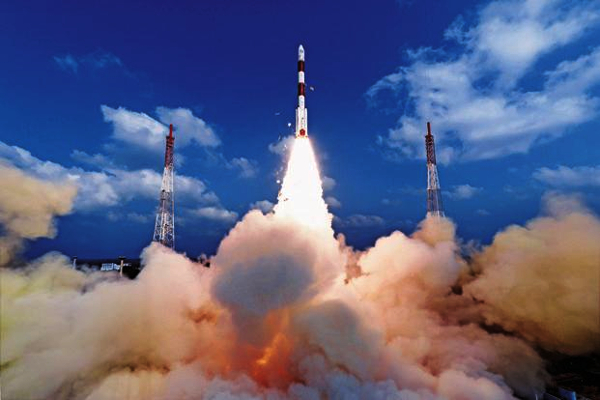
NEW DELHI: The launch of the country’s most advanced earth observation satellite Gisat-1, which will allow India to better monitor the subcontinent, including its borders with Pakistan and China, is slated for launch before May 15. The launch of the 2,268-kg satellite was earlier aborted in the first half of this month due to a technical glitch.
Indian space research organisation (Isro) chairman K Sivan told TOI, “The technical glitch related to a voltage fluctuation issue in the satellite is being fixed. Thereafter, the satellite will be assembled in the launch vehicle and tested again. All these things will take time and the launch is likely to happen in the first half of next month. The delay in the launch of Gisat-1 by GSLV-F10 and the Covid situation will, however, postpone other launches, including the first test-flight of the Small Satellite Launch Vehicle (SSLV or mini PSLV), this year.”
Equipped with high resolution cameras, Gisat-1 will allow the country to monitor the Indian landmass and oceans, particularly its borders, continuously as it will provide near real-time imaging of the large area region of interest at frequent intervals. It will also help in quick monitoring of natural disasters, episodic and any short-term events. The geo-satellite will also obtain spectral signatures for agriculture, forestry, mineralogy, disaster warning, cloud properties, snow and glaciers and oceanography. The satellite is configured around modified I-2k bus carrying multispectral and hyperspectral payloads in different bands with improved spatial and temporal resolution.
Gisat-1 will be placed in a geosynchronous transfer orbit by the GSLV-F10 rocket. Subsequently, the satellite will reach the geostationary orbit using its onboard propulsion system.
Sivan said Covid cases had been found among staff at the Sriharikota launch centre as well as at the Isro headquarters in Bengaluru. “But we are taking all precautions and following all Covid-related SOPs,” he said.
The Isro chief also told TOI that launches of Chandrayaan-3 and Aditya L1 solar missions will happen in the first half of next year as these “missions have a limited and specific launch window within which we have to launch them”.
On the first launch of the Gaganyaan unmanned flight in December this year, Sivan said green fuel will be used for the first time in the orbital module. However, switching rocket propulsion to green fuel in PSLV and GSLV will take some time, he said.
Source: ToI
You may also like
-
India Integrates 82.6 GHz Gyrotron With SST-1 Tokamak, Advancing High-Power Fusion Plasma Heating
-
BRICS Looks Beneath the Oceans as Bloc Moves Toward High-Speed Submarine Cable Network
-
RVNL Completes 10.8-km Himalayan Escape Tunnel as Rishikesh–Karnaprayag Rail Project Nears Final Tunnelling Stage
-
Indian Railways Freight Loading Rises 5.4% in August as Passenger and Cargo Connectivity Expands
-
IISc Develops Engineered Nanobody Antivenom With Broad Protection Against Indian Cobra Venoms
