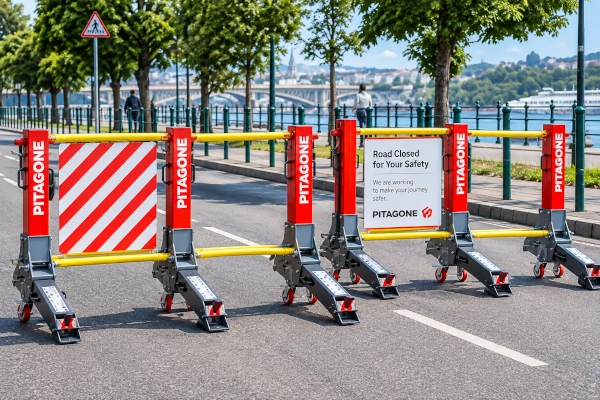
India’s homeland-security and critical-infrastructure protection sector is set to gain a new manufacturing capability under a partnership between Krishna Industries and Belgian security specialist Pitagone, with the companies planning local production of mobile anti-vehicle barriers designed to stop deliberate vehicle-ramming attacks.
The agreement was exchanged in New Delhi on September 3, 2026, during the India-Belgium Defence CEOs Roundtable and B2B meetings held alongside Belgian Prime Minister Bart De Wever’s visit to India. The Ministry of Defence officially listed Krishna Industries Pvt Ltd and Pitagone among the Indian and Belgian companies entering new industrial partnerships.
The initiative differs from many of the other agreements announced during the roundtable because it focuses primarily on physical protection of military facilities, government installations, public spaces and critical infrastructure rather than conventional weapons or combat platforms.
Pitagone India Joint Venture Reportedly Planned
Reporting from the bilateral engagement says the companies intend to establish a new venture called Pitagone India to manufacture and market the Belgian company’s security systems locally.
According to reports, Pitagone Belgium is expected to hold a 51% majority stake in the planned venture, while India would become a manufacturing and sales base for the company’s anti-ram protection products. The partnership is also reportedly intended to support exports from India to other Asian markets, including Southeast Asia.
The Ministry of Defence has confirmed the Krishna Industries-Pitagone agreement but has not separately published the proposed ownership structure, investment value, manufacturing location or production capacity.
The joint venture should therefore be treated as a reported industrial plan emerging from the agreement rather than a fully detailed manufacturing project whose commercial structure has already been publicly finalised.
Designed to Stop Vehicles Being Used as Weapons
Pitagone specialises in mobile anti-ram barriers intended to prevent cars, vans and heavier vehicles from being deliberately driven into protected areas or crowds.
Vehicle-ramming attacks pose a particular security challenge because ordinary road vehicles can be converted into weapons without requiring explosives, firearms or sophisticated preparation.
Potential targets include military entrances, government compounds, airports, railway stations, public events, ceremonial routes, embassies and other locations where large numbers of people or strategically important facilities are concentrated.
Traditional protection often depends on permanently installed bollards, concrete blocks or reinforced barriers. Pitagone’s approach instead emphasises rapidly deployable modular systems that can be positioned temporarily and removed when no longer required.
This makes the technology useful for security situations where the protected perimeter changes according to the event or threat level.
Mobile Barriers Can Be Deployed Without Permanent Construction
Pitagone describes its products as modular security barriers designed for fast deployment without extensive civil engineering.
The systems can be installed across roads, entrances and temporary access points before an event and subsequently removed, allowing streets or facilities to return to normal operation.
The company says its barriers are used by police forces, armed forces, federal agencies, airports, ports, public-transport operators and major private organisations in more than 35 countries.
Mobility is particularly important for military and law-enforcement users because security requirements can change rapidly.
A military installation may need to reinforce an entrance during heightened threat conditions, while police may need to establish temporary vehicle exclusion zones around political events, festivals, sporting venues or public gatherings.
A modular system provides that protection without requiring permanent fortification of every potential location.
Pitagone Has Developed Several Barrier Classes
The Belgian company’s portfolio includes multiple anti-ram barrier designs intended for different threat environments.
Its F11 system is described as an all-terrain mobile barrier designed to protect against vehicle-ramming attacks. The F18 provides a modular certified barrier architecture, while the larger F24 is intended for heavier protection requirements.
Pitagone also offers the OGMP armoured mobile guard post, combining physical protection with a deployable security position.
The company says its systems undergo recognised crash-testing and certification processes before being offered for security applications.
The exact Pitagone products selected for manufacture in India under the Krishna Industries partnership have not yet been announced publicly.
Local Production Could Lower Deployment Costs
Manufacturing the barriers in India could have several advantages over importing complete systems from Europe.
Physical-security equipment is often heavy and bulky, making transportation a meaningful component of total procurement cost. Local fabrication can reduce logistics expenditure while allowing systems to be customised for Indian road conditions, security requirements and operating environments.
Domestic production would also simplify spare-parts availability, repairs and replacement of damaged components.
For security organisations purchasing substantial numbers of barriers for deployment across multiple cities or military facilities, local manufacturing can therefore be more important economically than the sophistication of the individual product suggests.
It could also allow Indian-made systems to support export requirements in nearby Asian markets, particularly where buyers require rapid delivery and competitive pricing.
Military Bases Face Growing Vehicle-Borne Threats
Although Pitagone’s products have extensive civilian-security applications, their inclusion in an India-Belgium defence-industry roundtable reflects their relevance to military infrastructure.
Military bases contain ammunition stores, aircraft, communications equipment, command centres and other assets that require controlled vehicle access.
A hostile vehicle approaching at high speed can pose several different threats. It can itself be used as an impact weapon, carry armed attackers through a security perimeter or transport explosives towards a protected installation.
Physical anti-vehicle protection therefore forms an important layer between the public road network and the internal military security zone.
Mobile barriers can complement fixed gates, bollards, guard posts, surveillance cameras and armed security personnel by providing a mechanical method of preventing unauthorised vehicles from penetrating the perimeter.
Public Events Present a Different Security Requirement
The civilian application is equally significant.
Large gatherings frequently take place in streets and open public spaces that cannot be permanently closed to traffic. Authorities must therefore create temporary pedestrian zones while ensuring that hostile vehicles cannot enter them.
Conventional concrete blocks provide protection but can be difficult to transport and may require heavy equipment for installation.
Purpose-built mobile barriers allow security agencies to create temporary defensive perimeters with greater flexibility.
Pitagone says its systems are specifically intended to protect public spaces while allowing them to remain accessible when the elevated security requirement has passed.
That combination has become increasingly relevant internationally following vehicle-ramming attacks at public gatherings in several countries.
Part of a Broader India-Belgium Defence Manufacturing Push
The Pitagone agreement was one of several industrial partnerships announced during the September 3 engagement.
Other agreements involved Kalyani Strategic Systems with Thales on 70-mm rockets, Kalyani with FN Herstal on small arms and counter-UAS systems, Larsen & Toubro with Exail Robotics on maritime technologies, India Optel with OIP on electro-optics, Tembo Classic Engineering with Lachaussée on ammunition manufacturing, and DGVK Enterprises with Sol1 on unmanned systems.
Minister of State for Defence Sanjay Seth urged Belgian companies to combine their specialised technological capabilities with India’s manufacturing scale through co-development and co-production.
Belgium’s Defence and Foreign Trade Minister Theo Francken similarly highlighted the potential for deeper industrial collaboration between the two countries across defence and security technologies.
The Krishna Industries-Pitagone pact fits that wider strategy at the security-infrastructure end of the spectrum.
India Could Become Pitagone’s Asian Manufacturing Base
The reported intention to serve Southeast Asian markets from India gives the partnership an export dimension.
Pitagone currently develops and manufactures its anti-ram systems in Belgium and supports customers across five continents.
Indian production would introduce an additional manufacturing base closer to several rapidly growing Asian security markets.
Countries across the region are increasing protection of airports, government facilities, public events and strategic infrastructure as security agencies respond to terrorism, organised violence and threats to high-profile gatherings.
Indian production could therefore serve both domestic government requirements and overseas customers seeking certified mobile anti-vehicle protection systems.
A New Niche Within India’s Security Manufacturing Ecosystem
The agreement illustrates how India’s expanding defence-industrial policy is moving into specialised technologies that sit outside traditional categories such as missiles, aircraft and ammunition.
Physical security systems, anti-drone equipment, surveillance sensors, cyber-security technologies and infrastructure-protection products increasingly form part of the same national-security ecosystem.
The Krishna Industries-Pitagone partnership addresses one such niche: rapidly deployable protection against vehicle-borne attacks.
The September 3 agreement establishes the industrial foundation for local cooperation, while the next important milestones will be formalisation of the reported Pitagone India venture, selection of systems for domestic manufacture and identification of Indian production facilities.
Successful localisation would give India another domestic source of specialised security equipment while potentially establishing the country as Pitagone’s production and export base for the wider Asian market.
You may also like
-
India Post Creates History-Records ₹8,213 Crore Revenue in First Half of FY 2026–27, Parcel Business Grows 71%
-
Jeeraphool Rice of Chhattisgarh: The Fragrant Heritage Grain of Surguja with GI Recognition
-
HPCL Commissions India’s First Indigenous Blue Hydrogen Unit at Visakhapatnam Refinery
-
Bihar’s GI-Tagged Mithila Makhana Expands Global Reach as India Exports 7,265 Tonnes in FY26
-
Sigma Advanced Systems Secures ₹174 Crore Export Order for 155mm Artillery Ammunition Subsystems
