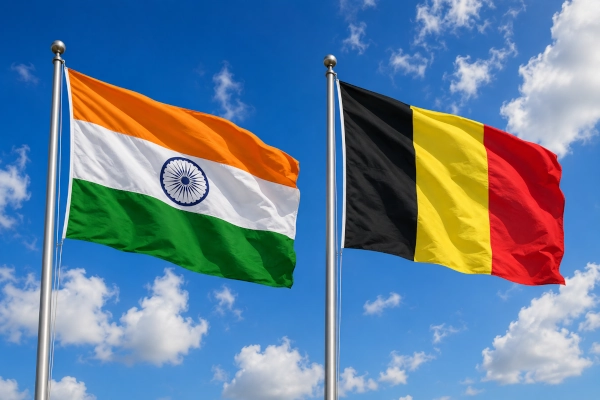
India and Belgium have agreed to explore the creation of a dedicated Joint Working Group on Counter-Terrorism, adding a new security dimension to a bilateral relationship that is already expanding across defence, technology, trade and law enforcement.
The proposal was included in the India-Belgium Joint Statement issued during Belgian Prime Minister Bart De Wever’s official visit to India from September 2 to 4, 2026. Both governments said the mechanism would be designed to strengthen bilateral cooperation against evolving terrorist threats and create a more structured channel for regular engagement between their security establishments.
Belgium also reiterated its solidarity with India in the fight against terrorism, including cross-border terrorism, and again condemned the April 2025 terrorist attack in Pahalgam, Jammu and Kashmir. The two sides stressed that terrorism in any form cannot be justified and called for those responsible to be held accountable in accordance with international law.
Focus on Networks, Financing and Safe Havens
The proposed working group would fit within a broader India-Belgium approach that places emphasis not only on individual attacks but also on the infrastructure that enables terrorism.
The two governments called for stronger international action against terrorist organisations, their networks, financial channels and safe havens. They specifically referred to entities designated under the UN Security Council 1267 sanctions regime and highlighted the importance of cooperation through institutions such as the United Nations and the Financial Action Task Force.
This gives the proposed mechanism a wider remit than conventional intelligence-sharing alone. It could provide a platform for exchanges on terrorist financing, extremist networks, sanctions enforcement, emerging operational methods and international legal cooperation.
Counter-Terrorism Becomes Part of a Wider Security Partnership
The initiative comes as India and Belgium are simultaneously institutionalising their defence relationship.
During the same visit, the two countries signed a Letter of Intent between their defence ministries covering staff talks, training, research cooperation, military exchanges and defence-industrial partnerships. Maritime security, emerging technologies and Indo-Pacific cooperation have also been identified as areas for deeper engagement.
The counter-terrorism proposal therefore forms part of a broader transition from periodic bilateral consultations towards regular security mechanisms.
Belgium’s decision to appoint a Defence Attaché in New Delhi and India’s plan to post a resident Defence Attaché in Brussels further strengthen the institutional channels available for defence and security dialogue.
CBI and Belgian Federal Police Sign Separate Security Pact
The visit also produced a concrete law-enforcement agreement between India’s Central Bureau of Investigation and the Federal Police of Belgium.
The MoU covers cooperation against transnational organised crime, cybercrime and related offences, along with information-sharing, capacity building, exchange of best practices and assistance in tracing fugitives.
This agreement complements the proposed counter-terrorism working group by creating an operational police-to-police channel alongside broader strategic and intelligence cooperation.
Modern terrorist networks frequently overlap with organised crime, illicit financial flows, cyber operations, forged documentation and cross-border movement of individuals. Closer institutional links between police agencies can therefore support the wider counter-terrorism architecture.
Financial Intelligence Could Become Increasingly Important
The reference to terrorist financing and FATF mechanisms is particularly significant.
Counter-terrorism increasingly depends on identifying financial transactions, shell entities, fundraising networks and logistical support structures before an attack takes place. India has consistently pushed for stronger international action against organisations and individuals involved in financing or facilitating terrorist activity.
Belgium’s position within the European Union also gives the bilateral mechanism a wider dimension, as information-sharing and financial enforcement can intersect with European policing, sanctions and regulatory networks.
A dedicated working group could help coordinate bilateral positions on these issues while providing a forum for exchanging threat assessments and investigative practices.
Cyber-Enabled Terrorism Adds a New Challenge
The parallel emphasis on cybercrime is also relevant because terrorist organisations increasingly use digital platforms for propaganda, recruitment, fundraising, communications and operational planning.
The CBI-Belgian Federal Police agreement creates a formal structure for cooperation in cyber investigations, while the proposed counter-terrorism group could address the broader national-security implications of digital extremist networks.
Belgium and India have already identified cyber and hybrid threats as areas of strategic cooperation within the wider India-EU security framework, giving bilateral discussions access to a larger European security ecosystem.
From Political Solidarity to Institutional Cooperation
Belgium’s condemnation of the Pahalgam attack provides the political context for the new initiative, but the more significant development is the attempt to convert shared positions into permanent institutional cooperation.
Statements of solidarity are important diplomatically, but working groups allow officials to meet regularly, exchange assessments and pursue specific operational or policy priorities.
The proposed Belgium-India Joint Working Group on Counter-Terrorism could therefore become the principal bilateral forum for handling terrorist threats, while the CBI-Federal Police mechanism addresses related criminal and investigative dimensions.
Security Ties Expand Alongside Defence Cooperation
The initiative reflects the broader transformation of India-Belgium relations during the September 2026 summit.
The partnership is no longer centred primarily on trade, diamonds, pharmaceuticals and European economic links. Defence manufacturing, maritime security, cybercrime, counter-terrorism and emerging technologies are now becoming regular components of bilateral engagement.
The proposed counter-terrorism working group adds another institutional layer to that process and gives both countries a dedicated mechanism for dealing with threats that increasingly operate across national borders, financial systems and digital networks.
Its establishment would mark a shift from ad hoc security consultation towards a more structured India-Belgium counter-terrorism partnership built around intelligence, law enforcement, financial disruption and coordinated international action.
You may also like
-
Sigma Advanced Systems Secures ₹174 Crore Export Order for 155mm Artillery Ammunition Subsystems
-
Bharat Electronics Secures ₹1,011 Crore in New Defence Orders for Radar, Communication and Sonar Systems
-
India’s 300 kW Laser Weapon Ambitions Could Strengthen Future Defence Against Cruise Missiles
-
Indian Army Seeks 360-Degree Laser Warning System with Automatic Smoke Protection for Tanks
-
DRDO Seeks Indian Industry Partners for Development and Production of R-59 Air-Launched Weapon System
