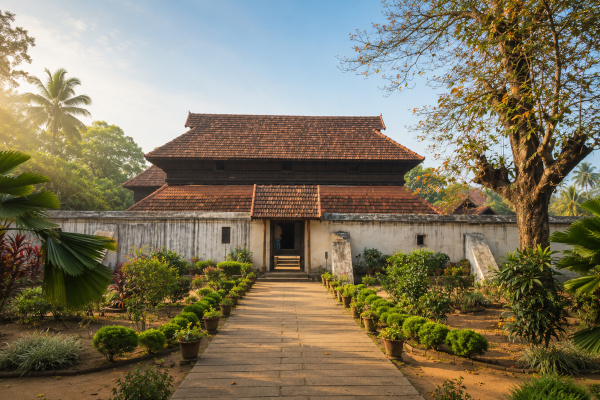
The history of central Travancore carries the memory of many small but powerful kingdoms that shaped Kerala before the rise of a unified Travancore state. Among them, Kayamkulam held a special place. Known historically as Odanad and closely associated with the Onattukara region, Kayamkulam was once an important kingdom ruled by the Kayamkulam Rajas. Its rulers controlled a fertile and strategic stretch of land in southern Kerala, positioned between the older powers of Venad, Kollam, Ambalappuzha and the coastal trade world of the Arabian Sea.
The Kayamkulam Raja was not merely a local chief. He represented one of the notable ruling houses of central Kerala during a time when the region was divided into several principalities. These kingdoms were small in size compared with later Travancore, but they were politically alert, militarily active and deeply connected to trade, temple culture and local warrior traditions.
The Land of Odanad and Onattukara
Kayamkulam belonged to the historic region of Odanad, also remembered as Onattukara. This region included areas around present-day Kayamkulam, Mavelikkara, Krishnapuram and nearby parts of Alappuzha and Kollam. The land was known for its paddy fields, waterways, temple networks and trade links.
Odanad’s earlier centres were associated with Kandiyoor and Muttom, while Kayamkulam and Krishnapuram later rose in importance. Over time, Kayamkulam became the political and commercial face of the kingdom. Mavelikkara retained cultural importance, while Kayamkulam became closely linked with military strength and royal authority.
The geography of Kayamkulam gave it strategic value. It stood near important inland routes and coastal trade channels. Its access to waterways helped movement of goods, soldiers and administrative communication. In the age before modern roads, control over rivers, backwaters, ports and temple-centred settlements gave a ruler real power.
The Kayamkulam Rajas
The rulers of Kayamkulam belonged to the old regional order of Kerala, where royal houses, temple authorities, Nair military houses and local chieftains formed a complex political structure. The Kayamkulam Raja commanded loyalty from warrior families and local power centres. His court represented the pride of Odanad and the independence of the Onattukara region.
The Kayamkulam kingdom was known for its military culture. Its rulers maintained armed retainers and depended on regional martial traditions. The famous Kayamkulam Vaal, the double-edged sword associated with the Kayamkulam Rajas, remains one of the strongest symbols of this martial heritage. This sword represents both the courage and the danger of a time when Kerala’s small kingdoms constantly had to defend their frontiers.
The Kayamkulam Raja’s position was also shaped by the politics of adoption, succession and alliances. In the 18th century, royal adoptions and claims over territories often created tension between neighbouring kingdoms. Kayamkulam became involved in such disputes, especially in relation to Kollam and Travancore. These disputes eventually brought Kayamkulam into direct conflict with Marthanda Varma of Venad.
A Kingdom in the Path of Expansion
The 18th century changed the history of Kerala. Anizham Thirunal Marthanda Varma, who ruled Venad from 1729 to 1758, began transforming a relatively smaller southern kingdom into the powerful state of Travancore. His vision was clear: strengthen royal authority, defeat internal opponents, build a disciplined army, control trade routes and absorb neighbouring principalities.
For Marthanda Varma, Kayamkulam was not a minor target. It was a strategically located kingdom that stood in the path of Travancore’s northward expansion. If Travancore had to grow beyond Venad and Kollam, it had to deal with Kayamkulam.
For the Kayamkulam Raja, this was a struggle to preserve independence. He faced a rising military state that had stronger central authority, better organisation and, after the Battle of Colachel, access to improved military methods through European-trained officers such as Eustachius De Lannoy.
The conflict between Kayamkulam and Travancore was therefore not simply a war between two kings. It was a clash between an older regional order and a new centralised state.
Conflict With Marthanda Varma
The Kayamkulam Raja resisted Travancore’s pressure with determination. At different stages, Kayamkulam sought support from other powers, including neighbouring principalities and the Dutch. This was a common political strategy of the time. Smaller kingdoms attempted to balance the rise of a stronger neighbour by forming alliances.
The struggle intensified in the 1740s. Travancore’s expansion had already shaken the political balance of southern Kerala. Kayamkulam’s resistance became one of the major obstacles before Marthanda Varma.
The Treaty of Mannar in 1742 temporarily reduced the conflict. Under the treaty, Kayamkulam accepted a subordinate position and agreed to terms imposed by Travancore. However, the arrangement did not bring lasting peace. The Kayamkulam Raja and his allies continued to resist the growing dominance of Travancore.
By 1746, the conflict reached its decisive stage. Travancore moved against Kayamkulam with greater force. The final defeat of Kayamkulam marked one of the major turning points in the creation of Travancore. The Kayamkulam Raja lost his kingdom, and the territory was annexed into the expanding Travancore state.
The Fall of Kayamkulam
The fall of Kayamkulam was a dramatic moment in Kerala’s political history. It symbolised the end of one of the proud central Kerala principalities and the rise of a larger, more organised kingdom under Marthanda Varma.
The Kayamkulam Raja’s defeat was not the result of weakness alone. It came at a time when the political structure of Kerala itself was changing. Small kingdoms that had survived for centuries through local alliances and regional authority were now facing a new kind of state power. Travancore had a stronger army, centralised administration, clear strategic direction and the ability to absorb conquered territories.
The annexation of Kayamkulam extended Travancore’s influence northward and strengthened its control over central Kerala. It also opened the way for further expansion into other principalities. In that sense, Kayamkulam’s fall became an important step in the making of modern Travancore.
Krishnapuram Palace and the Memory of Royal Kayamkulam
The historical memory of Kayamkulam is closely tied to Krishnapuram Palace. Located near Kayamkulam, this palace is one of the most important heritage sites associated with the region. The present palace is linked to the Travancore period after the annexation of Kayamkulam, but the site preserves the memory of the older royal landscape of Odanad.
Krishnapuram Palace reflects traditional Kerala architecture with sloping tiled roofs, inner courtyards, wooden passages and a quiet royal atmosphere. It is now known for its museum, sculptures, antique collections and the famous Gajendra Moksham mural.
The Gajendra Moksham mural is one of the great treasures of Kerala mural art. It depicts the mythological story of Lord Vishnu rescuing the elephant king Gajendra. The mural represents devotion, royal faith and the artistic refinement of Kerala’s palace culture.
The palace also houses the Kayamkulam Vaal, the famous double-edged sword associated with the Kayamkulam Rajas. More than an object of war, the sword has become a symbol of lost sovereignty, courage and regional pride.
Kayamkulam Vaal: Symbol of a Warrior Kingdom
The Kayamkulam Vaal occupies a special place in the memory of the Kayamkulam Rajas. Unlike ordinary swords, it is sharpened on both sides. This made it a dangerous and distinctive weapon. In local memory, it represents the warrior culture of Kayamkulam and the military confidence of its rulers.
The sword also reminds us that Kerala’s history was not only shaped by temples, trade and literature. It was also shaped by military houses, battlefield decisions, forts, alliances and resistance. The Kayamkulam Raja belonged to this world of political courage and martial readiness.
Even after the kingdom disappeared into Travancore, the Kayamkulam Vaal remained as a symbol of the royal house’s identity. It continues to attract attention because it carries the emotional power of a vanished kingdom.
Cultural and Political Importance
The Kayamkulam Rajas were important because they represented the old political identity of central Travancore. Their kingdom stood between the southern power of Venad and the wider political world of central Kerala. They controlled a region that had agricultural wealth, strategic waterways and strong warrior traditions.
Their resistance to Travancore shows how deeply the smaller kingdoms valued their independence. These rulers were not passive victims of expansion. They negotiated, resisted, allied and fought. Their story adds depth to the history of Kerala by showing that the making of Travancore was not an easy or automatic process. It was created through diplomacy, warfare, administration and the absorption of proud regional powers.
Kayamkulam’s story also reminds us that defeated kingdoms continue to live through memory. Their palaces, swords, temples, legends, place names and folk traditions preserve their identity long after political power has ended.
Legacy of the Kayamkulam Raja
The legacy of the Kayamkulam Raja can be seen in three ways.
First, he represents the sovereignty of Odanad and Onattukara before Travancore’s rise. His kingdom reminds us that central Kerala had its own political identity before being absorbed into a larger state.
Second, he represents resistance. The Kayamkulam Raja did not surrender immediately to Travancore’s expansion. He sought alliances, fought wars and attempted to defend his kingdom’s autonomy.
Third, he represents the transition from old Kerala to modern Travancore. His fall marked the decline of the fragmented princely order and the rise of a larger, more centralised political structure under Marthanda Varma.
Today, Kayamkulam is remembered as a town, a cultural region and a historical name. But behind the modern town stands the memory of a kingdom that once mattered deeply in Kerala’s political map.
Conclusion
The Kayamkulam Raja was one of the important regional rulers of pre-modern Kerala. As ruler of Odanad, he controlled a strategic kingdom in central Travancore before the rise of Marthanda Varma’s Travancore state. His kingdom was known for its military culture, regional pride, trade connections and resistance to outside domination.
The annexation of Kayamkulam by Marthanda Varma was a turning point in Kerala history. It strengthened Travancore and changed the political destiny of southern Kerala. Yet the memory of Kayamkulam did not vanish. It survives through Krishnapuram Palace, the Gajendra Moksham mural, the Kayamkulam Vaal and the proud identity of Onattukara.
The story of the Kayamkulam Raja is therefore not merely the story of a defeated ruler. It is the story of a proud kingdom that stood at the crossroads of old Kerala and the new Travancore.
You may also like
-
Pundra — The Northern Bengal Kingdom of the Karatoya and the Ancient City of Pundranagara
-
Vanga — The River Kingdom of the Bengal Delta and the Eastern Sea
-
Kishkindha — The Boulder Kingdom of Pampa, Rishyamukha and the Tungabhadra
-
Setu — The Sacred Southern Crossing Between Rameswaram and Lanka
-
One Voice – One Resolve – One India: Namami Bharatam Marks 150 Years of Vande Mataram Across the Nation
