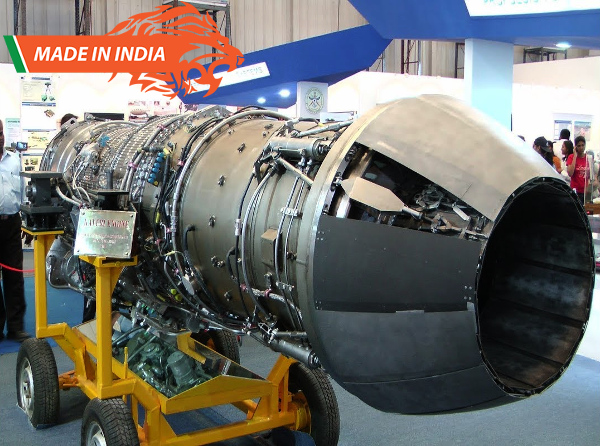
India’s indigenous Kaveri aero-engine programme has entered an important new phase as the Defence Research and Development Organisation advances the dry Kaveri derivative towards flightworthy certification for an unmanned combat aircraft application.
Recent reports have claimed that the latest Russian flight-test campaign has been completed and that the engine achieved 48.5 kN of dry thrust. However, as of 29 September 2026, the Ministry of Defence and DRDO have not issued a fresh official release confirming either the completion of that latest Russian campaign or the specific 48.5 kN figure. The official record nevertheless confirms that the Kaveri Derivative Engine is intended to produce about 49 kN of thrust and is being developed as the power plant for India’s remotely piloted strike aircraft programme.
Kaveri Derivative Officially Assigned to India’s Strike UAV Programme
The Ministry of Defence confirmed in a July 2025 parliamentary reply that the Kaveri Derivative Engine, or KDE, is being developed as the power plant for the Indian Unmanned Combat Air Vehicle programme.
Two separate projects have been sanctioned for this effort. The Flightworthy Kaveri Dry Engine Development programme carries a sanctioned cost of ₹472.42 crore, while the Technology Demonstration of the Kaveri Derivative Dry Engine has been sanctioned at ₹251.17 crore.
This establishes the dry Kaveri not as an experimental continuation of the original fighter-engine programme, but as a dedicated propulsion programme linked to India’s unmanned strike-aircraft ambitions.
DRDO Targets About 49 kN of Dry Thrust
DRDO Chairman Dr Samir V. Kamat has stated that the Kaveri derivative is expected to generate approximately 49 kN of thrust without an afterburner.
The dry-engine configuration is fundamentally different from the original Kaveri architecture intended for the Light Combat Aircraft. Removal of the afterburner reduces the engine’s maximum thrust but also makes it better suited to an unmanned aircraft where endurance, fuel efficiency, reliability and lower infrared signature can assume greater importance.
The approximately 49 kN thrust class also corresponds closely with the performance requirement associated with the unmanned combat-aircraft application now assigned to the engine.
High-altitude Testing and Flying Testbed Validation Form the Certification Path
DRDO has made clear that the Kaveri derivative must complete high-altitude testing followed by evaluation on a flying testbed before certification.
Dr Kamat said in 2025 that high-altitude testing of the derivative was underway and would be followed by flying-testbed trials. Certification would follow after these stages were completed.
This sequence is critical because a gas-turbine engine that performs successfully on a ground test stand must also demonstrate stable operation across changing altitude, air density, temperature, speed and airflow conditions.
Flying-testbed trials allow engineers to evaluate engine response, thermal behaviour, vibration, control-system performance, reliability and operating margins under realistic airborne conditions.
Russia Has Played a Major Role in Earlier Kaveri Flight Testing
Russia has long been associated with the Kaveri programme’s high-altitude and flight-test phases.
Official Ministry of Defence records confirm that the earlier Kaveri engine underwent altitude testing at the Central Institute of Aviation Motors in Russia and was subsequently integrated with an Ilyushin Il-76 flying testbed at the Gromov Flight Research Institute.
During those earlier trials, the Kaveri completed 27 flights amounting to roughly 55 to 57 hours. The engine was tested at altitudes reaching about 12 kilometres and speeds of up to Mach 0.7.
These tests were significant because they represented the first occasion on which an indigenously developed Indian military gas-turbine engine underwent airborne testing.
The experience accumulated during that programme has subsequently been applied to the development of the Kaveri derivative.
Kaveri Was Not Abandoned After Tejas
The original Kaveri engine was conceived as the indigenous power plant for the Light Combat Aircraft programme. However, it could not achieve the thrust required for the operational Tejas configuration.
The Ministry of Defence stated in 2012 that the Tejas required an engine in approximately the 90 kN thrust class, while the Kaveri in its original architecture could not fully meet that requirement.
Instead of terminating the technological effort, DRDO redirected the engine towards other applications, including unmanned aircraft.
This transition eventually led to the dry Kaveri derivative that is now being developed specifically for the strike-UAV role.
Thousands of Hours of Engine Testing Built the Technology Base
The Kaveri programme has accumulated an extensive testing record over several decades.
Official government records show that nine full Kaveri engine prototypes and four core-engine prototypes were developed. By 2021, more than 3,200 hours of engine testing had been completed across different development configurations.
The programme also produced indigenous expertise in Full Authority Digital Engine Control systems, high-temperature materials, compressor technology, turbine systems, combustion technology and engine testing.
Although the original objective of powering Tejas was not achieved, the programme created an indigenous military aero-engine knowledge base that continues to support later engine-development efforts.
Indigenous Materials and Components Are Expanding
The Kaveri derivative is also benefiting from the gradual localisation of critical aero-engine materials and components.
In October 2025, the Centre for Military Airworthiness and Certification issued a Letter of Technical Acceptance for indigenous titanium oil-tank assembly castings for the Kaveri Derivative Engine KDE-2.
The work is being undertaken by PTC Industries in partnership with DRDO’s Gas Turbine Research Establishment.
PTC Industries also received an order connected with the manufacture of single-crystal turbine blades for the Kaveri derivative. Single-crystal blades are among the most technologically demanding components in a modern gas-turbine engine because they must withstand extreme temperature, centrifugal loading and sustained high-speed operation.
The development of such components within India represents an important parallel advance to the engine programme itself.
February 2026 Review Underlined Government Focus on Aero Engines
The Kaveri programme received high-level attention again in February 2026 when Defence Minister Rajnath Singh visited DRDO’s Gas Turbine Research Establishment in Bengaluru.
During the visit, he reviewed indigenous military gas-turbine engine programmes and witnessed a full-afterburner test of the Kaveri engine.
The Defence Minister reiterated the government’s commitment to achieving greater self-reliance in aero-engine development, one of the most technically demanding areas of modern aerospace engineering.
The review reflected the broader strategic importance now attached to indigenous propulsion, particularly as India simultaneously develops next-generation fighters, unmanned combat aircraft and advanced missile systems.
The Dry Kaveri Is Intended for an Unmanned Strike Aircraft
The dry Kaveri should not be confused with an engine intended to replace the GE F404 currently powering the Tejas Mk1 and Mk1A.
Its officially stated application is the Indian unmanned combat-aircraft programme.
A dry turbofan offers several characteristics that can be advantageous for such an aircraft. Without an afterburner, the engine can offer lower fuel consumption and potentially lower thermal signature while still generating sufficient thrust for a subsonic or high-subsonic strike platform designed around stealth and endurance rather than fighter-like acceleration.
The power plant therefore forms one of the key enabling technologies for India’s future autonomous combat-aircraft capability.
Certification Will Be the Next Defining Milestone
The most consequential step for the programme will be completion of flying-testbed validation followed by certification.
That stage would demonstrate that the Kaveri derivative has moved beyond ground-based developmental testing and can operate reliably under representative airborne conditions.
It would also provide the basis for integration with the intended unmanned aircraft and for subsequent propulsion-system development associated with the flight demonstrator.
The official trajectory of the programme is now considerably clearer than it was during the earlier Tejas era. The government has assigned the dry Kaveri a defined unmanned-combat-aircraft role, funded dedicated flightworthy development, expanded indigenous component manufacturing and continued high-level oversight of the propulsion programme.
For India, the significance extends beyond a single engine. Successful maturation of the Kaveri derivative would strengthen the domestic knowledge base required for future military gas-turbine engines and deepen India’s ability to design advanced combat aircraft around propulsion systems developed within the country.
References
Press Information Bureau, Ministry of Defence — Development of Indigenous Defence Technologies, 25 July 2025
https://www.pib.gov.in/PressReleasePage.aspx?PRID=2148337
Press Information Bureau, Ministry of Defence — Raksha Mantri Reviews Indigenous Military Gas Turbine Engine Projects at GTRE, 16 February 2026
https://www.pib.gov.in/PressReleasePage.aspx?PRID=2228670
Press Information Bureau, Ministry of Defence — Development of Kaveri Engine, 29 November 2021
https://www.pib.gov.in/PressReleasePage.aspx?PRID=1776092
Press Information Bureau, Ministry of Defence — Kaveri Engine, 14 May 2012
https://www.pib.gov.in/newsite/PrintRelease.aspx?lang=2®=3&relid=83706
Press Information Bureau, Ministry of Defence — Development of Indigenous Aero-Engine by DRDO, 21 December 2011
https://www.pib.gov.in/newsite/PrintRelease.aspx?lang=2®=48&relid=79102
Press Information Bureau, Ministry of Defence — Developments of Kaveri Fighter Engine, 30 July 2015
https://www.pib.gov.in/newsite/PrintRelease.aspx?relid=123940
Press Information Bureau, Ministry of Defence — Titanium and Superalloy Materials Plant at PTC Industries, 18 October 2025
https://www.pib.gov.in/PressReleasePage.aspx?PRID=2180722
You may also like
-
Rajnath Singh to Lead Indian Delegation at ASEAN Defence Summit in Philippines, Strengthening Indo-Pacific Security Cooperation
-
Bengaluru Startup Paar Autonomy Develops AI-Powered Drone Systems for GPS-Denied Environments
-
Sigma Advanced Systems Secures Fresh ₹973 Crore NATO Artillery Ammunition Order
-
India Advances Indigenous Defence and Space Technologies Through Naval Innovation, Drones and Advanced Electronics
-
Thales Seeks Indian Partnerships for Next-Generation Missiles, Radars and Electronic Warfare Systems
