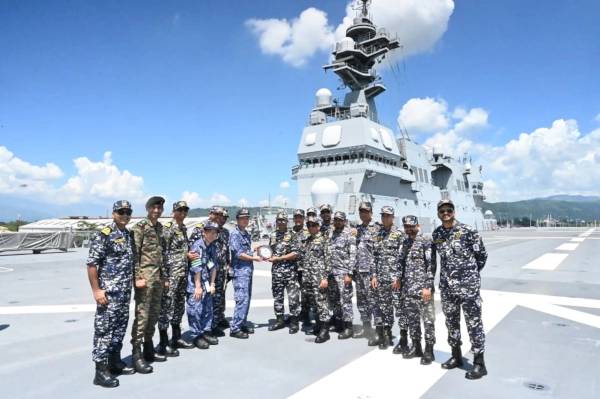
Indian Naval Ships INS Sahyadri and INS Kulish are participating in the second ASEAN-India Maritime Exercise, or AIME 2026, being held in the Philippines with naval units from ASEAN member states. The exercise is being co-hosted by the Indian Navy and the Philippine Navy as part of the expanding maritime engagement between India and Southeast Asia.
The exercise brings together warships and personnel from India and ASEAN countries to strengthen interoperability, operational familiarity and cooperation at sea. Alongside INS Sahyadri and INS Kulish, participating ships include BRP Jose Rizal, BRP Tarlac and RSS Justice from ASEAN member states.
Sea Phase to Be Conducted Off Zambales
The maritime phase of AIME 2026 is being conducted off the coast of Zambales province in the Philippines. The programme combines professional exchanges ashore with coordinated drills at sea, allowing participating navies to practise procedures that are increasingly important for regional maritime security and humanitarian operations.
The exercise includes boarding operations, helicopter cross-deck landings and medical evacuation drills. These activities are designed to improve coordination between ships operating under different national command structures and to build familiarity with common operational procedures.
Maritime Domain Awareness and HADR Form Key Components
AIME 2026 is not limited to conventional naval manoeuvres. Subject-matter expert exchanges are also being conducted on maritime domain awareness, Humanitarian Assistance and Disaster Relief, logistics, and women, peace and security.
Maritime domain awareness has become increasingly important in the Indo-Pacific as regional navies seek a clearer operating picture of commercial shipping, fishing activity, piracy, trafficking, natural disasters and other developments across heavily used sea lanes.
Humanitarian Assistance and Disaster Relief is another important area of cooperation. Southeast Asia and the wider Indian Ocean-Pacific region are regularly affected by typhoons, earthquakes and other natural disasters, making the ability of regional navies to coordinate quickly during emergencies an important part of maritime preparedness.
INS Sahyadri Brings Frontline Frigate Capability
INS Sahyadri is a Shivalik-class stealth guided-missile frigate and represents one of the Indian Navy’s principal surface combatant classes. The ship is designed for multi-role operations and can undertake anti-surface, anti-air and anti-submarine missions while also supporting helicopters.
Its deployment to multinational exercises gives the Indian Navy an opportunity to operate a frontline frigate alongside partner navies while testing communications, procedures and operational coordination under realistic conditions.
Such deployments also demonstrate the Indian Navy’s ability to sustain warships across the wider Indo-Pacific and contribute to cooperative maritime-security missions beyond India’s immediate waters.
INS Kulish Adds Missile-Corvette Capability
INS Kulish is a Kora-class guided-missile corvette designed primarily for surface warfare and maritime strike missions. Its participation alongside the larger INS Sahyadri gives the Indian contingent a mix of capabilities during AIME 2026.
The presence of different ship types is particularly useful during exercises involving manoeuvring, boarding, logistics and coordinated maritime operations because crews must work across different platform sizes, operational roles and command arrangements.
India and Philippines Deepen Naval Cooperation
The Philippines has become an increasingly important maritime partner for India in Southeast Asia. Defence and security cooperation between the two countries has expanded through high-level exchanges, naval port calls, exercises and growing cooperation in maritime security.
The decision to co-host AIME 2026 with the Philippine Navy gives Manila a prominent role in India’s broader maritime engagement with ASEAN and places the exercise within a strategically important part of the Indo-Pacific.
Zambales faces the South China Sea, giving the exercise a geographically significant setting while its publicly stated focus remains professional cooperation, interoperability, humanitarian response and maritime-security skills.
ASEAN-India Maritime Cooperation Expands
The ASEAN-India Maritime Exercise was created to give India and ASEAN navies a dedicated platform for multilateral maritime cooperation. Its second edition reflects the gradual institutionalisation of naval interaction between India and Southeast Asian countries.
India’s maritime engagement with ASEAN forms part of its wider Act East policy and Indo-Pacific approach. Naval exercises, port visits, professional exchanges and training programmes create operational familiarity that can support cooperation during emergencies as well as routine maritime-security missions.
For ASEAN navies, engagement with India also provides access to a major Indian Ocean naval power with growing experience in long-range deployments, anti-piracy patrols, humanitarian assistance, hydrography and maritime surveillance.
Interoperability Becomes Increasingly Important
Multinational maritime operations depend heavily on interoperability. Ships from different countries may use different communications systems, operating procedures and command structures, which makes repeated exercises essential for building familiarity.
Boarding exercises help standardise procedures used during maritime-security operations. Helicopter cross-deck landings allow naval aviators and ship crews to practise operating from foreign vessels, while medical evacuation exercises improve the ability to transfer casualties between participating ships.
Logistics discussions are equally important because sustained multinational operations require ships to coordinate replenishment, maintenance and support while operating away from their home ports.
AIME 2026 Strengthens India’s Maritime Engagement With ASEAN
The participation of INS Sahyadri and INS Kulish in AIME 2026 adds another operational layer to India’s growing defence relationship with ASEAN.
By combining frontline naval deployments with practical training in maritime domain awareness, humanitarian response, logistics, boarding operations and aviation coordination, the exercise is building the kind of familiarity needed for effective multinational operations.
AIME 2026 therefore reflects a broader trend in India’s regional maritime diplomacy: deeper interaction with Southeast Asian navies, regular deployment of Indian warships across the Indo-Pacific and an expanding role for the Indian Navy in cooperative maritime security.
References
- Akashvani News — Indian, ASEAN navies participate in second ASEAN-India Maritime Exercise in Philippines, September 29, 2026.
https://newsonair.gov.in/indian-asean-navies-participate-in-second-asean-india-maritime-exercise-in-philippines/ - Indian Embassy in the Philippines — Official information on ASEAN-India Maritime Exercise 2026 and India-Philippines maritime cooperation.
- Indian Navy — Official information on INS Sahyadri, INS Kulish and Indian Navy deployments in the Indo-Pacific.
You may also like
-
Rajnath Singh to Lead Indian Delegation at ASEAN Defence Summit in Philippines, Strengthening Indo-Pacific Security Cooperation
-
Bengaluru Startup Paar Autonomy Develops AI-Powered Drone Systems for GPS-Denied Environments
-
Sigma Advanced Systems Secures Fresh ₹973 Crore NATO Artillery Ammunition Order
-
India Advances Indigenous Defence and Space Technologies Through Naval Innovation, Drones and Advanced Electronics
-
Thales Seeks Indian Partnerships for Next-Generation Missiles, Radars and Electronic Warfare Systems
