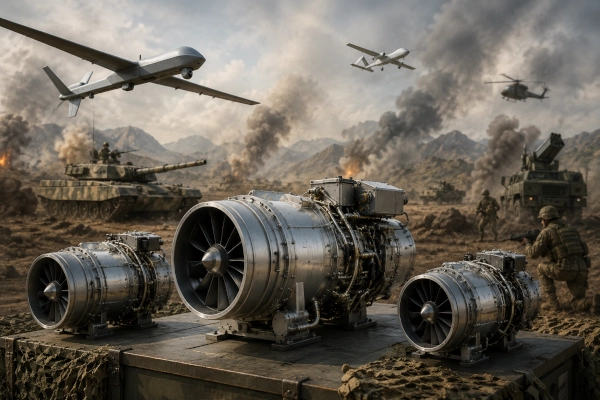
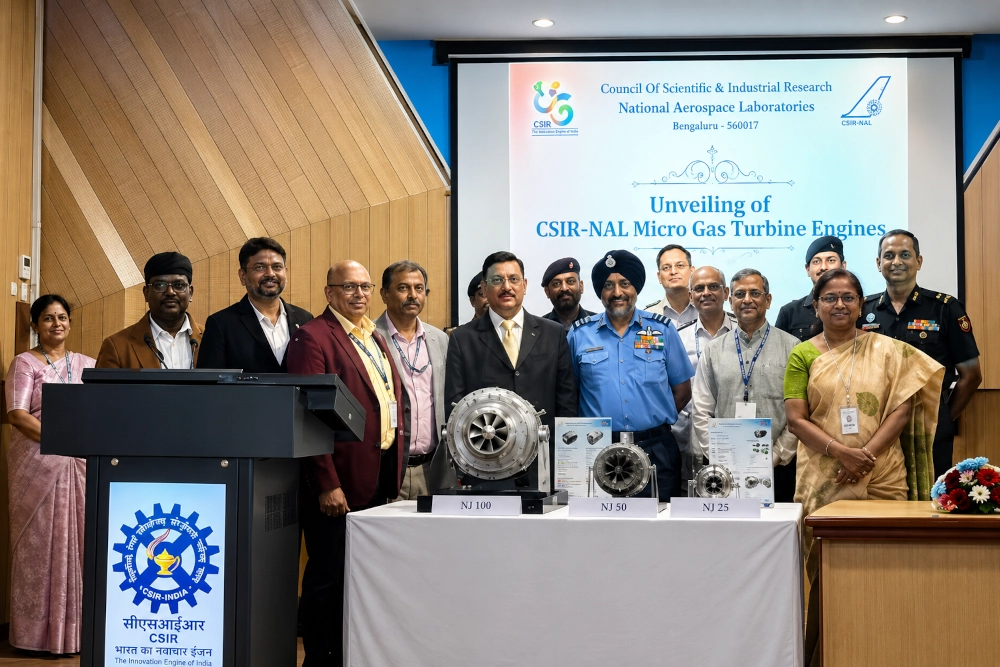
India has expanded its indigenous aerospace propulsion capability with CSIR-National Aerospace Laboratories unveiling three domestically developed micro and small gas turbine engines designed for unmanned and compact defence platforms.
The new NJ-series consists of the NJ-05 producing 5 kg of thrust, NJ-50 producing 50 kg and NJ-100 producing 100 kg. The engines are intended for applications such as tactical unmanned aerial vehicles, drone interceptors and compact missile systems, where lightweight and high-performance propulsion is critical.
Their development required advances in high-speed turbomachinery and high-temperature combustion technologies, two technically demanding areas in miniature gas turbine engineering. Building these capabilities domestically could reduce dependence on imported propulsion systems that remain important components of many unmanned and precision-strike platforms.
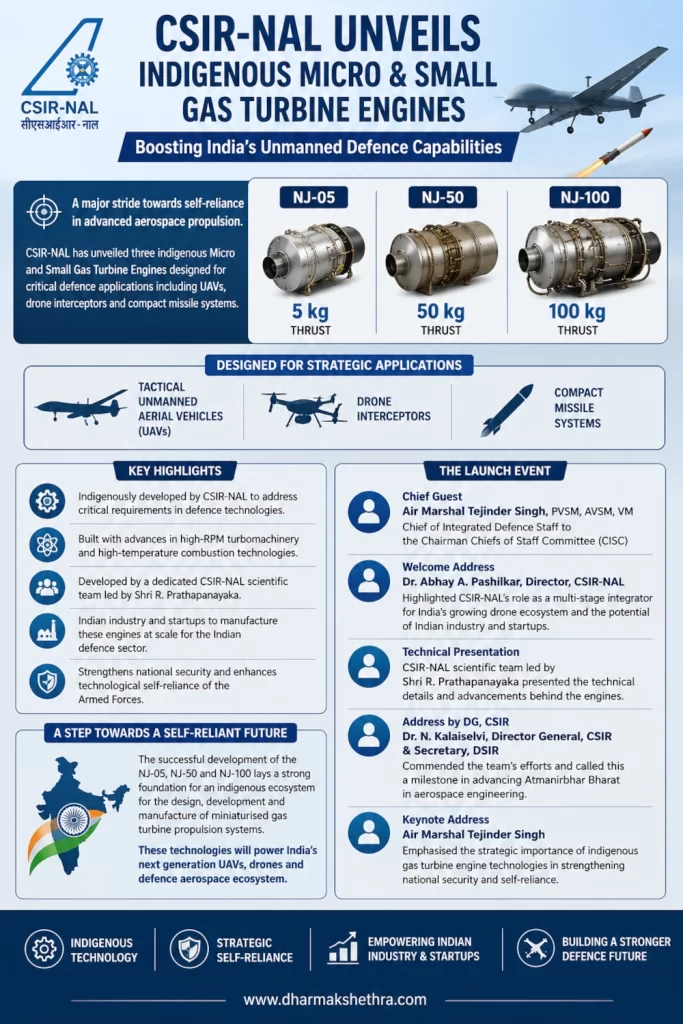
CSIR-NAL also plans to involve Indian aerospace companies and startups in taking the engines toward larger-scale manufacturing. This approach could create a domestic supply chain for propulsion systems serving the rapidly expanding UAV and defence-drone industry.
The unveiling of the NJ-05, NJ-50 and NJ-100 therefore represents more than the introduction of three engines. It establishes a broader indigenous technology base for miniaturised gas turbine propulsion, potentially supporting future Indian drones, interceptors and other high-speed unmanned platforms while strengthening self-reliance in a strategically important aerospace technology.
Source: PIB :https://www.pib.gov.in/PressReleaseDetail.aspx?PRID=2303065®=48&lang=1
You may also like
-
IndigoTex Raises ₹5 Crore to Scale Indigenous Advanced Textile Technologies
-
Sunfox Technologies Raises $7 Million to Take India-Built Spandan ECG Platform Global
-
DRDO Opens Actuators, Infrared Seeker, Lightweight Torpedo and Armour Technologies to Indian Industry
-
Airtel Extends Free International Roaming Across Its New Postpaid Plans
-
Indian Army to Add 225 Indigenous FPV Drones; Aerodrone Says Systems Were Tested Up to 17,500 Feet
