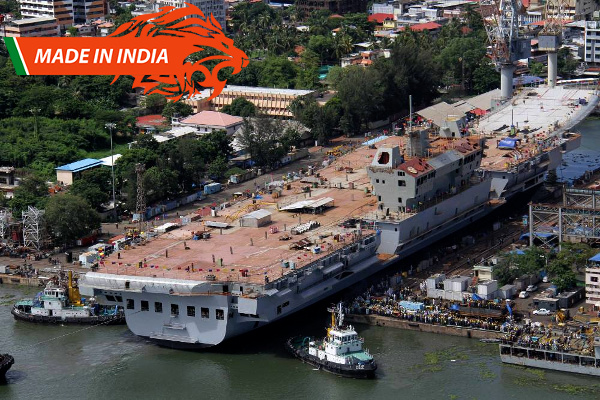
The country’s first Indigenous Aircraft Carrier (IAC), Vikrant, is in advanced stage of construction and will be delivered to the Navy in 2021 for advanced trials, according to Vice Admiral A.K. Saxena, Controller of Warship Production and Acquisition in the Navy.
“Starting of gas turbines will take place in the third quarter of this year. Basic trials will be conducted in February-March next and contractor sea trials after that. It will be delivered to the Navy in 2021,” he said on Monday. Flight trials would start after the delivery, he added.
Vice Admiral Saxena was speaking at a curtain-raiser for a seminar on ‘nation building through shipbuilding’, being jointly organised by the Navy and FICCI (Federation of Indian Chambers of Commerce and Industry) later this month.
Another Navy officer said aviation trials, which were expected to commence by February 2021, would take about two years and the carrier was expected to be commissioned into the Navy in early 2023.
However, there is not much progress on the proposed Indigenous Aircraft Carrier-II, which is on the drawing board.
Vice Admiral Saxena said its requirement was by and large accepted. At the moment it was about availability of finances versus the requirements. “It is still under deliberation.”
Vikrant, weighing 40,000 tonnes, is being built by Cochin Shipyard Limited. It works on Short Take-Off But Arrested Recovery (STOBAR) mechanism similar to the present carrier INS Vikramaditya with an angular ski-jump. The ship is powered by four General Electric (GE) gas turbines. It will operate Russian origin MiG-29K fighters, which also fly from Vikramaditya.
Source: TH
Image Courtesy: Indian Navy
You may also like
-
INS Sahyadri and Kulish Join ASEAN Navies for AIME 2026 in Philippines
-
From Kaveri Dry Engine to IAF Fighter Powerplant: What India Must Achieve Next
-
Tejas Mk1A Nears IAF Combat Induction as Final Radar and Missile Integration Tests Approach Completion
-
Indian Navy Targets Historic Induction of 18 Warships in 2026
-
CSIR-CGCRI and DRDO Advance Lightweight Bullet-Resistant Glass-Ceramic Armour for Military Platforms
