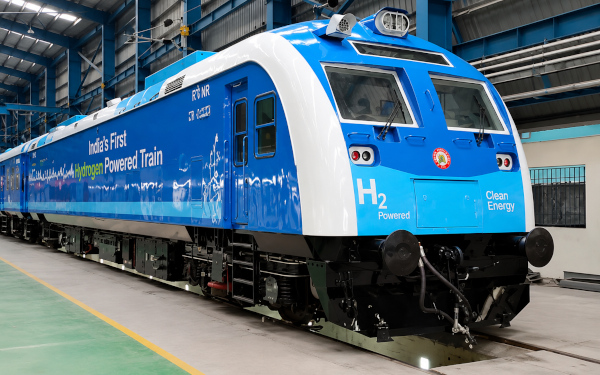
India’s first hydrogen fuel-cell train has travelled more than 1,200 kilometres and saved over 3,200 litres of diesel during its first week of commercial operation, demonstrating the potential of clean hydrogen technology in the railway sector.
The train was introduced on the Jind–Sonipat route on July 17, 2026. According to the Ministry of Railways, its onboard power system produces electricity without releasing smoke or carbon emissions from the train’s exhaust, with water vapour emerging as the principal by-product.
The early operational results mark an important milestone in Indian Railways’ efforts to reduce dependence on fossil fuels and develop cleaner alternatives for routes where complete electrification may be difficult or economically demanding.
Hydrogen Fuel Cells Generate Electricity Onboard
Unlike conventional diesel trains, the hydrogen train generates the electricity required for propulsion through an electrochemical reaction between hydrogen and oxygen.
Hydrogen stored aboard the train is supplied to fuel cells, where it reacts with oxygen drawn from the atmosphere. The process produces electricity to power the traction system, while water and heat are released as by-products.
As the train does not burn diesel, it eliminates tailpipe carbon emissions and substantially reduces local air pollution along the railway route.
The technology also offers quieter operation than conventional diesel locomotives because fuel cells have fewer moving components and do not depend on internal combustion.
Indigenous 10-Coach Train Produces 2,400 kW
The hydrogen train has been developed indigenously by Indian Railways and consists of 10 coaches.
It is equipped with two Hydrogen Driving Power Cars that together generate 2,400 kilowatts of power. This makes the train one of the most powerful hydrogen-powered railway systems developed for passenger operations.
The fuel-cell propulsion system is supported by lithium iron phosphate batteries. These batteries help manage variations in power demand, store recovered energy and provide additional power during acceleration.
High-pressure cylinders installed aboard the train store the hydrogen required for operations. The combination of fuel cells, batteries and hydrogen storage equipment allows the train to maintain efficient performance while avoiding conventional diesel consumption.
Dedicated Hydrogen Facility Established at Jind
Indian Railways has also established its first dedicated hydrogen storage and refuelling facility at Jind to support the new train.
The facility can store approximately 3,000 kilograms of green hydrogen. The fuel is maintained at pressures of up to 500 bar and dispensed into the train’s storage system at around 350 bar.
The creation of this infrastructure is significant because hydrogen-powered mobility requires specialised arrangements for fuel production, compression, storage, transportation and dispensing.
The Jind facility provides Indian Railways with practical experience in managing a complete hydrogen supply chain for railway operations.
Multiple Safety Systems Installed
Hydrogen is a highly combustible gas and requires careful handling. Indian Railways has therefore incorporated several layers of safety and monitoring into the train and its supporting infrastructure.
Independent detection systems continuously monitor the train for hydrogen leaks, excessive heat, flames and smoke.
Automatic shut-off mechanisms can isolate the hydrogen supply if an abnormal condition is detected. Continuous ventilation systems have also been installed to prevent the accumulation of gas in enclosed areas.
The train’s systems have been designed to meet international safety standards and mandatory validation requirements applicable to hydrogen storage and fuel-cell operations.
These measures are intended to ensure that hydrogen is safely stored, supplied and used throughout the train’s journey.
Delhi Route Trials Planned
Following the initial operations on the Jind–Sonipat section, Indian Railways is preparing to conduct trials on a route towards Delhi.
The proposed expansion will allow the railway authorities to study the train’s performance under different operating conditions, including heavier traffic, longer distances and more demanding timetable requirements.
The trials are expected to generate important data on fuel consumption, refuelling time, reliability, maintenance requirements and passenger operations.
The experience gained from the project could guide the introduction of hydrogen trains on other non-electrified and heritage railway routes.
Building an Indigenous Hydrogen Rail Ecosystem
The hydrogen train project extends beyond the development of a single train. It establishes the foundation for an indigenous ecosystem covering fuel-cell systems, high-pressure storage, battery integration, refuelling infrastructure, safety engineering and railway maintenance.
The successful operation of the train could encourage Indian manufacturers and research institutions to develop more components domestically, reducing dependence on imported hydrogen technologies.
Hydrogen-powered trains could become particularly useful on railway lines where installing overhead electrification is technically difficult, environmentally sensitive or financially unviable.
By replacing diesel trains on selected routes, hydrogen propulsion could contribute to lower fuel imports, reduced greenhouse-gas emissions and improved air quality.
India’s first hydrogen train therefore represents both a technological achievement and an important step towards cleaner railway transportation. Its early diesel savings indicate the potential for hydrogen-based propulsion to support Indian Railways’ long-term transition towards sustainable and low-emission mobility.
Reference
DD India
“India’s First Hydrogen Train Saves Over 3,200 Litres of Diesel in First 1,200 km of Operations”
Published on July 25, 2026, at 3:14 PM IST
You may also like
-
EON Space Labs and Dhruva Space Advance Indian Space Hardware on Transporter-18 Mission
-
SatLeo Labs’ TAPAS-1 Reaches Orbit, Advancing India’s Private Thermal-Imaging Capability
-
TakeMe2Space’s MOI-1A Reaches Space on Falcon 9 Transporter-18 Mission
-
Bank of Baroda Enters Pension Fund Management After PFRDA Appointment
-
SCI and India’s Push for a Larger Indigenous Maritime Fleet
