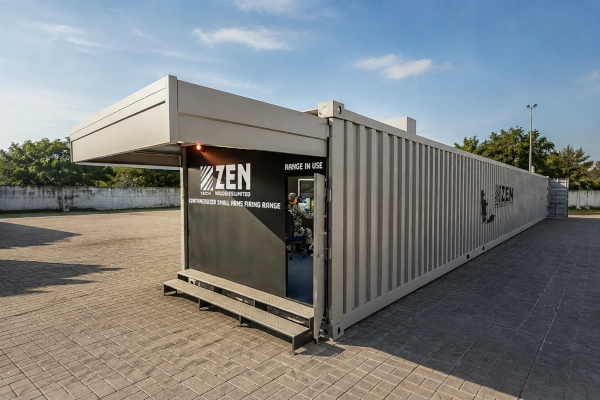
The new Containerised Small Arms Firing Range (CSAFR) was inaugurated at INS Tanaji on August 13, 2026, by Vice Admiral Sanjay Vatsayan, Flag Officer Commanding-in-Chief, Western Naval Command. The inauguration formed part of his review of infrastructure and operational works at INS Tanaji and the Naval Armament Depot at Trombay.
The project was conceptualised by the Indian Navy and developed by Zen Technologies Limited, an Indian defence technology company specialising in military training systems, live-fire ranges, simulators and counter-drone technologies. Zen announced that it had delivered and installed the facility ahead of the originally planned schedule.
A Live-Fire Facility, Not Just a Simulator
Unlike virtual weapons-training systems, the CSAFR provides a controlled environment for actual small-arms firing.
Zen describes its CSAFR technology as a modular live-fire range designed to recreate realistic combat situations while maintaining a zero-danger area outside the protected range. Its containerised configuration means the facility does not require the extensive safety zones normally associated with conventional outdoor firing ranges.
That characteristic is particularly useful for the Navy. Many naval bases and shore establishments are located in heavily developed coastal areas where finding sufficient land for traditional firing ranges can be difficult.
A containerised range allows live-fire facilities to be installed much closer to operational units, reducing the need to move personnel to distant training areas for routine weapon qualification.
AI-Enabled Performance Assessment
The most notable feature of the Navy’s new range is the integration of digital target-management and performance-analysis capabilities.
According to Zen Technologies, personnel can engage moving targets simultaneously while the system generates individual scores and performance analytics. This enables instructors to assess each firer using recorded training data rather than depending solely on manual inspection of conventional targets.
Zen has described the delivered system as AI-enabled, although publicly available information does not disclose the detailed artificial-intelligence architecture or algorithms used inside the Navy configuration.
The company’s wider range technology incorporates software-driven target detection, scoring and recording systems. Its Smart Target System, for example, can record shot locations, misses, group size, scores and firing-lane status electronically.
For operational training, such technology can give instructors a clearer picture of accuracy, reaction time and consistency while allowing personnel to immediately review their performance.
Designed Around Naval Combat Scenarios
The CSAFR has been tailored to requirements that extend beyond routine target shooting.
Zen says the range supports training relevant to the security of naval shore establishments, Low Intensity Maritime Operations, ship-boarding missions and Fleet Protection Measures.
These roles have become increasingly important as naval personnel prepare to deal with threats ranging from small hostile craft and sabotage attempts to attacks on ships, ports and coastal installations.
One training configuration allows personnel to practise engagements against fast-moving targets representing high-speed boats. The range also supports firing under night and low-visibility conditions, providing a more demanding environment than static daytime marksmanship practice.
For boarding teams and ship-protection personnel, the ability to practise rapid target acquisition against moving threats has direct relevance to operations at sea.
From Five Days to One for Qualification Training
The new facility could also substantially increase the speed at which the Navy conducts small-arms qualification.
Zen Technologies states that 100 personnel can complete an Annual Qualification Course in a single day using the CSAFR, compared with approximately five days at a conventional outdoor range.
The improvement comes from having a dedicated facility that is readily available and less dependent on the scheduling, weather conditions and safety restrictions associated with large outdoor ranges.
For a military service operating numerous ships and shore establishments, reducing the time required for recurring qualification can return personnel to operational duties sooner while maintaining weapons-proficiency requirements.
All-Weather Training Close to Operational Units
Weather and location can impose substantial limitations on conventional ranges. Heavy rain, poor visibility or restrictions around populated areas may interfere with training schedules.
An enclosed containerised facility provides far greater control over these variables.
Zen’s broader containerised range technologies employ ballistic protection, ricochet-management materials, ventilation and acoustic treatment to create a safe environment for live firing. The company describes containerised ranges as transportable facilities intended to deliver firing convenience while requiring considerably less dedicated space than traditional ranges.
For INS Tanaji, this means sailors and naval security personnel can maintain small-arms proficiency without routinely leaving the establishment for basic firing exercises.
Increasing Realism in Naval Training
Small arms remain important aboard modern warships despite the Navy’s increasing reliance on sophisticated missiles, sensors, aircraft and unmanned systems.
Naval personnel may need individual weapons during harbour security duties, protection of sensitive installations, boarding of suspicious vessels and defensive operations against small craft.
Boarding operations present particularly demanding conditions. Personnel may have to move onto an unfamiliar vessel, distinguish threats quickly and operate in confined spaces where engagement distances are short.
Similarly, protecting a warship against a fast-moving boat requires rapid identification and engagement of a moving target rather than conventional static-range shooting.
The ability to recreate elements of these scenarios within a controlled live-fire facility allows training to move closer to the conditions personnel could encounter during an actual mission.
An Indian Defence Technology Programme
The project also highlights the growing role of Indian companies in supplying specialised training infrastructure to the Armed Forces.
Hyderabad-headquartered Zen Technologies has spent more than three decades developing defence training and simulation equipment. Its portfolio today covers live-fire ranges, weapons simulators, instrumented combat-training systems and counter-unmanned aerial system technologies. The company says it has deployed more than 1,000 solutions and filed over 200 patents globally.
The Navy’s CSAFR represents a different form of indigenisation from the high-profile development of missiles, warships or combat aircraft. Modern armed forces also require domestic capabilities in training technology, target systems, simulation and performance assessment.
Such systems determine how effectively personnel can use the weapons they already possess.
A Step Towards Data-Driven Combat Training
The inauguration at INS Tanaji points towards a broader transformation in military training.
Traditional ranges primarily measure whether a shooter hits a target. Digitally instrumented facilities can capture considerably more information, allowing instructors to examine an individual’s performance across repeated engagements and increasingly complex scenarios.
At the same time, containerisation makes advanced live-fire infrastructure easier to locate near military units rather than concentrating training at a limited number of large ranges.
The Indian Navy now has a facility that combines real ammunition, moving targets, maritime-oriented scenarios, individual performance analytics and a compact protected firing environment.
For a service responsible for ships, naval bases and critical coastal infrastructure, that combination provides a practical way to improve small-arms readiness while reducing the logistical burden of conventional range training.
The 25-metre facility at INS Tanaji may be relatively compact compared with the Navy’s larger infrastructure projects, but its significance lies in how training is delivered. It brings controlled, technology-assisted live fire directly to an operational naval establishment and demonstrates how indigenous defence technology is increasingly entering areas that sit behind frontline combat capability but remain essential to it.
Sources
Zen Technologies — Containerised Small Arms Firing Range: Official product information describing the CSAFR as a modular live-fire tactical training range.
Zen Technologies announcement, August 2026: Details of the Indian Navy installation, maritime training scenarios, performance analytics and training throughput.
Western Naval Command/INS Tanaji visit reporting: Confirmation that Vice Admiral Sanjay Vatsayan inaugurated the 25-metre CSAFR at INS Tanaji on August 13, 2026.
Zen Technologies corporate information: Details of the company’s indigenous defence training and simulation portfolio.
You may also like
-
India Moves Towards Five-Year Assured Orders for Defence Startups Under New Procurement Reforms
-
Zen Technologies Introduces Indigenous Hyper-Strike Falcon AI-Guided Counter-Drone Interceptor
-
L&T and Germany’s SCHOTTEL Expand Partnership for Controllable Pitch Propeller Systems in Indian Shipbuilding
-
India to Train 60,000 Civil Defence Volunteers Across 12 States and UTs with Indian Army Support
-
Indian Army’s Northern Command Opens 75-Day Defence Technology Internship Programme for Young Innovators
