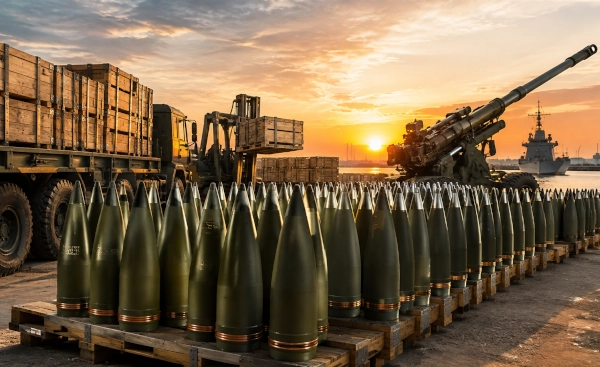
Mumbai-based Balu Forge Industries Limited announced the development in an exchange disclosure on August 17, 2026, confirming the successful commercialisation of its 155mm ERFB-BB and ERFB-BT shell variants.
The company said it received the multi-month contract from an Indian ammunition player, whose identity has not been disclosed. The first phase will involve the supply of 10,000 shells, followed by monthly deliveries in quantities that the two companies will mutually determine.
The financial value of the latest contract has not been disclosed, and the 10,000-unit figure should therefore be viewed as the initial pilot quantity rather than the total volume expected over the entire contract period.
From Development to Commercial Production
The order follows Balu Forge’s successful development and manufacturing of the more sophisticated ERFB family of 155mm projectile bodies.
Just five days before announcing the new order, BFIL told investors in its August 12, 2026 NSE earnings disclosure that it had successfully produced ERFB-BB and ERFB-BT shells and had become one of a relatively small group of manufacturers possessing the capability.
The same filing confirmed that serial production and dispatches of the company’s 152mm and standard 155mm artillery shells had already begun.
The August 17 purchase order therefore represents an important transition: the advanced ERFB variants have moved beyond manufacturing development into commercial supply.
Balu Forge describes the achievement as validation of the precision forging, machining, metallurgical control and automation capabilities it has been developing for defence manufacturing.
What Is a 155mm ERFB Shell?
ERFB stands for Extended Range Full Bore.
Unlike conventional artillery projectiles, ERFB shells use an aerodynamically optimised body designed to reduce drag and retain velocity over greater distances. They form part of the family of ammunition used with modern 155mm artillery systems that increasingly emphasise longer-range engagements.
Balu Forge is producing two variants.
The ERFB-BT, or Boat Tail, version uses a tapered rear section that improves airflow around the projectile and reduces aerodynamic drag.
The ERFB-BB, or Base Bleed, variant adds a base-bleed arrangement at the rear of the projectile. The system generates gas behind the shell during flight, reducing the low-pressure wake that creates much of the projectile’s base drag. The objective is not to propel the shell like a rocket but to allow it to retain energy more efficiently and travel farther.
This makes manufacturing the projectile body substantially more demanding than producing a basic artillery shell casing. Dimensional accuracy, material properties, machining tolerances and consistency all become important when the projectile must withstand the enormous stresses generated when fired from a modern artillery gun.
Relevant to India’s 155mm Artillery Expansion
The development comes as the Indian Army continues moving towards 155mm artillery as its principal heavy-gun calibre.
India operates or is introducing several 155mm systems, including the indigenous Dhanush, the Advanced Towed Artillery Gun System (ATAGS), the K9 Vajra-T self-propelled gun and the M777 lightweight howitzer.
Balu Forge’s release highlighted ERFB ammunition in the context of platforms including Dhanush and ATAGS and said the company sees applications across both the domestic and international artillery markets.
The significance for India goes beyond one ammunition order.
An expanding artillery fleet requires a large and sustained supply of ammunition for operational reserves, annual training, testing and replenishment. Building domestic manufacturing capacity across several private and public-sector producers can create greater resilience than depending on a small number of suppliers.
The requirement becomes even more important for specialised extended-range ammunition, where manufacturing complexity and stringent quality standards limit the number of potential producers.
Balu Forge’s Belgaum Defence Manufacturing Push
Balu Forge entered the large-calibre ammunition manufacturing business by leveraging its existing experience in high-precision forging and machining.
The company has established an automated artillery-shell manufacturing line at its greenfield manufacturing campus in Belgaum, Karnataka, as part of a broader move into defence production.
The facility has been configured to produce large-calibre shell bodies using automated and robotics-assisted manufacturing processes.
BFIL’s expansion represents a significant diversification for a company traditionally known for precision forged and machined components supplied to automotive, industrial and engineering customers.
Large-calibre ammunition allows the company to apply many of the same core competencies — metallurgy, forging, heat treatment, precision machining and quality control — to a defence product where manufacturing consistency is critical.
Earlier Five-Year Agreement Established the Production Base
The latest order follows a much larger defence supply agreement announced by Balu Forge earlier in 2026.
On February 26, the company disclosed to the National Stock Exchange that it had entered into a legally binding five-year Memorandum of Understanding with a NATO-affiliated entity for large-calibre ammunition shell supplies from its Belgaum facility.
That agreement initially covers the supply of:
- 30,000 155mm M107 shell bodies per month
- 10,000 152mm shell bodies per month
Both are to be supplied in Ready-to-Fill condition.
At the time, Balu Forge said serial deliveries would begin with the 155mm M107 and 152mm variants. The February agreement specifically identified 155mm ERFB-BB/BT ammunition as a future extension subject to trials and approval.
The successful production and subsequent commercial order announced in August therefore show that BFIL has now progressed into the extended-range segment it had identified earlier in the year.
Importantly, the February NATO-linked arrangement and the new August order from an Indian ammunition company are separate developments. They should not be treated as the same contract.
Production Capacity Being Expanded
The scale of Balu Forge’s ammunition ambitions is larger than the initial 10,000-shell ERFB order.
When it announced the five-year agreement in February, BFIL disclosed existing production capacity of approximately 360,000 shell bodies per year and acknowledged that the contracted volumes would eventually exceed this level.
The company consequently outlined plans to expand capacity using internal accruals.
In its August 12 update, management said the defence expansion remained on schedule and that additional capacity was moving towards commercialisation.
It also confirmed that serial production and deliveries of both 152mm and 155mm artillery shells were already underway.
The addition of ERFB-BB and ERFB-BT manufacturing pushes BFIL further up the ammunition value chain, from standard forged shell bodies towards more technically demanding extended-range products.
Growing Role of India’s Private Defence Industry
India’s ammunition manufacturing landscape has changed considerably as private-sector companies build capabilities that were once concentrated largely within state-owned defence factories.
Large-scale ammunition manufacturing requires specialised metallurgy, high-volume forging, heat treatment, precision machining, rigorous inspection and dependable supply chains. Producing artillery shells at industrial scale is therefore as much a heavy-engineering challenge as it is a defence-sector one.
Companies with established expertise in forging and precision engineering have consequently emerged as natural participants.
Balu Forge’s progression illustrates that trend. It has moved from engineering components into standard large-calibre projectile bodies and is now commercialising more advanced ERFB variants.
The company has also highlighted its access to the NATO supply chain, giving the Belgaum facility potential relevance beyond domestic requirements.
Export Potential for Indian 155mm Ammunition
The global market for 155mm ammunition has expanded sharply in recent years as militaries rebuild artillery stockpiles and increase production capacity.
At the same time, many armed forces are seeking greater range from existing artillery systems. This has increased demand for advanced projectile configurations such as ERFB-BT and ERFB-BB ammunition.
India has an opportunity to use its large engineering and manufacturing base to participate in this market while simultaneously strengthening domestic supply security.
Balu Forge’s February agreement with a NATO-affiliated entity already demonstrates export interest in Indian-manufactured large-calibre shell bodies. Its development of ERFB variants potentially broadens the range of ammunition components it can offer to international customers.
However, export contracts remain subject to the applicable Indian defence-export controls, customer qualification procedures and technical acceptance requirements.
Moving Towards Greater Defence Integration
Balu Forge has indicated that ammunition shell manufacturing will form only one part of its expanding defence business.
The company is developing capabilities in multi-alloy forgings and other high-value defence components while moving towards greater integration through its energetics subsidiary.
Its August earnings update also highlighted production of defence-related aluminium forged and machined components, large gear blanks and road-wheel arms.
This strategy could eventually allow BFIL to participate in a wider portion of the defence manufacturing chain instead of remaining solely a supplier of forged steel components.
A Significant Step for Indigenous Artillery Ammunition
The importance of the new 10,000-unit order lies less in the size of the pilot batch and more in what it demonstrates.
Balu Forge has taken an advanced 155mm projectile design from manufacturing development into commercial production and secured a customer for the first batch.
If the pilot supply meets the customer’s requirements, the contract is designed to transition into recurring monthly deliveries, providing BFIL with an opportunity to scale ERFB production alongside its existing 152mm and 155mm M107 programmes.
The development also adds another Indian private-sector producer to the country’s expanding large-calibre ammunition ecosystem at a time when both domestic and international demand for artillery ammunition remains strong.
With serial manufacturing already underway for conventional shell bodies and ERFB-BB/BT variants now entering commercial supply, Balu Forge’s Belgaum facility is emerging as another important node in India’s growing indigenous artillery ammunition manufacturing base.
Official Sources
National Stock Exchange / Balu Forge Industries — February 26, 2026: Official company filing covering the five-year large-calibre ammunition agreement, Belgaum production facility, manufacturing capacity and planned ERFB variants. Read the official NSE filing
National Stock Exchange / Balu Forge Industries — August 12, 2026: Official earnings release confirming serial production of 152mm and 155mm shells and successful production of ERFB-BB/BT variants. Read the official August NSE disclosure
Balu Forge Industries exchange disclosure — August 17, 2026: Announcement titled “Press Release – Receipt of Multi Month Contract for 155mm ERFB BB/BT Shells”, confirming the first purchase order, 10,000-unit pilot supply and subsequent monthly deliveries. The filing is recorded in the company’s NSE/BSE regulatory announcements.
You may also like
-
ICAR Scientists Develop Indigenous Protective Gloves for Cotton Farmers, Sign Commercial Manufacturing Agreement
-
India Moves Towards Five-Year Assured Orders for Defence Startups Under New Procurement Reforms
-
BHEL–Coal India Joint Venture Begins Construction of ₹25,016 Crore Indigenous Coal Gasification Project in Odisha
-
Zen Technologies Introduces Indigenous Hyper-Strike Falcon AI-Guided Counter-Drone Interceptor
-
L&T and Germany’s SCHOTTEL Expand Partnership for Controllable Pitch Propeller Systems in Indian Shipbuilding
