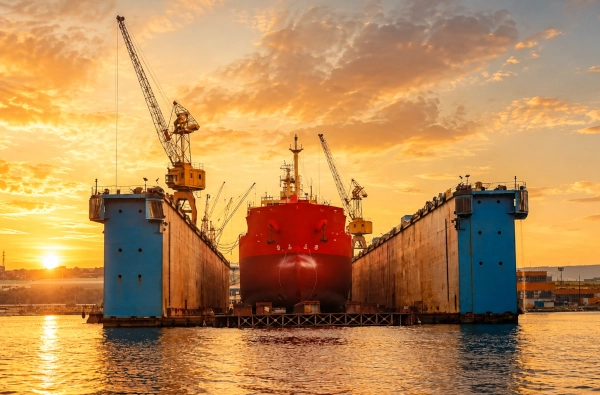
Mazagon Dock Shipbuilders Limited (MDL) is significantly expanding its naval shipbuilding infrastructure with a new 12,000-tonne lifting-capacity Floating Dry Dock at its Nhava Yard near Mumbai. The massive facility, assembled through an innovative modular construction programme, will strengthen MDL’s ability to build, dock, repair and refit larger warships and commercial vessels while preparing the shipyard for India’s next generation of naval programmes.
The Floating Dry Dock represents one of the most important additions to MDL’s infrastructure in recent years. The state-owned defence shipbuilder has been developing its Nhava facility as part of a long-term programme to increase capacity beyond its established Mumbai shipyard.
MDL’s official documentation places the dock at approximately 180 metres in length and 44 metres in outer width, with an inner beam of about 32 metres and a lifting capacity of 12,000 tonnes. The facility has also been designed to support roll-on/roll-off movement of vessels between the dock, Nhava Yard and MDL’s submarine-launch infrastructure.
The 12,000-tonne figure refers to the lifting capacity of the floating dry dock, rather than the weight of the dock itself. The completed floating structure reportedly weighs close to 10,000 tonnes.
A Giant Floating Shipyard
A floating dry dock functions as a movable docking platform capable of partially submerging itself by taking water into ballast tanks. A vessel can then enter the dock before the ballast water is pumped out, causing the structure to rise and lift the ship clear of the water.
Once raised, engineers and technicians gain access to the ship’s hull, propellers, shafts, underwater sensors and other systems that cannot normally be reached while the vessel remains afloat.
This makes floating dry docks valuable not only for routine maintenance but also for major repairs, refits, equipment installation and elements of ship construction.
MDL’s new facility dramatically increases this flexibility at Nhava. Instead of depending entirely on fixed dry docks at its traditional Mumbai facilities, the company gains an additional heavy docking asset that can support a wider range of naval and commercial programmes.
MDL has itself stated that the new dock forms part of the infrastructure required for the construction of advanced and next-generation vessels.
180 Metres Long and Built for Heavy Naval Work
The scale of the new dock illustrates the transformation taking place at Nhava.
The Floating Dry Dock measures approximately:
- Length: 180 metres
- Outer width: 44 metres
- Inner beam: approximately 32 metres
- Height: approximately 19.5 metres
- Lifting capacity: 12,000 tonnes
Shoft Shipyard, which undertook the physical construction, states that the dock can accommodate vessels with drafts of up to approximately nine metres.
This capacity gives MDL additional flexibility for docking sizeable naval surface combatants, auxiliary vessels and commercial ships.
The facility should not, however, be interpreted as meaning that every vessel displacing 12,000 tonnes can automatically be accommodated. Dry-docking compatibility also depends on hull dimensions, docking weight, underwater configuration, stability requirements and dock-block arrangements.
Built in Gujarat, Assembled at Nhava
One of the most interesting aspects of the project is how the enormous structure was constructed.
The Floating Dry Dock was built for MDL by Shoft Shipyard Pvt Ltd, headquartered at Bharuch in Gujarat. SeaTech Solutions International also provided engineering and project-management support for the programme.
Construction activities formally commenced at Shoft Shipyard in December 2023.
Building a structure of this size presented a major engineering challenge because the infrastructure required to construct the entire dock as a single unit was not available at Nhava.
The solution was modular construction.
Shoft fabricated six large sections at Bharuch, which were launched separately and transported by sea to Nhava. The modules were subsequently assembled into the complete floating dock.
According to Shoft, the sections travelled roughly 200 nautical miles before assembly.
For the project, Shoft also constructed a temporary 240-metre by 60-metre assembly dock at Nhava. The six modules were brought together there to create the final 180-metre-long structure.
The approach demonstrates the increasing capability of India’s private and public shipbuilding industries to cooperate on large marine-engineering projects.
Floating Dock Launched in April 2026
The project reached a major milestone in April 2026, when the assembled Floating Dry Dock was successfully floated.
By July, the dock had been berthed at MDL’s Nhava jetty.
Commissioning of several major systems, including its cranes, main and emergency diesel-generator sets and electrical switchboards, had been completed. Other machinery and onboard systems were undergoing final commissioning, according to a July 2026 project update.
SeaTech Solutions has separately listed the P7600 project as a 12,000-tonne lifting-capacity Floating Dock delivered to Mazagon Dock Shipbuilders Limited, describing it as an important addition to docking, repair and maintenance infrastructure at Nhava Yard.
The available information therefore shows that the dock has been constructed, assembled, launched and delivered to the Nhava facility, while final system commissioning has formed part of the work required to bring the entire asset to full operational readiness.
Nhava Is Becoming MDL’s Second Major Shipbuilding Hub
The importance of the Floating Dry Dock becomes clearer when viewed alongside MDL’s broader plans for Nhava.
MDL owns roughly 40 acres at Nhava, where it plans to progressively develop a greenfield shipbuilding and ship-repair facility.
The long-term plan envisages infrastructure including dry berths, vessel-transfer facilities, workshops, hard stands and a graving dry dock that can also function as a wet basin.
Once fully developed, Nhava is intended to handle the construction and repair of larger warships and commercial vessels, complementing MDL’s heavily utilised facilities in Mumbai.
This additional capacity is important because India’s naval shipbuilding requirements are expanding.
MDL has already constructed some of the Indian Navy’s most sophisticated indigenous warships, including Delhi-class and Kolkata-class destroyers, Visakhapatnam-class Project 15B destroyers and Nilgiri-class Project 17A stealth frigates. It has also built the Navy’s Kalvari-class conventional submarines under Project 75.
Future naval programmes will place even greater demands on shipyard infrastructure.
India is preparing for additional destroyers, frigates, submarines and numerous auxiliary and specialist vessels. Building these platforms in parallel requires much more than design expertise. Shipyards need large assembly areas, heavy cranes, dry docks, fabrication shops, launch infrastructure and sufficient waterfront space.
Nhava is intended to provide precisely that additional capacity.
Greater Capacity for Warship Repair and Refit
The strategic value of the Floating Dry Dock extends beyond construction.
Warships spend decades in service and undergo repeated maintenance cycles, refits and modernisation programmes. Dry-docking capacity can therefore become a bottleneck even when sufficient shipbuilding capacity exists.
During a major refit, ships may require inspection and repair of the underwater hull, propeller and shaft work, sonar-related maintenance, corrosion treatment, structural modifications and replacement or installation of equipment.
Adding another large docking facility gives MDL greater flexibility to undertake this work without tying up its existing fixed infrastructure.
This could become particularly valuable as the Indian Navy expands towards a larger fleet and an increasing number of domestically constructed warships enter service.
The requirement for indigenous maintenance, repair, overhaul and life-cycle support will grow alongside the fleet itself.
Supporting Future Naval Construction
MDL’s official planning documents have repeatedly linked the Floating Dry Dock with preparations for advanced and next-generation vessels.
That does not mean the new facility has been earmarked exclusively for one future warship class. Rather, it gives MDL additional infrastructure that can support several programmes depending on vessel dimensions and docking requirements.
This distinction is important because India is considering major future surface-combatant projects while simultaneously expanding the Coast Guard and pursuing new submarine programmes.
Infrastructure investments made today will determine how many of those vessels Indian shipyards can construct simultaneously during the next decade.
An Indigenous Marine Engineering Achievement
The project also carries an important industrial dimension.
Although the facility belongs to MDL, its construction brought together expertise from different parts of India’s maritime sector.
A private Indian shipyard fabricated the enormous dock in modular sections in Gujarat. The modules were transported by sea to Maharashtra, assembled at Nhava and integrated into MDL’s expanding shipbuilding infrastructure.
SeaTech provided engineering and project-management support from design through construction and handover, while MDL drove the broader infrastructure programme.
Shoft describes the project as the largest Floating Dry Dock built in India. Contemporary industry reporting also described the April 2026 launch in those terms.
Rather than relying purely on overseas infrastructure, the project demonstrates that Indian yards and engineering companies can execute increasingly large and complex marine structures domestically.
Strengthening India’s Naval Industrial Base
India’s drive for greater self-reliance in defence is often measured through indigenous weapons, sensors, missiles and combat systems. Shipyard infrastructure is an equally important part of that equation.
A country cannot sustain a large indigenous navy unless it possesses sufficient facilities to design, construct, launch, dock, repair and modernise its ships throughout their service lives.
MDL’s 12,000-tonne Floating Dry Dock therefore represents more than a new piece of industrial equipment.
Together with the wider development of Nhava Yard, it expands the physical infrastructure behind India’s naval construction programme and reduces pressure on MDL’s historic Mumbai facilities.
As India prepares for increasingly complex surface ships, submarines and supporting vessels, such infrastructure will play a decisive role in determining how quickly those programmes can move from design boards to operational fleets.
The giant floating dock now berthed at Nhava is a visible sign of that transformation: India is not only designing and building more of its own warships, but is also creating the heavy maritime infrastructure needed to build, maintain and sustain them at home.
Sources
Mazagon Dock Shipbuilders Limited: Official Annual Report and corporate infrastructure publications confirming the 12,000-tonne Floating Dry Dock and Nhava development programme.
Shoft Shipyard: Project information on the 180 m × 44 m × 19.5 m Floating Dry Dock and its modular construction at Bharuch.
SeaTech Solutions International: P7600 project information covering engineering, construction and delivery of the 12,000-tonne lifting-capacity dock to MDL.
ETInfra, July 1, 2026: Project-status report confirming the April 2026 floating, assembly at Nhava and commissioning status.
You may also like
-
ICAR Scientists Develop Indigenous Protective Gloves for Cotton Farmers, Sign Commercial Manufacturing Agreement
-
BHEL–Coal India Joint Venture Begins Construction of ₹25,016 Crore Indigenous Coal Gasification Project in Odisha
-
PM Modi to Inaugurate RBI’s Tier IV Data Centre and Cybersecurity Training Institute in Bhubaneswar
-
India Creates 11 Crore Digital Farmer IDs Five Months Ahead of Target, Strengthening AgriStack Infrastructure
-
Chak-Hao Black Rice of Manipur and Nagaland: The Aromatic Purple Heritage Grain with GI Recognition
