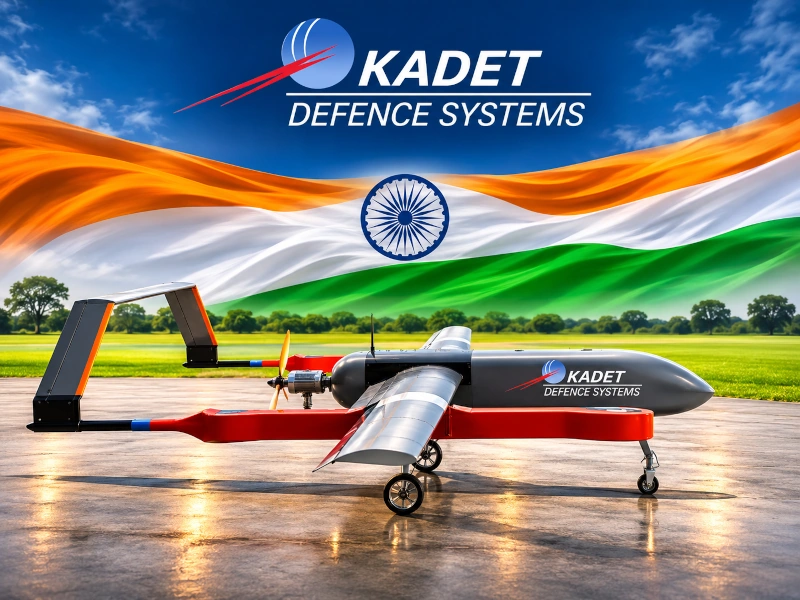
Bengaluru-based Kadet Defence Systems is strengthening India’s indigenous unmanned aerial systems ecosystem through the development of loitering munitions, jet-powered aerial targets and advanced unmanned platforms designed for military training, surveillance and precision-strike applications. The company has developed a range of unmanned systems and has worked with the Defence Research and Development Organisation (DRDO) on technologies supporting the requirements of the Indian Armed Forces.
The company’s product portfolio includes canister-launched loitering munitions, vertical take-off and landing unmanned aircraft, combat UAVs and high-speed aerial targets capable of simulating different aerial threats. Its Anudishya jet-powered aerial target system represents an important development in indigenous high-speed target technology and has also secured international export business.
Kadet Defence has been involved in aerial target development for several years, supplying systems used in military training, weapon development and evaluation activities. Its subsequent expansion into loitering munitions reflects the increasing participation of Indian private companies in the design and manufacturing of sophisticated unmanned defence technologies.
Indigenous Loitering Munitions Developed with DRDO Collaboration
Kadet Defence Systems has undertaken the development of indigenous Loitering Aerial Munition (LAM) systems under a Development-cum-Production Partner arrangement with DRDO.
The programme encompasses several categories of unmanned platforms, including canister-launched aerial munitions, tactical vertical take-off and landing systems and combat UAVs designed to carry or release munitions.
Loitering munitions combine characteristics of unmanned aircraft and precision-guided weapons. Unlike conventional missiles that follow a relatively direct trajectory towards a designated target, these systems can remain airborne for a period while conducting surveillance, identifying potential targets and awaiting engagement instructions.
Their development has become an important part of modern military technology because they combine reconnaissance and strike functions within relatively compact unmanned platforms.
Kadet Defence announced its indigenous loitering munition programme in 2024 and reported securing a contract covering more than 50 systems, with deliveries planned for completion that year. The announcement marked an important stage in the company’s expansion from aerial target manufacturing into unmanned combat systems.
The company has continued to develop a family of platforms with different operating ranges, payload capacities and mission configurations.
HO3B Canister-Launched Loitering Munition
Among the company’s unmanned systems is the HO3B, a canister-launched loitering munition designed for short-range applications.
According to Kadet Defence’s published technical specifications, the HO3B is a rocket-assisted, canister-launched unmanned system capable of supporting autonomous target tracking and engagement. The company identifies a mission engagement range of up to 15 kilometres and a payload capacity of five kilograms.
The system is designed for deployment from compact launch arrangements, including vehicle-mounted configurations. Its published specifications also describe multiple operating modes and an endurance exceeding 90 minutes.
The HO3B forms part of the company’s efforts to develop mobile unmanned systems with relatively small deployment requirements.
The use of canister launch technology allows an aircraft to remain protected within a launch container until deployment, while reducing the need for conventional runway infrastructure.
The platform also incorporates autonomous and guided operating modes, reflecting the company’s emphasis on combining unmanned flight capabilities with modern electronic control systems.
PD1A and PD2 Multi-Mission Unmanned Platforms
Kadet Defence’s product portfolio also includes the PD1A and PD2, unmanned aerial systems developed for multiple mission requirements.
The PD1A is described as a vertical take-off and landing platform capable of supporting surveillance, reconnaissance, battlefield management, electronic warfare and munition-carrying applications. According to the company’s published specifications, the aircraft has a maximum take-off weight of approximately 50 kilograms and an endurance exceeding 90 minutes.
Its multi-mission configuration allows the integration of different payloads according to the intended operational requirement. The platform is designed to support activities ranging from information gathering to specialised military missions.
The larger PD2 incorporates a heavy-fuel propulsion system and is designed for extended endurance. Kadet Defence lists a maximum take-off weight of approximately 120 kilograms, a payload capacity of 30 kilograms and an endurance exceeding six hours.
The PD2 is intended to support reconnaissance, communications relay and other missions requiring longer airborne endurance and larger payload capacities.
Together, the PD1A and PD2 represent the company’s approach to developing unmanned platforms that can accommodate different mission requirements through varying aircraft sizes, propulsion arrangements and payload configurations.
Anudishya: India’s Indigenous Jet-Powered Aerial Target System
An important component of Kadet Defence’s aerospace development activities is Anudishya, a jet-powered aerial target system designed to simulate fast-moving airborne threats during military training and weapons evaluation.
The company announced the development of indigenous jet-powered aerial targets as part of its efforts to provide advanced training and evaluation equipment for the Indian Armed Forces.
According to Kadet Defence, Anudishya is capable of speeds exceeding 500 kilometres per hour, has a stated flight range of approximately 300 kilometres and can operate at altitudes exceeding 6,000 metres.
The aircraft incorporates advanced composite materials and technologies intended to support the simulation of different aerial threats. The company has also identified low-observable characteristics and swarming-related capabilities among the system’s features.
Jet-powered aerial targets are used to reproduce selected flight characteristics of high-speed aircraft and other airborne threats during training and evaluation exercises.
These platforms allow military personnel and weapons-development organisations to examine the performance of air defence equipment under controlled conditions.
Anudishya represents an indigenous addition to this category of specialised aerospace equipment, combining high-speed unmanned flight with technologies used in military training and weapons evaluation.
Export of Indigenous Aerial Target Technology
Kadet Defence has also reported export success with its jet-powered aerial target systems.
The company announced that its indigenous aerial target technology had secured export business from a friendly foreign country, marking an important step in its participation in international defence markets.
The development reflects the application of Indian-designed unmanned technologies beyond domestic military requirements.
Aerial targets form an important component of military training because they provide controlled, repeatable platforms for evaluating weapons, sensors and air defence systems.
The ability to develop and manufacture such systems domestically is relevant not only to India’s defence requirements but also to the country’s expanding defence export ecosystem.
Kadet Defence’s export announcement illustrates the international commercial potential of specialised unmanned aerospace technologies developed by Indian private companies.
Whistler Aerial Targets Support DRDO Radar Development
Kadet Defence has also contributed to the development and evaluation of Indian air defence technologies through its Whistler aerial target system, previously identified as the JX2 NG.
The company has reported that Whistler supported trials associated with DRDO’s Atulya Air Defence Fire Control Radar, developed for the upgraded L-70 air defence gun system.
During a month-long programme conducted off the Odisha coast, Whistler unmanned aircraft undertook multiple flights extending to distances of approximately 25 kilometres.
The aircraft presented different aerial threat profiles while the radar system tracked and engaged the simulated targets during evaluation activities.
According to Kadet Defence, flight data generated during these trials was used to improve the radar system’s tracking algorithms.
The programme demonstrates the role of unmanned aerial targets in supporting indigenous weapons development. By reproducing controlled aerial scenarios, such platforms provide information that can assist engineers and military personnel in evaluating radar tracking and weapon-system performance.
Kadet Defence’s contribution to the Atulya programme reflects cooperation between Indian private aerospace manufacturers and the country’s defence research establishment.
JX2 and JX3 Aerial Target Platforms
Kadet Defence’s aerial target portfolio includes the JX2 and JX3 families, developed to support different training and evaluation requirements.
The JX2-20 is a lower-speed unmanned aerial target designed for air defence threat replication. The aircraft uses a catapult launch arrangement and parachute recovery system, allowing it to operate without a conventional runway.
According to the company’s published specifications, the JX2-20 has a wingspan of approximately 2.5 metres, an endurance exceeding 45 minutes and a speed exceeding 60 metres per second in its specified configuration.
The platform can be equipped with specialised payloads intended to reproduce selected radar, thermal and other characteristics of airborne targets.
The JX3-30 represents a higher-speed jet-powered system. Kadet Defence lists a speed of approximately 150 metres per second, an endurance exceeding 60 minutes and a maximum service ceiling of 8,000 metres.
Its published specifications identify applications including air defence threat replication, high-speed target operations and specialised military training.
The development of both lower-speed and jet-powered aerial targets provides the company with a range of platforms capable of supporting different training and evaluation scenarios.
Role of Aerial Targets in Air Defence Training
Aerial target systems are an important part of modern air defence training because they allow military personnel to practice detecting, tracking and engaging simulated airborne threats.
The effectiveness of an air defence system depends upon several interconnected capabilities, including sensors, tracking equipment, fire-control systems and the performance of the weapon itself.
Unmanned aerial targets provide a means of examining these capabilities during controlled exercises.
Different aircraft configurations can reproduce selected characteristics of slow-moving drones, faster aerial platforms and other airborne objects.
The systems can also carry specialised equipment that modifies their radar or infrared signatures, enabling training organisations to evaluate how sensors respond to different simulated threats.
Kadet Defence’s product range addresses these requirements through multiple aerial target platforms with differing speeds, endurance characteristics and payload configurations.
The company’s participation in DRDO radar trials demonstrates the practical relationship between indigenous aerial target development and the evaluation of Indian air defence technologies.
Advanced Composites and Indigenous Unmanned Systems Manufacturing
Kadet Defence’s operations also involve the development and manufacturing of unmanned aircraft structures, propulsion-related integration, electronic systems and associated equipment.
Modern unmanned aerial systems require lightweight structures capable of supporting aerodynamic performance while carrying sensors, communication equipment and mission payloads.
Composite materials are widely used in unmanned aircraft because they can provide favourable strength-to-weight characteristics and support the manufacture of complex airframe structures.
The company identifies composite fabrication, system integration and unmanned aircraft development among its principal areas of expertise.
Kadet Defence also emphasises domestic design and manufacturing as part of its business model.
Its published corporate information describes its products as indigenously designed, developed and manufactured, with Indian content forming a substantial proportion of its systems.
These activities contribute to the development of domestic expertise across several specialised areas of unmanned aerospace engineering.
Expanding India’s Private Defence Technology Capabilities
Kadet Defence Systems represents the growing participation of Indian private companies in advanced unmanned military technologies.
Its activities extend beyond the manufacture of conventional drones to include specialised aerial targets, loitering munitions, jet-powered unmanned aircraft and systems supporting military training and weapons evaluation.
The company’s work with DRDO demonstrates the role that private manufacturers can undertake in national defence research programmes.
Its jet-powered aerial target exports also reflect the commercial opportunities available to Indian aerospace companies developing specialised technologies for international defence customers.
The emergence of Indian manufacturers in these areas is consistent with the country’s emphasis on indigenous defence production, domestic intellectual property and increased participation by private enterprises in the defence industrial ecosystem.
Kadet Defence’s range of platforms illustrates how expertise developed in one area of unmanned aviation, such as aerial targets, can be extended into other categories of unmanned systems through continued engineering and product development.
Conclusion
Kadet Defence Systems’ development of indigenous loitering munitions and jet-powered aerial targets represents an important contribution to India’s expanding private defence manufacturing sector.
From its Whistler aerial targets supporting DRDO’s Atulya radar development to the Anudishya jet-powered platform and its growing family of loitering munitions, the Bengaluru-based company has established capabilities across several categories of unmanned defence technology.
The company’s combination of indigenous aircraft design, composite manufacturing, system integration and specialised unmanned platforms reflects the increasing technical capabilities of India’s private aerospace industry.
Its collaboration with DRDO and reported success in defence exports also demonstrate the growing relationship between domestic innovation, military technology development and international defence markets.
Kadet Defence’s progress highlights the expanding role of Indian private enterprises in developing sophisticated unmanned aerospace systems, strengthening indigenous defence manufacturing capabilities and advancing India’s position as a developer and exporter of specialised military technologies under Aatmanirbhar Bharat.
You may also like
-
Belrise Industries Expands into Aerospace and Electronics Manufacturing, Reports 26% Manufacturing Revenue Growth
-
Agnikul Cosmos Plans ₹510 Crore Orbital Data Centre Manufacturing Facility in Andhra Pradesh
-
AXISCADES Secures 16 New Defence Orders with ₹730 Crore Production Potential
-
Kaynes Technology Partners with Toyokawa Techno for TFT Display Module Manufacturing in India
-
DRDO Seeks Indian Industry Partner for BHEDAK High-Power Directed-Energy Weapon
