India’s Defence Public Sector Undertakings are being prepared for a larger role in the country’s military-industrial transformation, with the government asking them to move beyond domestic production and emerge as globally competitive defence manufacturers.
Defence Minister Rajnath Singh reviewed the annual performance of all 16 Defence Public Sector Undertakings in New Delhi on September 1, assessing their progress in indigenous manufacturing, advanced technology development, defence exports, supply-chain resilience and execution of major military programmes.
The review was attended by Minister of State for Defence Sanjay Seth, Defence Production Secretary Sanjeev Kumar and the Chairmen and Managing Directors of the DPSUs. The leadership of the defence companies presented their major achievements during the year as well as their future investment, manufacturing and technology roadmaps.
DPSUs Account for ₹1.29 Lakh Crore of India’s Defence Production
India recorded defence production worth approximately ₹1.8 lakh crore during FY 2025-26, of which the 16 DPSUs contributed around ₹1.29 lakh crore. Their substantial share demonstrates the continuing importance of public-sector manufacturers in India’s defence industrial ecosystem even as private-sector participation expands rapidly.
Rajnath Singh described the performance as an important indicator of India’s progress towards establishing a self-reliant defence manufacturing base. The government has increasingly positioned domestic defence production not merely as an industrial-development programme, but as a strategic requirement intended to reduce dependence on overseas suppliers for critical military equipment.
The DPSUs today operate across virtually every major segment of the defence sector, including combat aircraft, helicopters, missiles, radars, electronic warfare systems, warships, submarines, armoured vehicles, specialised materials and military engineering equipment.
Timely Delivery and Lower Import Dependence Become Key Priorities
The Defence Minister called on DPSUs to place greater emphasis on timely delivery of military platforms and systems while accelerating efforts to reduce dependence on imported components, technologies and critical subsystems.
Delays in defence projects can directly affect the modernisation schedules of the Armed Forces, particularly when major platforms require complex integration of propulsion systems, sensors, weapons, electronics and specialised materials. Strengthening domestic supply chains and improving production efficiency are therefore expected to become increasingly important as India expands its indigenous defence programmes.
Rajnath Singh also highlighted the strategic importance of maintaining assured supply chains, surge-production capability, adequate inventories of critical spares and rapid repair infrastructure. Recent conflicts around the world have demonstrated that defence-industrial capacity can become decisive during prolonged military operations when equipment losses, ammunition consumption and maintenance requirements rise sharply.
He emphasised that the progress of the DPSUs should therefore be viewed not simply through an economic or industrial lens but as part of India’s broader national-security preparedness.
Defence R&D Must Produce Operational Technologies
The government also intends to increase pressure on defence companies to convert research expenditure into deployable military capabilities.
While welcoming the growing investment made by DPSUs in research and development, Rajnath Singh said the success of such expenditure should ultimately be judged by the technologies, intellectual property, prototypes and operational products it produces.
India’s defence companies have traditionally worked closely with organisations such as the Defence Research and Development Organisation while increasingly establishing their own research centres and technology-development programmes.
The next stage of this transformation is expected to involve greater investment in emerging technologies including artificial intelligence, autonomous systems, advanced sensors, electronic warfare, new materials, propulsion technologies, directed-energy systems and next-generation communication networks.
The Defence Minister encouraged the DPSUs to identify specialised technology sectors where India could eventually progress beyond import substitution and become an international technology leader.
‘Make in India, Make for the World’
Exports are emerging as another major component of the government’s strategy for defence public-sector companies.
Rajnath Singh urged the enterprises to substantially expand their presence in overseas markets under the government’s broader “Make in India, Make for the World” objective. The long-term ambition is to transform India’s largest defence companies from predominantly domestic suppliers into globally recognised aerospace, shipbuilding, missile, electronics and land-systems manufacturers.
Achieving that objective will require Indian systems to compete internationally not only on cost but also on reliability, quality, lifecycle support, delivery schedules and technological sophistication.
The Defence Minister therefore called on the DPSUs to raise product quality to international standards while improving productivity through capital expenditure and manufacturing expansion.
Greater cooperation with Indian start-ups, Micro, Small and Medium Enterprises and private technology companies was also highlighted as an important part of the transformation. The government increasingly views these smaller companies as an essential source of innovation, specialised components and disruptive technologies within the wider defence manufacturing ecosystem.
Seven DPSUs Pay ₹3,951 Crore Dividend to Government
The growing commercial strength of several defence public-sector companies was also reflected in dividend payments during the review.
The heads of seven major DPSUs presented dividend cheques worth a combined ₹3,951 crore to the Defence Minister for the government’s equity holdings for FY 2025-26.
The companies included Hindustan Aeronautics Limited, Mazagon Dock Shipbuilders Limited, Bharat Electronics Limited, Bharat Dynamics Limited, Garden Reach Shipbuilders & Engineers Limited, BEML and Mishra Dhatu Nigam Limited.
Several of these companies have benefited from expanding domestic defence procurement, large order books and growing interest in Indian military equipment from overseas customers.
HAL remains the country’s principal military aircraft manufacturer, while BEL plays a central role in radars, communications, electronic warfare and other defence electronics. BDL specialises in missile systems, while MDL and GRSE are among India’s principal warship builders. BEML supplies specialised military vehicles and engineering equipment, while MIDHANI manufactures advanced alloys and strategic materials required for aerospace and defence applications.
New Roadmaps for Indigenisation and Modernisation
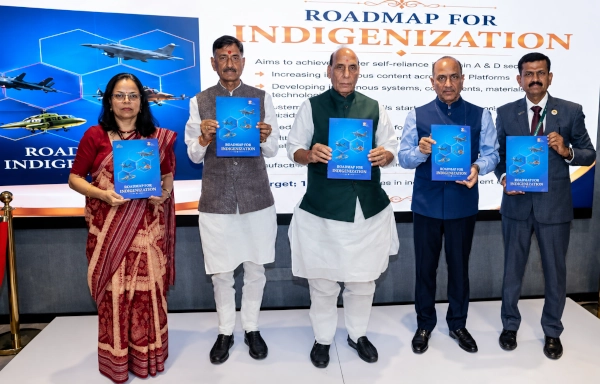
Four publications outlining future defence-industrial initiatives were also released during the meeting.
The first, Aatmanirbhar DPSU – A Journey of DPSUs Towards Self-Reliance, outlines indigenisation targets, new products and manufacturing processes that the defence enterprises plan to develop over the next five years.
Another initiative, DISHA, is aimed at strengthening interaction between industry and students by providing young engineers and researchers with greater exposure to defence technologies and modern manufacturing techniques.
Two additional roadmaps focus specifically on Hindustan Aeronautics Limited. One outlines HAL’s modernisation programme as it prepares for future aerospace manufacturing requirements, while another presents an indigenisation roadmap intended to reduce dependence on imported technologies, components and systems across the aerospace and defence sector.
These plans are particularly significant as HAL prepares for increasingly complex programmes involving advanced combat aircraft, helicopters, unmanned systems, aircraft upgrades and potentially new propulsion and avionics technologies.
Defence PSUs Enter a New Phase
India’s defence public-sector companies are now entering a period in which their performance will increasingly be measured not only by production value but also by technological capability, export competitiveness and their ability to deliver complex military systems on schedule.
The ₹1.29 lakh crore contribution of the DPSUs to national defence production during FY 2025-26 demonstrates their continuing scale within India’s defence industry. The next challenge will be to convert that manufacturing base into a more technologically independent and globally competitive ecosystem.
As India simultaneously expands indigenous procurement, defence exports and private-sector participation, the role of the DPSUs is likely to evolve from that of traditional state-owned manufacturers into anchor companies supporting much larger networks of domestic suppliers, technology companies, start-ups and MSMEs.
The government’s objective is ultimately more ambitious than replacing imported equipment. It is seeking to create defence enterprises capable of developing advanced technologies, sustaining military production during crises and competing for major contracts in international markets.
You may also like
-
Indian Navy Vice Chief Inspects Japan’s Mogami-Class Stealth Frigate as India-Japan Shipbuilding Cooperation Expands
-
Philippine Marine Wargames Reportedly Show BrahMos Can Penetrate Chinese Destroyer Air Defences
-
Safran Signs 18 Agreements with Indian Aerospace Suppliers, Expanding Make in India Manufacturing Partnerships
-
Indian Army’s Vajra Corps Certifies First Batch of Drone Operators, Strengthens Battlefield Surveillance
-
India to Seek 35% Increase in Defence Modernisation Budget for FY 2027–28
