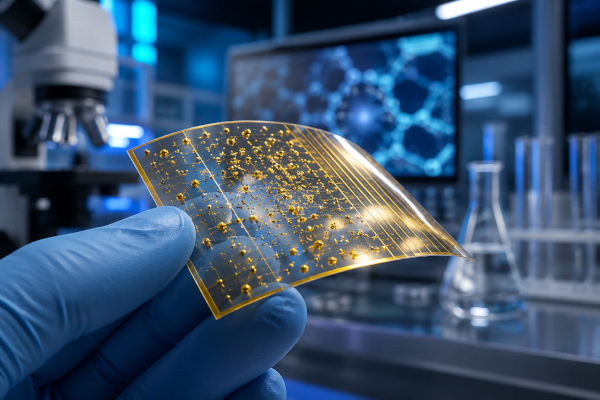
Indian researchers have developed an ultrathin flexible film embedded with tiny amounts of nano-gold that can convert small temperature changes into electrical signals, opening a new route for self-powered sensors, wearable electronics and low-energy smart devices. The work was carried out by scientists from the Institute of Nano Science and Technology, Mohali, an autonomous institute under the Department of Science and Technology.
The breakthrough is important because future electronics will increasingly depend on lightweight, flexible and low-power materials that can function without heavy batteries. From health-monitoring wearables to environmental sensors and smart photodetectors, next-generation devices need materials that can respond to tiny changes in heat, light and motion while consuming very little energy.
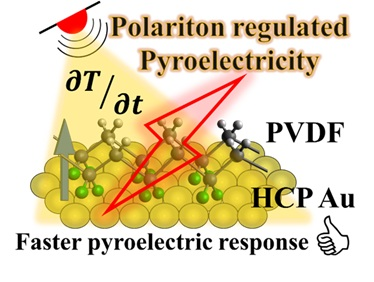
The research team, led by Prof. Dipankar Mandal with collaborators including Sudip Naskar, worked with polyvinylidene fluoride, commonly known as PVDF. PVDF is a flexible ferroelectric polymer already valued in electronic and sensing applications because of its ability to respond to physical changes. By embedding a minute quantity of nano-gold into this polymer, the scientists were able to sharply improve its pyroelectric behaviour, which means its ability to generate electricity when temperature changes.
The key innovation lies in how the gold nanoparticles interact with the polymer at the nanoscale. The researchers used hexagonal nano-gold particles inside films thinner than 100 nanometres. This helped the PVDF film achieve a highly ordered polar phase, where molecular dipoles become better aligned. Such ordering is essential for efficient pyroelectric performance because the material can respond more effectively when exposed to small thermal fluctuations.
Earlier systems combining plasmonic materials and pyroelectric polymers had shown promise, but many of them depended on thicker devices or less controlled interfaces. That made them less suitable for truly thin, wearable and low-power electronics. The new INST work addresses that limitation by showing that controlled gold-polymer interactions can enhance performance even in ultrathin films.
The study also highlights the role of plasmon-dipole-electron coupling. In simple terms, the nano-gold particles help regulate the behaviour of molecular dipoles in the PVDF film, improving both thermal energy conversion and broadband optical absorption. This means the material may be useful not only for heat-based sensing but also for devices that respond to light and thermal signals together.
One of the most promising aspects of the work is that the film was able to demonstrate efficient pyroelectric energy conversion within a small temperature range of 294 to 301 Kelvin. This is close to ambient conditions, making the development relevant for real-world devices that must operate around normal environmental temperatures rather than under extreme laboratory conditions.
The possible applications are wide. In healthcare, such films could support self-powered wearable sensors that monitor body heat variations or physiological signals. In environmental monitoring, they could help build small autonomous sensors that harvest energy from minor temperature changes. In energy-efficient electronics, they could reduce dependence on frequent charging or bulky power sources.
The research, published in Advanced Functional Materials, adds to India’s growing work in nanotechnology, smart materials and flexible electronics. It also shows how advanced materials research can support practical technology areas such as healthcare devices, low-grade heat harvesting, photodetectors and autonomous sensing systems.
At a broader level, the development reflects the direction in which electronics is moving. The future will not be defined only by faster processors or larger batteries, but also by smarter materials that can generate, sense and respond to energy from their surroundings. The nano-gold embedded PVDF film is a step toward that future, where wearable and flexible devices may become thinner, more efficient and more independent of conventional power sources.
Source: PIB
You may also like
-
Indian Researchers Study RAD51 DNA-Repair Gene Variant in Prostate Cancer
-
TDB Backs Multi Nano Sense With ₹37.51 Crore to Build Indigenous Multi-Gas Sensor Platform
-
IISER Berhampur and NIT Rourkela Researchers Explore Cotarnine Derivatives for Wound Healing and Biomedical Applications
-
IISER Tirupati Develops pH-Responsive DNA Nanostructures for Controlled Drug Delivery
-
India and France Expand Space Cooperation Into Human Spaceflight, TRISHNA and Start-up Ecosystem
