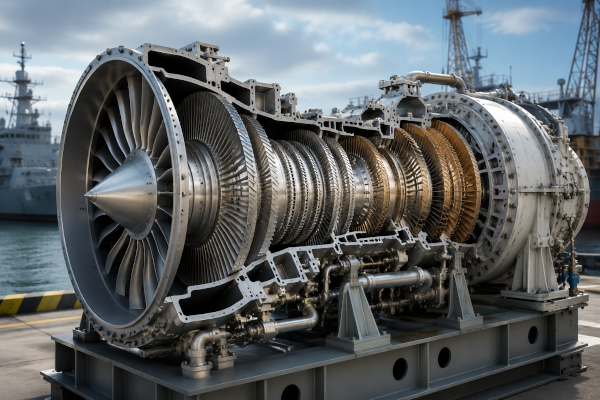
Bharat Forge is preparing to build India’s first private-sector marine gas turbine repair, overhaul and indigenous development complex in Visakhapatnam, marking a major step in the country’s effort to localise critical naval propulsion capability. The proposed facility, to be developed through the company’s aerospace division, will come up in Andhra Pradesh at a time when India is pushing private industry deeper into high-technology defence manufacturing.
The project is strategically important because marine gas turbines are among the most critical systems on modern warships. They provide the high-power propulsion required by frontline naval platforms, and their maintenance, repair and overhaul cycles directly affect fleet availability. For a blue-water navy, propulsion is not a background engineering issue; it is the heart of operational readiness. A destroyer, frigate or carrier-support vessel may carry advanced missiles, radars and combat systems, but without reliable propulsion, its combat value is sharply reduced.
The planned Visakhapatnam hub is expected to be located close to the Naval Dockyard, INS Eksila and the Eastern Naval Command headquarters. This location matters. Visakhapatnam is one of India’s most important naval centres, and placing a private-sector turbine support ecosystem near existing naval infrastructure could reduce turnaround time, improve maintenance responsiveness and support faster fault diagnosis, repair and testing. The project is expected to cover nearly 80 acres and generate around 750 direct and indirect jobs.
The facility is planned in two phases. In the first phase, Bharat Forge will create a marine gas turbine repair and overhaul complex with hot-section restoration capability for blades, vanes and combustion liners. It will also include component manufacturing and non-destructive testing laboratories. The company is also aiming for a 72-hour turnaround capability for the Naval Dockyard in Visakhapatnam, which would be a major operational advantage if achieved at scale.
The second phase is even more significant from a technology-sovereignty perspective. Bharat Forge plans to set up a private-sector marine gas turbine development and assembly facility with a full-spectrum hot test cell. This would support the development, assembly and qualification of indigenous marine gas turbines in India. If the programme matures successfully, it could reduce the country’s dependence on overseas propulsion supply chains and create a domestic base for future naval engine technologies.
The move also fits into Bharat Forge’s wider gas turbine ambitions. The company already says it has established a Gas Turbine & Technology Development Centre in Bengaluru for ab-initio design and development of gas turbine engines. It has also worked on small gas turbine engines, engine testing, compressor design, combustor development, turbine design, engine control systems and related high-temperature components.
There is also a clear continuity with Bharat Forge’s earlier strategic moves. In December 2023, the company informed stock exchanges that Kalyani Strategic Systems Limited, its wholly owned subsidiary, proposed to acquire a 51% stake in Zorya Mashproekt India Private Limited. That filing described ZMI as a company engaged in developing indigenous capabilities for build-ups, repair and overhaul of gas turbine engines, and said the objective was to create Indian capabilities for design, manufacturing, maintenance, repair, overhaul and spare support for gas turbines.
For the Indian Navy, the timing is important. The Russia-Ukraine war exposed the vulnerability of global defence supply chains, especially in specialised areas such as marine propulsion. Several Indian naval platforms have historically depended on foreign-origin gas turbines and imported support ecosystems. A domestic repair and overhaul hub can therefore reduce risk, shorten maintenance cycles and improve long-term fleet availability.
Andhra Pradesh is also positioning itself as a major defence and aerospace manufacturing state. A recent Ministry of Defence event in the state saw foundation stones and grounding ceremonies for several strategic aerospace and defence projects, including naval systems, defence energetics and drone manufacturing. Defence Minister Rajnath Singh described such projects as part of India’s wider push for self-reliance in defence manufacturing.
The Bharat Forge marine gas turbine hub should therefore be seen as more than a single industrial project. It represents the convergence of three national priorities: naval readiness, private-sector defence manufacturing and propulsion self-reliance. If executed properly, Visakhapatnam could become a specialised centre for marine gas turbine sustainment, testing and eventually indigenous development.
The larger message is clear. India’s defence industrial base is moving from assembling platforms to mastering the complex systems that keep them alive in service. Engines, turbines, hot-section components, test cells and repair ecosystems are not glamorous like missiles or fighter jets, but they decide whether a military can sustain operations during a long crisis. Bharat Forge’s planned Visakhapatnam facility could become one of those quiet but strategically decisive building blocks in India’s maritime power story.
You may also like
-
India Advances Project-75(I) and Submarine Modernisation Plans to Strengthen Underwater Warfare Capability
-
India Advances Trade Diplomacy at G20 Ministerial in Milwaukee
-
Kokasa Launches to Build Indigenous Mission-Critical Systems for Su-30MKI, MiG-29 and T-72
-
Tata Projects and MDS Aero Partner to Build Advanced Aero-Engine Test Infrastructure in India
-
Flying Wedge Defence Partners With Portugal’s Keydef to Manufacture Kaal Bhairava and YAMA Drones in Europe
