India’s historic Kodaikanal Solar Observatory has once again shown the scientific value of patient, long-term observation. More than a century of solar records from the observatory has helped researchers study how giant convection patterns on the Sun’s surface respond to the familiar 11-year solar activity cycle. The study gives fresh insight into solar behaviour, especially the changing relationship between surface magnetic activity, supergranular structures and solar irradiance.
The Sun’s outer layers behave like a vast ocean of moving plasma. Energy produced deep inside the Sun travels outward through convection, creating visible surface patterns. Smaller cells appear as granulation, while much larger structures form what scientists call supergranulation. These supergranular network cells are enormous by earthly standards, measuring around 30,000 km across, with cooler lane-like regions of nearly 6,000 km. Each network cell survives for roughly 24 hours, constantly reshaping the solar surface.
The origin, size and behaviour of these supergranular patterns have remained important questions in solar physics. Their link with the Sun’s 11-year activity cycle is especially significant because solar activity affects magnetic storms, ultraviolet radiation and space weather conditions around Earth. A clearer understanding of these surface patterns can improve future predictions of solar cycles and their wider influence on planetary environments.
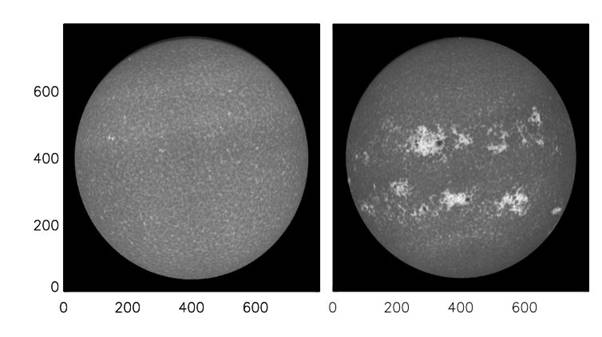
Researchers from the Indian Institute of Astrophysics, an autonomous institute under the Department of Science and Technology, studied the relationship between solar activity and two measurable features of the supergranular network: lane width and intensity. The study used archival Ca II K spectroheliograms from Kodaikanal Solar Observatory, a rare and valuable scientific record extending back to 1907.
The scale of the analysis was remarkable. Scientists examined around 34,000 Ca II K images from the Kodaikanal archive and compared the behaviour of lane widths and intensities at different solar latitudes with sunspot numbers. Sunspots are one of the most visible markers of solar activity, rising and falling in number through the 11-year cycle. The study found that both lane width and intensity show strong correlation with sunspot numbers, especially around 11° to 22° latitude in both hemispheres.
The findings also reveal that different solar features respond to the activity cycle at different latitudes. The strongest correlation for lane widths appears around 18° north and 20° south, while intensity correlations peak closer to 13° north and 14° south. This means the solar surface does not behave as one uniform system. Different layers, regions and magnetic structures respond to solar activity in their own rhythm.
A key result of the study is the discovery of time lag in these responses. Lane width changes peak close to solar maximum, while intensity changes peak around 1.25 to 1.5 years after solar maximum. The lag also varies with latitude. For lane widths, the delay ranges from about 0.5 to 0.8 years, while intensity can lag by 0.3 to 2.5 years. This pattern suggests that magnetic activity, surface convection and solar radiation are linked through a dynamic process that unfolds differently across the Sun’s surface.
The importance of the study lies in its contribution to solar-cycle forecasting. The Sun’s magnetic behaviour influences ultraviolet output, space weather and conditions that can affect satellites, communication systems, navigation networks and power grids on Earth. Understanding how supergranular properties respond to solar activity gives researchers another layer of information for studying solar irradiance variation, especially in the ultraviolet spectrum.
Kodaikanal’s archive has become a national scientific treasure because it captures more than nine solar cycles through consistent observation. In an age of space telescopes and advanced solar missions, this century-long record proves that older observatories still hold data capable of producing new discoveries. Long-term archives allow scientists to see patterns that short-duration missions may miss.
The study also points toward the future of Indian solar research. The proposed National Large Solar Telescope is expected to strengthen high-resolution studies of solar surface dynamics, including supergranular motion and magnetic flux transport. With archival depth from Kodaikanal and advanced observing capability from future instruments, India is building a strong position in solar physics and space-weather science.
This research is more than a study of sunlight and surface patterns. It shows how India’s oldest solar data can answer modern questions about the Sun’s behaviour. A century of patient observation from Kodaikanal is now helping scientists decode the pulse of the star that drives life, climate and space weather across the solar system.
Publication Link: https://ui.adsabs.harvard.edu/abs/2025ApJ…991L..26R/
You may also like
-
IISc Scientists Show How Strong Magnetic Fields Could Allow White Dwarfs to Exceed Chandrasekhar Limit
-
IIT Madras to Launch Global Mission to Map 100 Human Brains in 3D
-
3,898 Indian Scientists Feature in 2026 Global Top 2% Research Database; IISc Leads Indian Institutions
-
New Metal-free Porous Material can Help Produce Affordable Clean Energy
-
A Decade of Cosmic Flickering Reveals New Clues About A Rare Giant Binary Black Hole System
