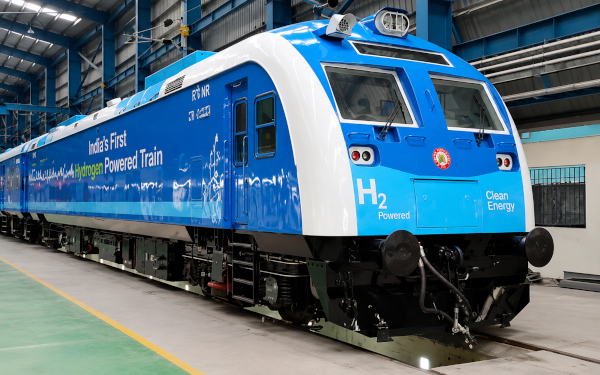
Indian Railways is preparing to raise the operational speed of India’s first indigenous hydrogen-powered train to 110 kmph, marking the next stage in the development of the country’s hydrogen-based rail ecosystem.
Railway Board Chairman and CEO Satish Kumar said in Indore on September 6 that the train, whose operational speed has so far been kept at around 75 kmph, has already completed trials at 120 kmph. Based on those trials, the Railways is now working towards permitting regular operations at a maximum speed of 110 kmph.
The Railways is also examining the possibility of deploying hydrogen trains on additional sections of the network. Discussions with stakeholders are focusing on route suitability, technical requirements and, crucially, the infrastructure required to ensure a reliable supply of hydrogen fuel.
India’s first hydrogen-powered train was flagged off by Prime Minister Narendra Modi on July 17, 2026, for operation on the Jind–Sonipat section of Northern Railway. Designed, engineered and integrated in India, the project was developed as a pilot for demonstrating hydrogen fuel-cell propulsion on the Indian railway network.
The ten-coach train uses two Hydrogen Driving Power Cars providing a combined 2,400 kW of power, supported by lithium iron phosphate batteries. Hydrogen stored onboard is used in fuel cells where it reacts with oxygen to generate electricity for propulsion. The process involves no combustion and produces water vapour rather than conventional tailpipe emissions.
Indian Railways has also established dedicated hydrogen storage and refuelling infrastructure at Jind, including storage capacity of about 3,000 kg. Hydrogen is stored at pressures of up to 500 bar and dispensed at 350 bar, while multiple systems are incorporated for detecting leaks, heat, flames and smoke.
The move towards 110-kmph operations therefore represents more than a speed upgrade. It is another step in determining whether the indigenous hydrogen train technology can be expanded beyond its initial demonstration corridor and eventually become a practical clean-traction option on suitable sections of the Indian railway network.
You may also like
-
SatLeo Labs’ TAPAS-1 Reaches Orbit, Advancing India’s Private Thermal-Imaging Capability
-
TakeMe2Space’s MOI-1A Reaches Space on Falcon 9 Transporter-18 Mission
-
Bank of Baroda Enters Pension Fund Management After PFRDA Appointment
-
SCI and India’s Push for a Larger Indigenous Maritime Fleet
-
Hindustan Shipyard to Serially Produce Indigenous JAYA Autonomous Underwater Vehicle After CSIR-NIO Technology Transfer
